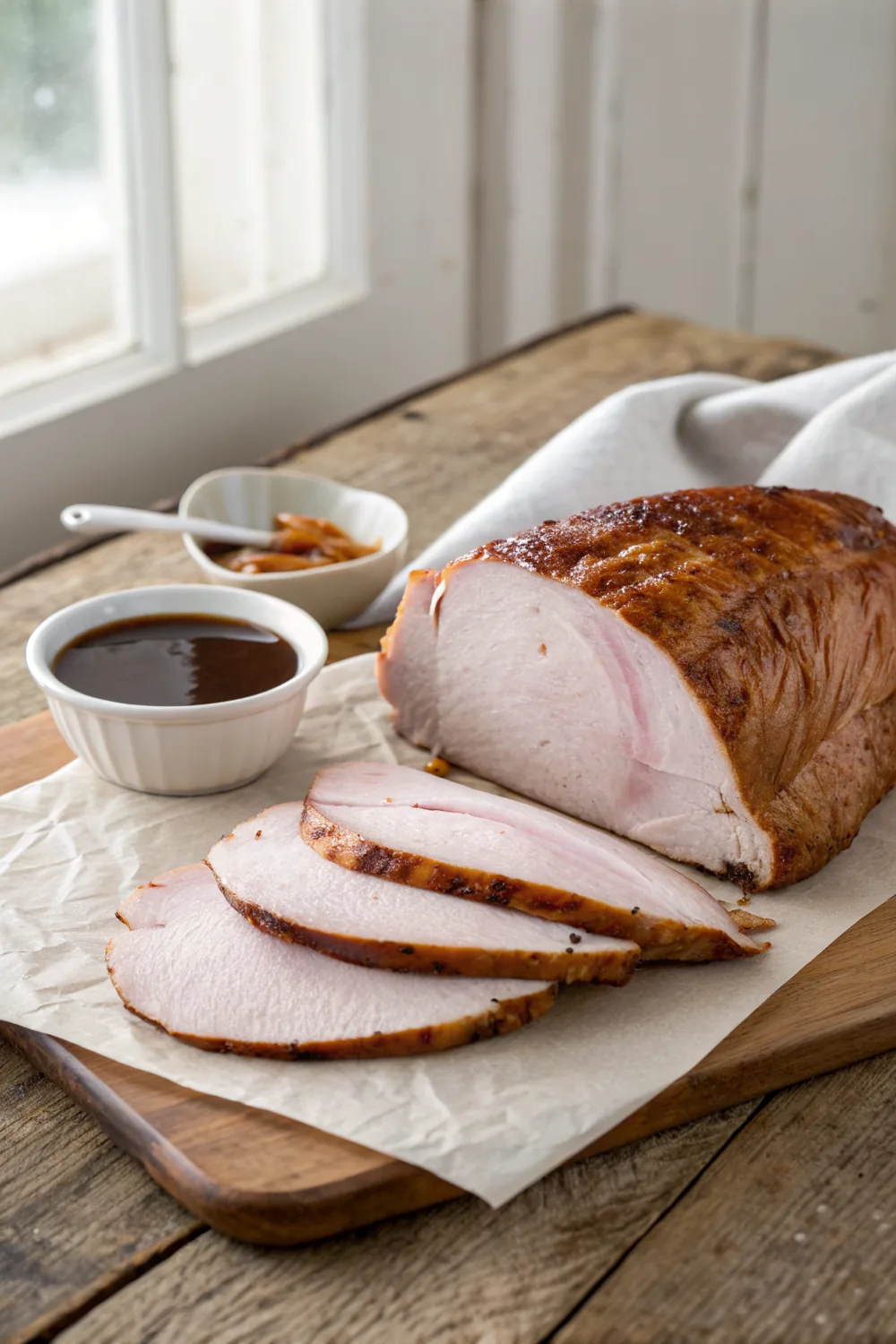
Texas BBQ
Smoked Turkey Breast
Chef Mia's smoked turkey breast: 6 to 8 lb bone-in, 24-hour dry brine, herb butter under the skin, post oak at 275F about 25 min per lb, pull at 160F.
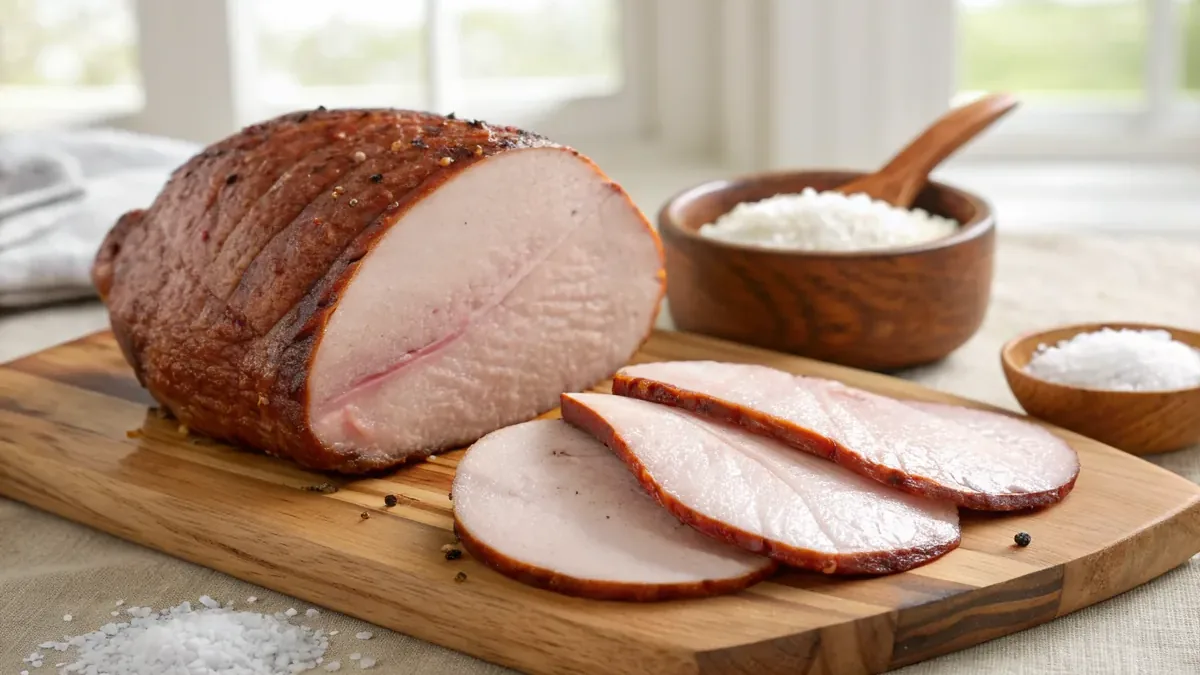
Quick answer: A smoked turkey breast is a whole bone-in breast, 6 to 8 lb (2.7 to 3.6 kg) with both lobes still on the bone, dry-brined for 24 hours with kosher salt at 1/2 teaspoon per pound plus black pepper and garlic powder, packed with herb butter under the skin, and smoked over post oak at 275F (135C) for roughly 25 minutes per pound, about 2 1/2 to 3 hours, until the thickest part reads 160F (71C). It rests 20 minutes and carries over to 165F (74C). A 3 lb boneless roast, tied, takes 1 1/2 to 2 hours. The dry brine and an uncovered night in the refrigerator give you crisp mahogany skin at a smoking temperature; the last 15 minutes at 325F finish the job. Feeds 4 to 6 with leftovers, on any cooker from an offset to a kettle.
A bone-in turkey breast is Thanksgiving with the arguments taken out: all the white meat, none of the thigh that is still pink at the joint when the breast is already done. That one fact is why I put a breast on the pit more often than a whole bird. The breast and the legs of a turkey want different finishing temperatures, 165F (74C) and 175F (79C), and on a whole bird you can only chase one of them. On a breast alone there is one number to hit, one probe to watch, and a cook that runs about 3 hours instead of the 4 my whole 12 lb pit-smoked turkey needs. If you are feeding a crowd, go read that page; it is the right bird for twelve people. This page is for the table of four to six, or for the second protein that goes on the pit next to a brisket.
The method is Central Texas through and through. A dry brine of kosher salt, black pepper, and garlic powder goes on 24 hours ahead, the same salt-pepper-garlic logic that seasons every brisket in Lockhart. Herb butter is pushed under the skin so the lean meat bastes itself from inside. Post oak, or pecan if that is what you have, burns at 275F (135C), hotter than a brisket fire because a turkey breast has no fat cap and no collagen to wait on; it just needs to reach temperature with smoke on it. Twenty-five minutes a pound is the planning number. Pull at 160F (71C), rest 20 minutes, and carryover takes it to 165F.
I smoke six or eight of these every November for the Texas Thanksgiving table, and the thing people remark on is never the smoke, it is the skin. Turkey skin at 275F wants to go leathery, not crisp, and most smoked turkey breast recipes either ignore that or tell you to live with it. The fix is a night uncovered in the refrigerator after the brine, so the skin dries and tightens, plus a short hot finish at the end. Everything below, from buying the right breast at HEB to carving the lobes off the bone, is built around those two problems: one temperature, and dry skin.
Why the Breast Alone Beats the Whole Bird for a Table of Six
A whole turkey is a compromise between two different pieces of meat. The breast is lean white muscle that is finished, and starting to dry, at 165F (74C). The thighs and legs are dark, worked muscle full of connective tissue that stays chewy until 175F (79C) and is better at 180F. On a whole bird the breast sits higher and further from the fire on most pits and the thighs are tucked lower, and even so the breast usually arrives at 165F while the thigh joint is still pink. Every roasting trick, from icing the breast to shielding it with foil, exists to buy the thighs time. A breast on its own has no thighs to wait for. You cook it to one number and take it off.
The second reason is size. A bone-in breast of 6 to 8 lb (2.7 to 3.6 kg) yields about 4 lb of carved meat, which feeds four to six people generously with sandwiches the next day. It fits on a 22 inch kettle with room for a drip pan beside the coals, which a 14 lb bird does not. It is done in about 3 hours instead of 4 or 5. And it does not force the cook to hover over a pit all Thanksgiving morning while the sides wait for the oven.
The third reason is the one that matters most in a Texas backyard. On a holiday the pit is usually already busy. A Central Texas brisket that went on at midnight is coming into its wrap around the time the breast needs to go on, and a turkey breast at 275F is content to share the cook chamber for the last three hours of that brisket, or to go on after a ham comes off. It is the second protein that makes a smoked holiday spread look generous without another twelve hours of fire management. All white meat also means nobody at the table is negotiating for the drumstick.
Buying It: Bone-In, Unenhanced, and What HEB Actually Sells
Ask the butcher for a whole bone-in, skin-on turkey breast, which is both lobes still attached to the breastbone and the ribs, with the back and the wings removed. It looks like a small turkey with no legs. In Texas the standard grocery sizes run 5 to 8 lb; HEB carries them fresh from about the first week of November and frozen year round, and Central Market usually has an air-chilled bird in the 6 to 7 lb range with better skin than anything shrink-wrapped. A 7 lb breast is my target for six people, and the numbers on this page are tuned to it.
Read the label before anything else. A great many supermarket turkey breasts are sold as 'enhanced', 'basted', or 'self-basting', which means they have been injected with a salt and phosphate solution, sometimes 8 to 15 percent of the weight. That injected bird will taste salty and spongy after a dry brine, and the skin never crisps because it is waterlogged. Look for a label that reads only 'turkey' or 'turkey breast'; if the ingredient line says 'contains up to X percent solution', put it back. Kosher birds are already salted and should not be brined again; treat them as brined and go straight to the pepper and garlic.
Boneless breast roasts are the other option, sold at 2 1/2 to 3 lb, often in a netting, sometimes as two lobes rolled together with the skin wrapped around. They cook faster, 1 1/2 to 2 hours at 275F, carve into neat rounds, and are the right choice for a table of three or four or for a cooker with no room. They also dry out faster, because there is no bone to slow the heat and no ribcage to sit on. Keep the netting on, or tie the roast with butcher's twine at 1 1/2 inch intervals so it cooks evenly, and do not skip the herb butter. For a room of guests the planning rule on my turkey per person page holds: about 3/4 lb of bone-in breast per person, about 1/2 lb of boneless, and add a quarter if you want sandwiches.
If your breast is frozen, it needs 2 to 3 days in the refrigerator to thaw, then a full day for the brine. That is four days of lead time from freezer to table, and it is the single most common reason a smoked turkey breast gets rushed. Buy it the Saturday before Thanksgiving. A cold water thaw, breast submerged in its wrapping with the water changed every 30 minutes, runs about 30 minutes per pound if you are caught short.
The 24-Hour Dry Brine and the Herb Butter Under the Skin
The seasoning is a dry brine, which is a rub that happens to be mostly salt and is given time to work. Kosher salt at 1/2 teaspoon per pound of breast, so a heaping tablespoon for a 7 lb bird, with 2 teaspoons of coarse black pepper and 1 1/2 teaspoons of garlic powder. That is the Lockhart trinity, and it is the same idea as my Texas rubs without the paprika and cumin that would scorch over three hours of smoke. A teaspoon of brown sugar is optional; it deepens the mahogany a shade and does not read as sweet at that quantity.
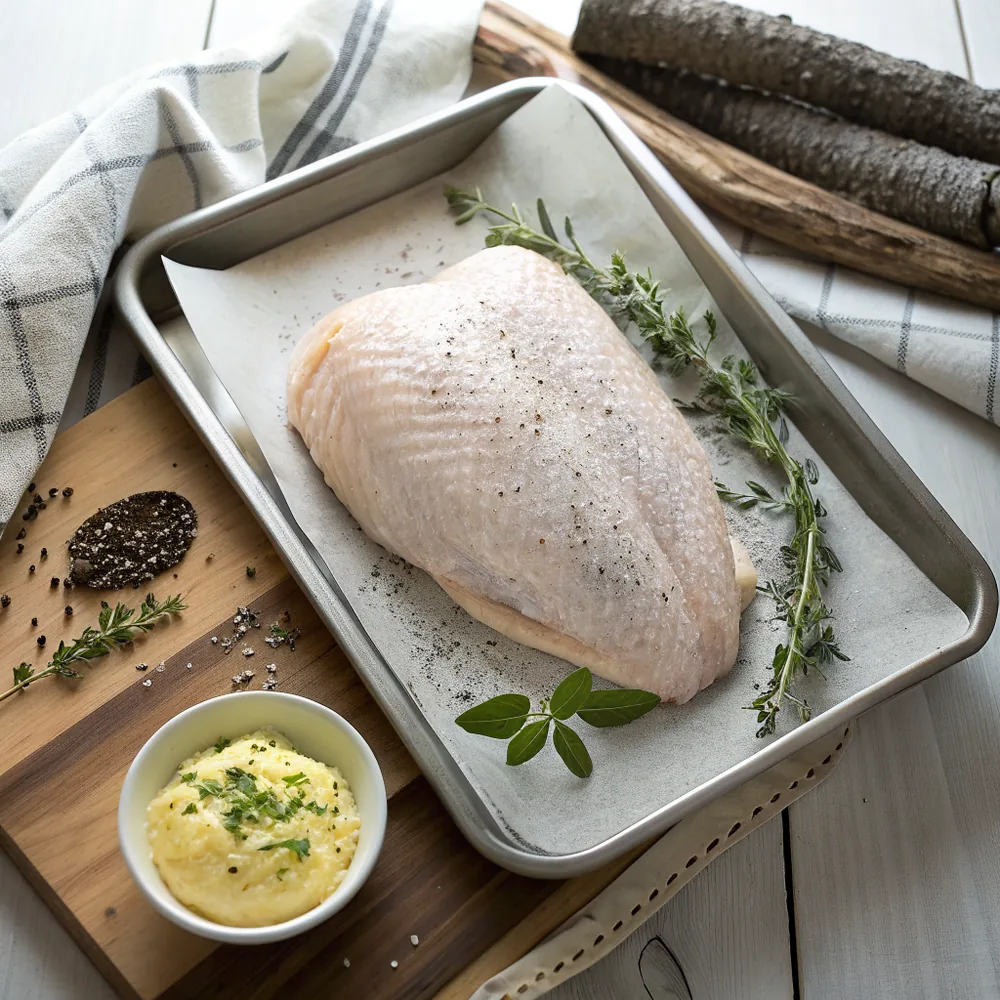
The salt goes on the skin, on the meat side of the ribs, and, most importantly, under the skin directly on the lobes, which you reach by working a finger in from the neck end and loosening the skin without tearing it. In the first hour salt pulls moisture out of the surface; over the next twelve hours that moisture dissolves the salt and the brine soaks back into the muscle, seasoning it to a depth a rub applied on the day never reaches. Salt also unwinds some of the muscle proteins so they hold more water during the cook, which is why a dry-brined breast is noticeably juicier at 165F than an unbrined one. Twenty-four hours is right; 12 is the minimum, and 36 is fine.
A wet brine does the same seasoning job, and my Thanksgiving turkey brine is the one I use when the bird is going in an oven. On a smoker the dry brine wins for one reason: skin. A wet-brined bird comes out of the bucket waterlogged, and at 275F that water has to steam out of the skin before any browning can start, which is where rubbery smoked turkey skin comes from. A dry-brined breast that spent the night uncovered on a rack in the refrigerator goes on the pit with skin that is already tight, dry, and tacky, and it browns from the first hour. If you only have a wet-brine habit, brine for 12 hours, then dry the breast uncovered on a rack for a full day before smoking.
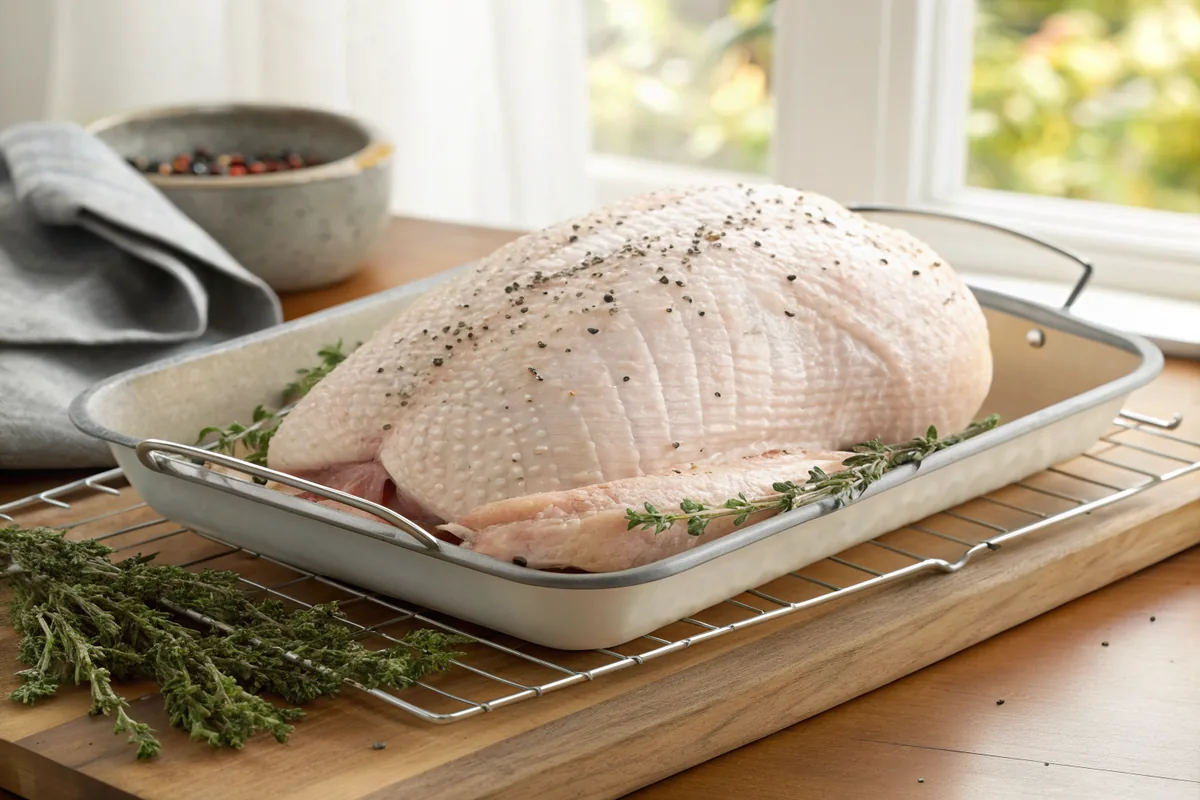
The herb butter is the insurance policy for lean meat. Six tablespoons of softened butter mashed with chopped sage, thyme, grated garlic, lemon zest, and pepper, pushed under the loosened skin and smoothed over each lobe by pressing on the outside of the skin. As the breast cooks the butter melts down into the meat and through it, basting from inside where a brush cannot reach. The sage and thyme are Thanksgiving in a breath; leave the lemon zest out if you want the smoke to be the only bright note. Do not salt the butter. The brine has done that.
One Fire, Four Cookers, and Post Oak Over Everything
The target is 275F (135C) at grate level, measured with a probe clipped to the grate next to the breast and not with the dial in the lid, which on most cookers reads 20 to 30 degrees off. Indirect heat, a drip pan with a cup of stock under the breast, and a clean, thin, blue smoke. The breast goes on skin up with the thicker, rounder end toward the fire on any cooker that has a hot side. That is the whole set-up; each cooker just gets there differently.
Offset. Build a small fire with a chimney of lit charcoal and one post oak split, and hold it with a split every 40 to 50 minutes. A turkey breast needs less fire than a brisket because the cook is short and the chamber does not need to be soaked with heat for twelve hours; think of it as a small, hot, clean fire rather than a big one choked down. Set the breast toward the middle of the chamber, not against the firebox, and rotate it once at the 90 minute mark. The offset makes the best skin of the four because its air moves.
Kettle. A 22 inch kettle is the cooker most people own and it does this job very well with a two-zone fire. Bank about 40 lit briquettes against one side, or use a charcoal basket, put a foil pan with the stock on the empty side, and set the breast over the pan with the lid vent over the meat so smoke is drawn across it. Two fist-sized post oak chunks on the coals at the start, one more at the hour. Top vent fully open, bottom vent about a third; that usually settles a kettle at 275F. Add 8 to 10 unlit briquettes at the 90 minute mark to carry it through.
Pellet grill. Set it to 275F, let it come up for 15 minutes, and use a drip pan on the grate below the breast. Pellet smoke is mild, so run the first 45 minutes at 225F if your grill has a smoke setting and you want more of it, then bump to 275F. Oak or pecan pellets, or a competition blend. The skin on a pellet grill tends to be the softest of the four because the air is humid and the fire is small, so plan on the hot finish described below and do not skip it.
Gas grill. Light the burners on one side to hold 275F and put the breast over the unlit burners on a rack over a drip pan. A pellet smoke tube, lit with a torch until it flames, then blown out to smolder, goes on the hot side and gives you two to three hours of real smoke; a foil packet of chips over the burner works in a pinch but needs refreshing every 30 minutes. This is the cooker most likely to run hot, so check the grate probe early. If you are choosing a cooker for next year, my smoker guide ranks the ones I trust for exactly this kind of cook.
Wood. Post oak is the Central Texas default and it is right for turkey: clean, mild, a little sweet, and it lets the meat taste like turkey. Pecan is the second choice and my favorite for poultry, softer than oak with a nutty edge that suits the sage butter. Apple and cherry are gentle and color the skin a deeper red. Mesquite is the one to be careful with; it is sharp and resinous and turns a turkey breast bitter in three hours if it is the only wood. One mesquite chunk with two of oak is the most I would use. Hickory is fine but forward; go light. Two or three chunks over the first two hours is plenty on a kettle or gas grill, since poultry skin takes smoke fast and a breast smoked hard for the whole cook can go acrid. The wood pairing tool lays out the whole grid if you are working with what is in the woodpile.
Twenty-Five Minutes a Pound at 275F, and the 160F Pull
At 275F a bone-in breast runs about 25 minutes per pound. A 6 lb breast is roughly 2 1/2 hours; a 7 lb breast about 2 3/4 hours; an 8 lb breast pushes 3 hours and a bit. Those numbers assume the breast went on cool from the counter after its 30 to 45 minutes out of the refrigerator, on a cooker that was already at temperature. Boneless roasts run faster, about 30 to 35 minutes per pound because they are smaller and denser, so a 3 lb tied roast is 1 1/2 to 2 hours. Every one of those figures is a planning number and nothing more. The thermometer decides.
Put a leave-in probe into the thickest part of one lobe, going in from the side at an angle so the tip sits in the center of the meat and is not touching the bone or the cavity, both of which read hot and lie. The second lobe gets checked with an instant-read thermometer at the end. The temperature climbs quickly to about 120F, slows through the 130s and 140s as the surface moisture evaporates, and then moves again. That stall is short on a breast, rarely more than 20 minutes, and it does not need a wrap.
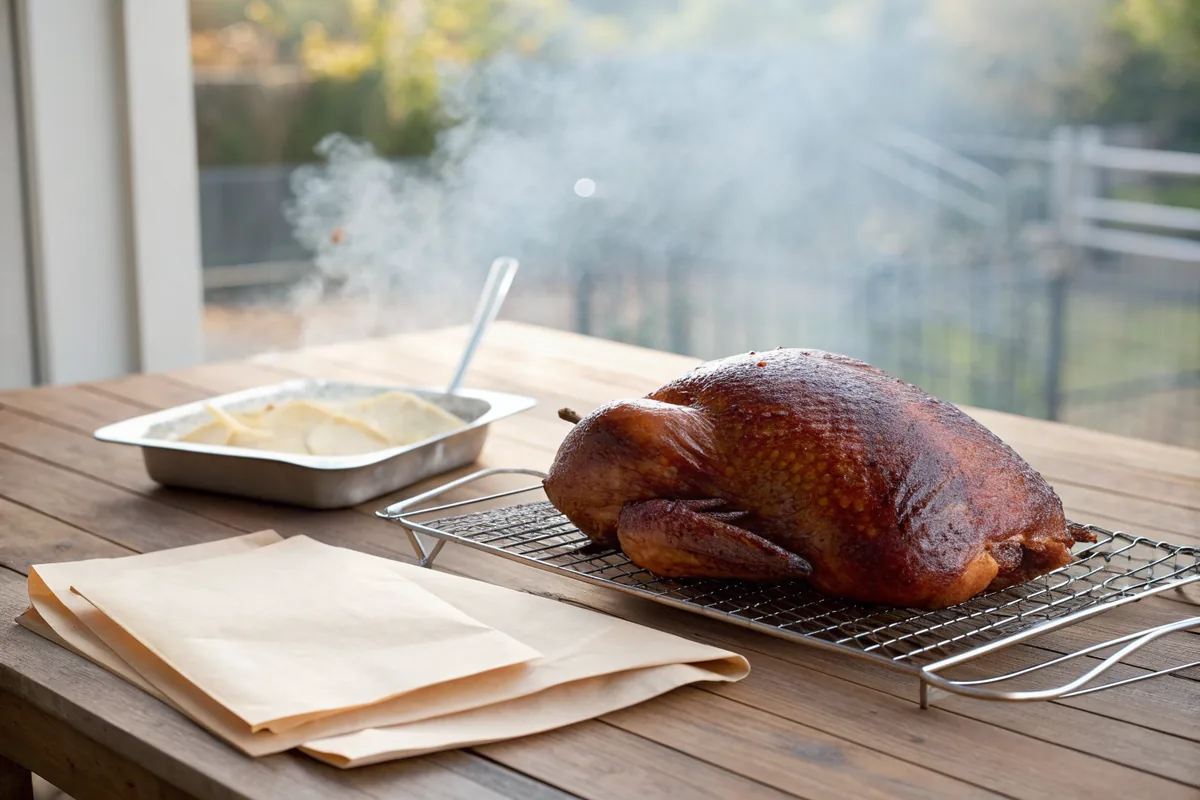
Pull at 160F (71C) in the thickest part, not 165F. A piece of meat this size carries over 5 to 7 degrees during a 20 minute rest, and a breast pulled at 165F is served at 170F, which is the difference between juicy and stringy on lean white meat. The USDA figure of 165F is the temperature the meat must reach at some point; it reaches it on the counter. If you have any doubt, the instant-read after the rest will show 165F or a shade above, and it will show it in both lobes.
Do not open the lid for the first hour. Every peek on a kettle costs 10 minutes of recovery and a gulp of oxygen to the coals. From the 90 minute mark, check the skin color and the probe, rotate if one side is darker, and refresh the drip pan if it has boiled dry. A dry pan under a turkey breast lets rendered butter burn on the foil and puts a sharp note in the smoke, which is the one thing a mild cut like this cannot hide.
The Skin Problem at 275F, and the Foil Boat Question
Smoked poultry skin is a known disappointment. Crisp skin needs the fat under it to render and the surface to dehydrate, and both of those happen readily at 400F and grudgingly at 275F. What you get at smoking temperature by default is skin that is beautifully colored, deeply flavored, and slightly rubbery. Most of the fix happens before the cook: the salt in the dry brine pulls water out of the skin, and 24 hours uncovered on a rack in the refrigerator, with the cold air moving over it, dries it further until it is tight and nearly translucent. That skin renders in three hours at 275F where a wet-brined skin never would.
The rest of the fix is a hot finish. When the breast reads 150F, open the vents and add a few lit coals on a kettle, feed a bigger split on the offset, or turn the pellet grill or gas grill up to 325F (163C), and run the last 15 minutes hot. The skin blisters and crisps without pushing the meat past 160F, because the inside is already most of the way there and the extra heat has only 15 minutes to matter. In an emergency, with a breast that came off the cooker pale, 5 minutes under a broiler set 8 inches away will do it, watched every minute.
The foil question comes up on every smoked turkey thread and the answer for a breast is: no wrap. Wrapping at 275F traps steam against the skin and undoes every hour of drying you did. There is no collagen in a turkey breast that needs a braise, and the stall is too short to matter. The one exception is color. If the skin is already a deep mahogany at the 90 minute mark and the meat is only at 120F, it will be black by the end. Make a loose foil boat, a sheet of foil folded up around the sides of the breast with the top open, so the bottom and sides are shielded and the skin on top keeps drying. Butter, not sugar, is what usually causes early darkening; if you rubbed the extra herb butter on the outside with a heavy hand, expect to need the boat more often.
Resting Twenty Minutes, Then Carving the Lobes Off the Bone
Twenty minutes on a wire rack, tented loosely with foil, is the rest. A tight tent softens the skin; no tent at all lets the surface cool too far. During those 20 minutes the internal temperature climbs to 165F, the juices that the heat pushed toward the center relax back out through the muscle, and the meat firms enough to slice cleanly. Carving at 5 minutes loses a shocking amount of juice to the board. Thirty minutes is fine. Forty-five is still warm enough under foil, which is the buffer you need when the sides are running behind.
Carving a bone-in breast into slices on the bone, the way a whole roast turkey is carved at the table, is the wrong move for smoked meat, because the ribs get in the way and you end up with shards. Take the lobes off first. Stand the breast on its wide end, find the ridge of the breastbone with your fingers, and cut straight down along one side of it, keeping the knife flat against the bone. Follow the curve of the ribcage down and out and the lobe comes away in one piece with its skin on. Repeat on the other side. You now have two skin-on pieces the size of a small loaf, and a carcass for stock.
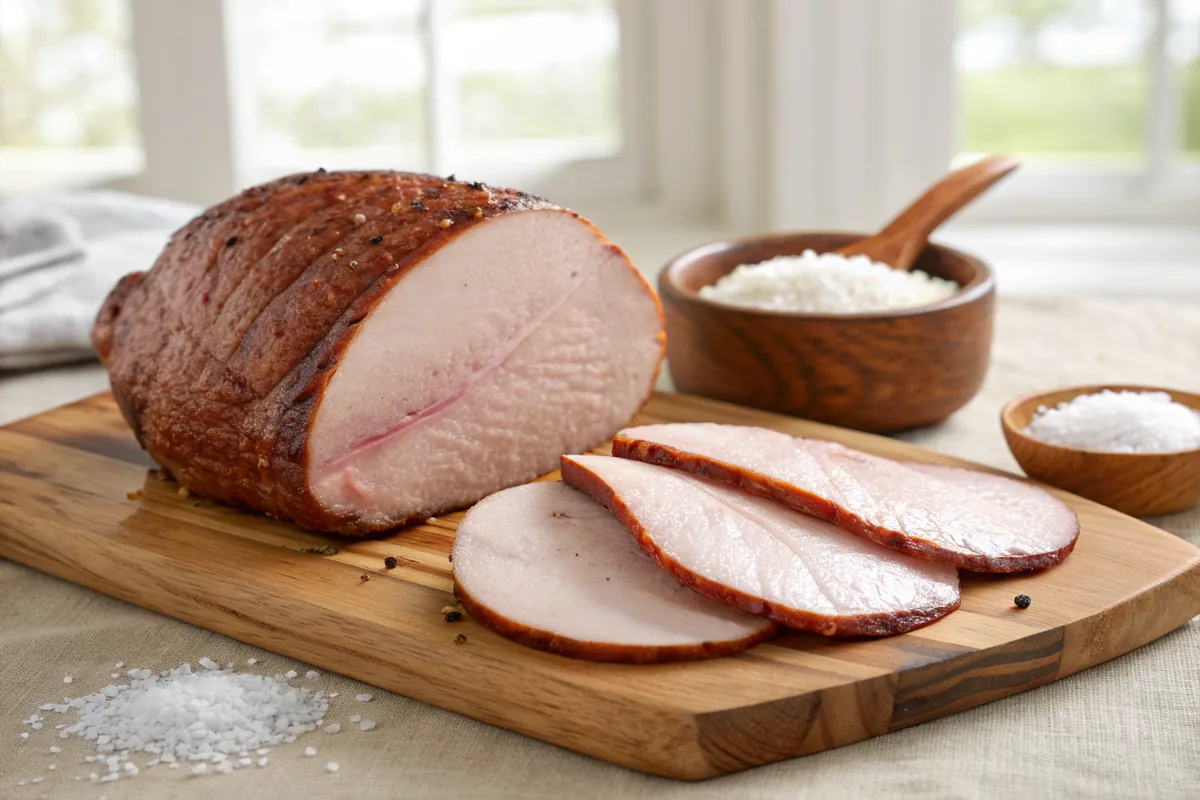
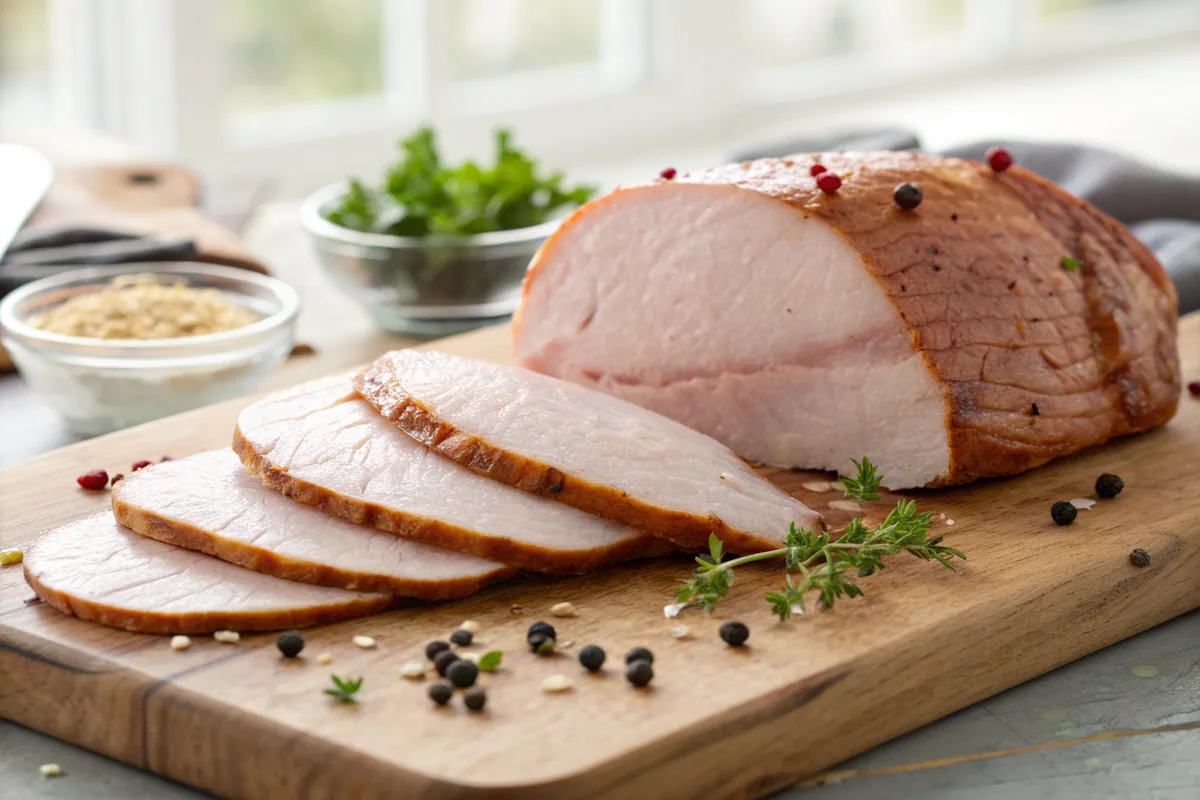
Slice each lobe across the grain, which runs the length of the lobe, in slices about 1/2 inch (12 mm) thick, or 1/4 inch for sandwiches. Cutting across the grain shortens the muscle fibers so the meat reads tender; slicing with the grain is why some turkey chews like rope. Keep the skin on every slice by holding it down with the flat of your hand as you go, and fan the slices on a warm platter with the pink smoke ring outward. Spoon a little of the rested juice from the board over the top. The lobe you are not slicing stays whole under foil, because a whole lobe holds heat and moisture far better than a pile of slices.
Gravy From a Small Drip Pan, and the Rest of the Texas Table
A turkey breast does not give you a roasting pan full of drippings, and this is where a lot of smoked-breast dinners come up short. What you get is the drip pan: a cup of stock that has spent three hours under the breast catching rendered butter, smoke, and a little juice. Skim most of the fat, then make a roux of 3 tablespoons butter and 3 tablespoons flour, whisk in the pan liquid plus enough stock to make 2 cups (480 ml), and simmer 5 minutes. It will be smoky, a little darker than oven gravy, and exactly right with this meat. Too much smoke for the table? Cut the pan liquid half and half with fresh stock. The full method, including the make-ahead version built on stock alone, is on my turkey gravy page.
The sides are the same ones the whole bird gets, and the breast leaves the oven free to make them. Cornbread dressing is not optional in this house; smoky gravy over it is half the reason to smoke the turkey at all. Green bean casserole and a bowl of mashed potatoes do the creamy work, and a spoon of jalapeno cranberry sauce cuts across the smoke better than any plain sauce does. Pickles, sliced white onion, and white bread on the platter make it a Central Texas plate, which is what a smoked turkey breast is.
If the breast is the second protein, put it on the platter next to the brisket slices rather than on its own and let people build the plate. The rest of the holiday, from the pies to the timeline that gets everything to the table hot, is laid out on the Texas Thanksgiving hub. The breast slots into that timeline in the 3 hour window before dinner and needs the pit, not the oven, which is the point.
This Page Versus the Whole 12 lb Bird Versus the Fryer
This is the smoked turkey breast page. The Texas BBQ-style whole turkey on this site is a different cook: a 12 lb bird, post oak at the same 275F, about 4 hours, pulled when the breast reads 165F and the thigh 175F, with the breast shielded and the legs toward the fire to manage the gap between those two numbers. It feeds ten to twelve, gives you drumsticks and wings and a real pan of drippings, and it is the centerpiece for a full house. Choose it for a crowd. Choose the breast for four to six, for a second protein, for a kettle, or for a dinner that has to be on the table 3 hours after the fire is lit.
The other fast option is the fryer, and my deep-fried turkey is the quickest whole bird in Texas: about 3 1/2 minutes per pound in 350F peanut oil, done in 45 minutes, with the crispest skin of any method and no smoke at all. It wants a whole bird, a propane burner, and a driveway. A turkey breast can be fried too, about 7 minutes per pound for bone-in, but the time saved over the smoker is smaller than it is for a whole bird, and you lose the smoke that is the reason to read this page.
A shorter way to put it: the whole bird is for the crowd and the drumstick people, the fryer is for the skin people and the clock, and the breast on the smoker is for the white meat people and the cook who wants one number to hit. In my house that last one wins two Novembers out of three, and a whole bird goes on when the cousins come.
Leftover Turkey Breast: Wrapping, Reheating, and the Next Three Days
Cool the leftover lobe within two hours and keep it whole, skin on, wrapped tightly in foil or in a covered container, for up to 4 days in the refrigerator. Sliced meat dries out at twice the rate of a whole lobe. If you must store slices, lay them flat in a container with a spoonful of the gravy or the pan juices over them. Smoked turkey breast freezes well for up to 3 months; slice it, freeze it flat in a zip bag with the air pressed out, and it thaws overnight in the refrigerator.
Reheating is where smoked turkey either survives or turns to cardboard. For slices, lay them in a skillet with a splash of stock, cover, and warm over low heat for 3 to 4 minutes; the steam does the work and the meat comes back moist. For a whole lobe, wrap it in foil with 2 tablespoons of stock and warm in a 300F (150C) oven for 20 to 25 minutes until it reads 140F. A microwave works only at half power, covered, with a damp paper towel over the meat. The skin never comes back crisp after a night in the refrigerator; slice it off and crisp it in a dry skillet on its own, then crumble it over the slices.
Cold, it is the best sandwich turkey there is, smoky and firm enough to slice thin, and it does everything a roast breast does in soups, pot pies, enchiladas, and salads, with the bonus that the smoke reads through a sauce. The full set of dishes I make from the second lobe and the carcass, from turkey tortilla soup to a smoked turkey King Ranch casserole, is on the leftover turkey recipes page. Save the carcass in the freezer; two smoked turkey breast frames make a stock that is the base for the best gumbo of the year.
Where a Smoked Turkey Breast Goes Wrong
Buying an enhanced bird. It is already injected with salt water, and a dry brine on top of that makes it salty and spongy, with skin that will not crisp. Read the label and buy a plain breast.
Skipping the uncovered night in the refrigerator. Wet skin cannot crisp at 275F. Salt it, rack it, and leave it bare for 24 hours.
Trusting the lid thermometer. The dial reads the dome, not the grate, and it is routinely 25 degrees off. Clip a probe to the grate at the level of the meat.
Cooking to 165F on the pit. Carryover adds 5 to 7 degrees during the rest, and 170F white meat is stringy. Pull at 160F in the thickest part.
Probe against the bone. It reads high and you pull the breast underdone. Angle the probe into the center of the lobe from the side, and confirm the second lobe with an instant-read.
Wrapping in foil. It steams the skin and there is no collagen to soften. No wrap, and a foil boat only if the color is running ahead of the temperature.
Too much smoke, or the wrong wood. Turkey takes smoke fast; three chunks over the first two hours is enough, and mesquite alone turns it bitter.
Carving on the bone. Take the lobes off whole, then slice across the grain, or you get shards and dry edges.
Resting too short. Five minutes and the board is a puddle. Twenty minutes under a loose tent, and carve the second lobe only when the first is gone.
Smoked Turkey Breast Recipe
Ingredients
- 1 whole bone-in, skin-on turkey breast, 6 to 8 lb (2.7 to 3.6 kg), not injected or labeled 'enhanced'
- For the dry brine:
- Kosher salt, 1/2 teaspoon per pound (about 1 tablespoon plus 1/2 teaspoon Diamond Crystal for a 7 lb breast; use a third less if Morton)
- 2 teaspoons coarsely ground black pepper
- 1 1/2 teaspoons garlic powder
- 1 teaspoon light brown sugar (optional, for color)
- For the herb butter:
- 6 tablespoons (3 oz / 85 g) unsalted butter, softened
- 1 tablespoon finely chopped fresh sage
- 1 tablespoon fresh thyme leaves, chopped
- 2 cloves garlic, grated
- 1 teaspoon finely grated lemon zest (optional)
- 1/2 teaspoon coarsely ground black pepper
- For the smoker:
- 3 or 4 fist-sized chunks of post oak or pecan, or 3 small splits for an offset
- 1 cup (8 oz / 240 ml) low-sodium chicken or turkey stock for the drip pan
- For the pan gravy (optional):
- 3 tablespoons (1 1/2 oz / 42 g) unsalted butter
- 3 tablespoons all-purpose flour
- Drip pan liquid plus stock to make 2 cups (16 oz / 480 ml)
Instructions
- Dry-brine 24 hours ahead. Pat the breast completely dry. Mix the salt, pepper, garlic powder, and sugar. Work a finger under the skin from the neck end to loosen it over each lobe without tearing it, and rub about a third of the mix directly on the meat under the skin. Rub the rest over the skin and the rib side. Set the breast skin up on a wire rack over a rimmed sheet pan and refrigerate uncovered for 24 hours (12 minimum, 36 maximum) so the skin dries.
- Make the herb butter. Mash the softened butter with the sage, thyme, garlic, lemon zest, and pepper until evenly green. No salt; the brine has handled it.
- Butter under the skin. Push about two thirds of the herb butter under the loosened skin and smooth it over each lobe by pressing on the outside of the skin. Rub the remaining butter thinly over the outside. Let the breast sit at room temperature for 30 to 45 minutes while the cooker comes up.
- Set the cooker to 275F. Build an indirect fire that holds 275F (135C) at grate level, measured with a probe clipped to the grate, not the lid dial. Offset: a small clean fire fed with one split every 40 to 50 minutes. Kettle: coals banked on one side, a foil drip pan with the stock on the other. Pellet grill: 275F with a drip pan on the grate below. Gas grill: burners lit on one side, a lit smoke tube on the hot side. Add 2 wood chunks at the start.
- Smoke skin up, probe in the lobe. Set the breast skin up over the drip pan, thicker end toward the fire on cookers with a hot side. Insert a leave-in probe from the side into the thickest part of one lobe, angled so the tip is in the center of the meat and not touching bone. Close the lid and leave it alone for the first hour. Add a third wood chunk at the one hour mark.
- Check at 90 minutes. Rotate the breast if one side is browning faster. Refill the drip pan if it has boiled dry. If the skin is already deep mahogany while the meat is under 120F, fold a loose foil boat around the sides with the top open. Do not wrap the breast.
- Hot finish from 150F. When the probe reads 150F (66C), raise the cooker to about 325F (163C): open the vents and add a few lit coals on a kettle, feed a bigger split on the offset, or turn a pellet or gas grill up. Run the last 15 minutes hot so the skin blisters and crisps.
- Pull at 160F. Take the breast off when the thickest part reads 160F (71C) and an instant-read in the second lobe agrees within a few degrees. Total time is about 25 minutes per pound, 2 1/2 to 3 hours for a 6 to 8 lb breast.
- Rest 20 minutes. Set the breast on a wire rack, tent loosely with foil, and rest 20 minutes. The center climbs to 165F (74C) and the juices settle. Meanwhile skim the drip pan, make a roux with the butter and flour, whisk in the pan liquid and stock to 2 cups, and simmer 5 minutes for gravy.
- Carve the lobes off, slice across the grain. Cut straight down along one side of the breastbone with the knife flat against the bone, follow the curve of the ribs, and lift the lobe off in one piece with its skin. Repeat on the other side. Slice each lobe across the grain about 1/2 inch thick, keeping the skin on each slice, and spoon the board juices over the platter. Keep the second lobe whole under foil until needed.
Frequently Asked Questions
How long does it take to smoke a turkey breast at 275F?
About 25 minutes per pound for a bone-in breast at 275F (135C), so a 6 lb breast takes roughly 2 1/2 hours, a 7 lb breast about 2 3/4 hours, and an 8 lb breast a little over 3 hours. A boneless 3 lb roast runs 1 1/2 to 2 hours because it is denser and cooks from all sides. Those are planning numbers; the breast is done when the thickest part of a lobe reads 160F (71C) on a probe that is not touching bone, and it climbs to 165F during a 20 minute rest. Cold weather, a wet cooker, or frequent lid-opening can add 20 to 30 minutes.
Should I smoke a turkey breast at 225F or 275F?
275F is better for turkey breast. At 225F the cook stretches to 40 minutes per pound or more, the skin sits in a humid chamber for four hours and comes out rubbery, and the lean meat gains nothing from the slower pace because there is no collagen to break down. At 275F the breast picks up plenty of smoke in the first two hours, the skin renders and browns, and the meat reaches 160F before it has time to dry out. If your cooker only holds 225F comfortably, smoke there for the first hour for flavor, then push it to 275F for the rest, and always finish hot for the last 15 minutes.
What temperature do you pull a smoked turkey breast?
Pull it at 160F (71C) in the thickest part of a lobe, then rest it 20 minutes tented loosely with foil. Carryover heat adds 5 to 7 degrees, so the breast is served at 165F (74C), the temperature white meat must reach for safety. Pulling at 165F on the pit means serving at 170F or higher, and that is the difference between juicy and stringy on a cut with almost no fat. Check the second lobe with an instant-read thermometer before resting; both lobes should be within a few degrees. Probe from the side into the center of the meat, never against the bone.
Do you wrap a turkey breast when smoking it?
No. Wrapping in foil or butcher paper at 275F traps steam against the skin and turns it rubbery, and a turkey breast has no collagen that needs the braising a wrap gives a brisket. The stall on a breast lasts 20 minutes at most and passes on its own. The only time foil belongs near the breast is a loose foil boat, folded up around the sides with the top open, if the skin is already deep mahogany at the 90 minute mark while the meat is still under 120F. That shields the sides from further color while the top keeps drying and crisping.
Is a bone-in or boneless turkey breast better for the smoker?
Bone-in is better if it fits your cooker and your table. The bone slows the heat, keeps the lobes from drying at the edges, gives you a carcass for stock, and a 6 to 8 lb bone-in breast feeds four to six with leftovers. A boneless roast of 2 1/2 to 3 lb is right for three or four people or a cooker with little space; it smokes in 1 1/2 to 2 hours at 275F and slices into neat rounds, but it dries faster and needs the netting or twine kept on so it cooks evenly. Both take the same dry brine and herb butter, and both are pulled at 160F.
How do you get crispy skin on a smoked turkey breast?
Dry it before it goes on, then finish hot. Salt the breast 24 hours ahead and leave it uncovered on a rack in the refrigerator so the skin tightens and dries; wet skin cannot crisp at 275F. Use a dry brine rather than a wet one for the same reason. Smoke skin up over indirect heat at 275F, never wrapped, and when the meat reaches 150F raise the cooker to 325F for the last 15 minutes so the skin blisters. If it still comes off pale, 5 minutes under a broiler 8 inches away finishes it. Pellet grills produce the softest skin and always need the hot finish.
What wood is best for smoking turkey breast?
Post oak is the Central Texas choice and the safest one: mild, clean, slightly sweet, and it lets the turkey taste like turkey. Pecan is my favorite for poultry, softer than oak with a nutty note that suits sage and butter. Apple and cherry are gentle and give the skin a deeper red color. Hickory works but is forward; use it lightly. Mesquite is sharp and can make a turkey breast bitter over three hours, so use at most one chunk alongside oak. Two or three fist-sized chunks over the first two hours are plenty on a kettle or gas grill, since poultry takes on smoke quickly.
Can I smoke a turkey breast on a gas grill or a pellet grill?
Yes, both work well at 275F. On a gas grill, light the burners on one side, put the breast on a rack over a drip pan on the unlit side, and add smoke with a lit pellet tube on the hot side or a foil packet of wood chips refreshed every 30 minutes; watch the grate temperature, since gas grills run hot. On a pellet grill, set 275F, use oak or pecan pellets, and run the first 45 minutes on a smoke setting if you want more flavor. Pellet grill skin comes out softest, so raise the temperature to 325F for the last 15 minutes without fail.