Texas Desserts
Texas Sheet Cake with Buttermilk
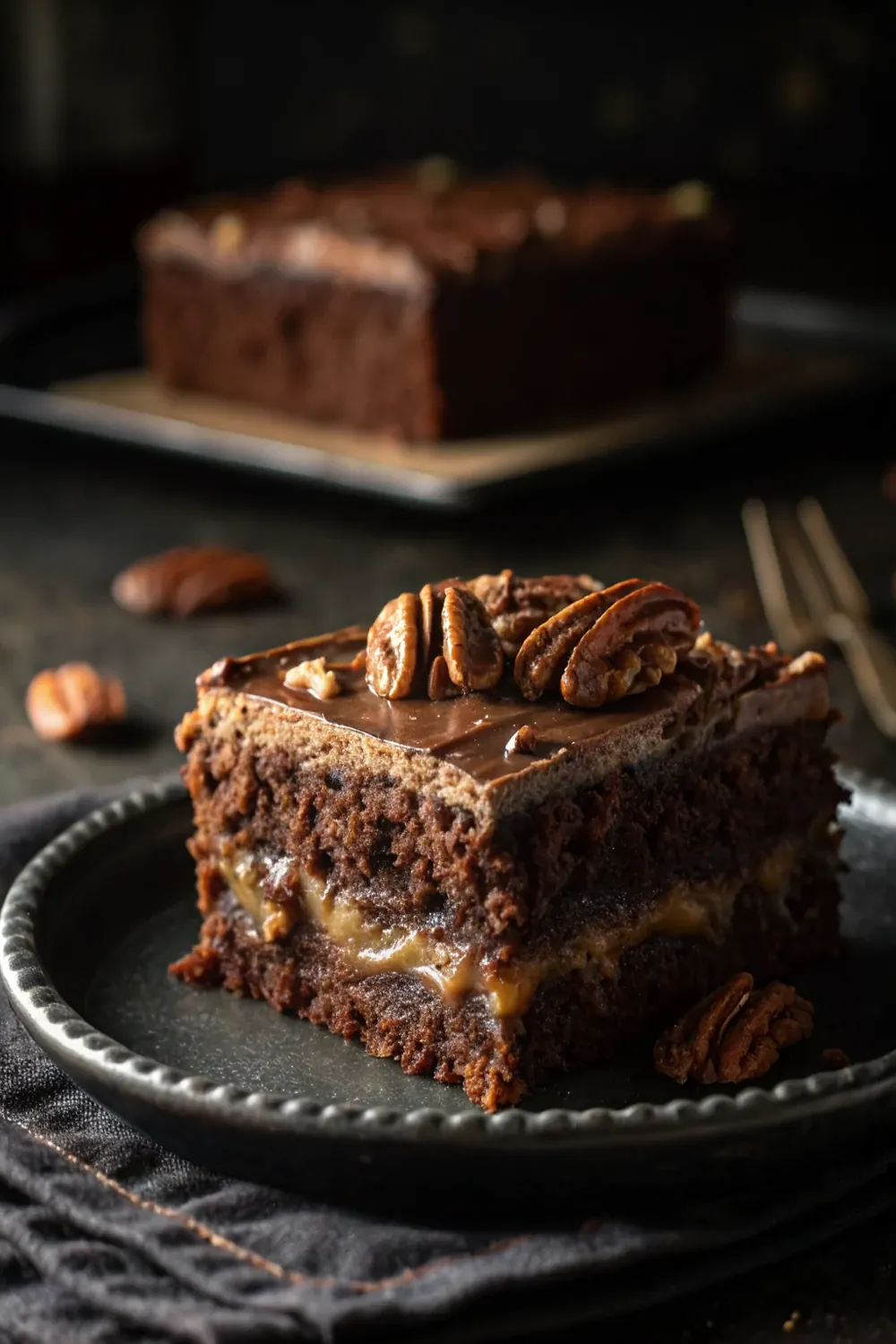
Chef Mia's Texas sheet cake with buttermilk: 1 cup buttermilk in the batter, cocoa fudge frosting poured on warm, jelly roll pan. The canonical fudgy version.
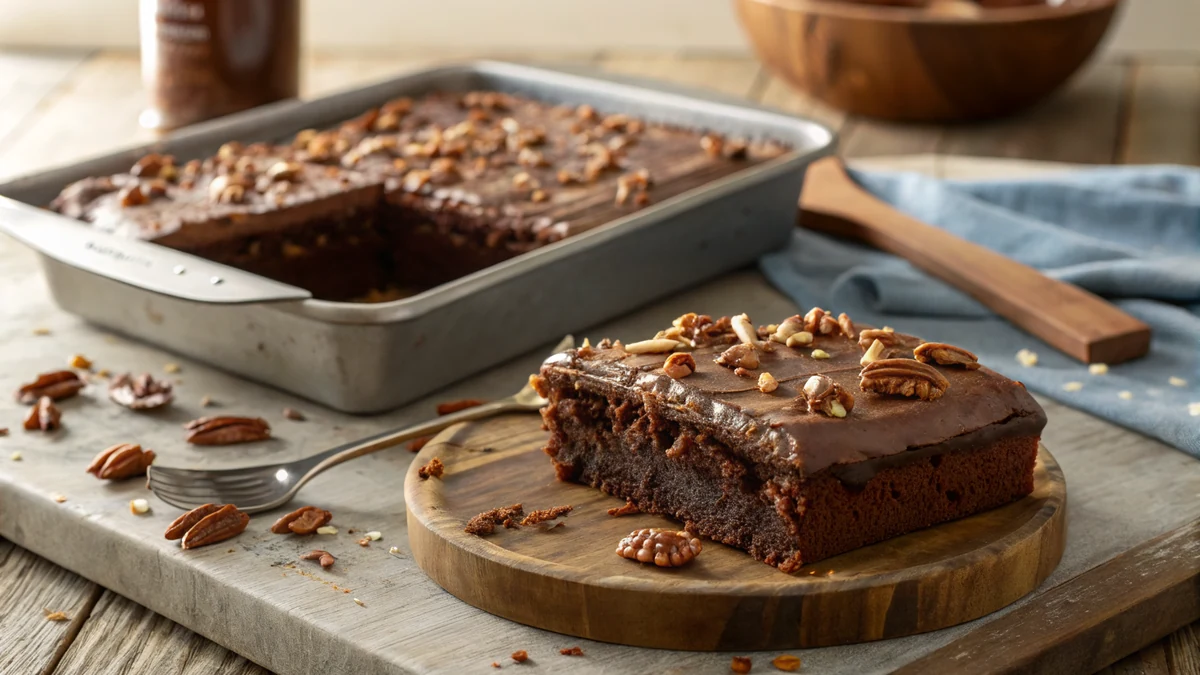
Quick answer: Texas sheet cake with buttermilk is the canonical 1950s Hill Country chocolate sheet cake, baked in a jelly roll pan (about 15 by 10 by 1 inch) so the cake comes out thin, fudgy, and meant to be sliced into 24 small squares for crowd-feeding. Buttermilk is the original recipe's wet ingredient and gives the cake its tender crumb and slight tang. Bring butter, water, cocoa powder, and oil to a quick boil in a saucepan, pour it over flour, sugar, and baking soda whisked in a large bowl. Whisk in two eggs, one cup of buttermilk, and a teaspoon of vanilla. Bake at 350F for 18 to 22 minutes. While the cake bakes, make the buttermilk-pecan frosting (butter, cocoa, milk or buttermilk, powdered sugar, vanilla, chopped pecans) and pour it over the warm cake straight out of the oven. The frosting seeps into the cake's surface as both cool, creating the signature fudgy texture.
Texas sheet cake with buttermilk is the recipe my grandmother typed onto an index card in 1968 for the Methodist church cookbook in Gillespie County. Her copy stayed in our family Bible for thirty years and the corners of the card got chocolate fingerprints on them every time she made it for a potluck. The cake is one of the most iconic Texas desserts in the canon - thin and fudgy, made in a jelly roll pan, cut into small squares, and crowned with a warm cocoa-pecan frosting poured directly onto the cake while it is still hot from the oven. The buttermilk is the original ingredient. Recipes that skip it (replacing with milk or sour cream) are post-1980 simplifications that lose the original tender crumb and slight tang.
The version below is essentially my grandmother's card recipe, rewritten for modern measurements and modern oven calibration. Buttermilk in the batter (1 cup, full-fat cultured), buttermilk in the frosting (or whole milk if you want it less tangy), Texas pecans on top because that is non-negotiable for any Texas chocolate dessert. The cake takes 25 minutes from cold ingredients to oven, bakes in 20 minutes, and yields 24 small squares from a single jelly roll pan. It is the dessert that feeds a Sunday afternoon football crowd, a baby shower, a funeral reception, or any gathering of more than ten people who want chocolate. The fudgy texture comes from pouring the warm frosting onto the warm cake; the frosting soaks into the top half-inch of cake as both cool, and the result is something halfway between a brownie and a sheet cake. The same jelly-roll-pan logic powers my peanut butter Texas sheet cake, the golden cousin this recipe's fans always ask about next.
Why the Buttermilk Matters (and How It Was the Original)
Texas sheet cake originated in Hill Country church cookbooks in the early 1950s. The original recipes - found in handwritten compilations from Gillespie, Comal, Kendall, and Burnet counties - all called for buttermilk in the batter and either buttermilk or whole milk in the frosting. Buttermilk was the canonical wet ingredient because Texas farm households had it on hand from cow dairy, and because the slight acidity tenderizes the gluten and gives the cake its signature soft crumb.
The post-1980 simplifications that replaced buttermilk with milk (or worse, water) emerged when Texas sheet cake spread beyond the Hill Country and home cooks who did not keep buttermilk on hand wanted shortcuts. The shortcut versions are still delicious but they lose two specific qualities: the slightly tangy back-of-the-tongue note that balances the chocolate sweetness, and the dense-fudgy crumb texture that distinguishes Texas sheet cake from other American chocolate sheet cakes.
If you want the canonical 1950s Hill Country version, the buttermilk is non-negotiable. If you only have milk, the recipe still produces a good cake; just not the original. Buttermilk substitute (1 cup whole milk plus 1 tablespoon white vinegar, stir and rest 5 minutes) works in a pinch but the lactic-acid-culture flavor is different from real cultured buttermilk.
The Jelly Roll Pan Is the Right Size
Texas sheet cake is defined by its pan. The 15-by-10-by-1-inch jelly roll pan (also called a quarter sheet pan) is the canonical vessel. The thin batter at 1/2 inch deep bakes in 18-22 minutes - fast enough that the texture stays fudgy rather than turning into typical layer-cake crumb.
A 9-by-13-inch baking dish (deeper than a jelly roll pan) is the substitute most home cooks reach for. It works but the cake bakes thicker (1 inch versus 1/2 inch) and takes longer (28-32 minutes). The texture turns more cake-like and less fudgy. The dish still tastes excellent; it is just not strictly Texas sheet cake.
An 18-by-13 half sheet pan is too large for a single batch - the cake spreads too thin and bakes in 14-16 minutes, risking dry edges. If you have a half sheet pan and want to use it, scale the recipe up 1.5x to give the right batter depth.
USA Pan and Nordic Ware both make excellent jelly roll pans for around $20-25. The Wilton aluminum jelly roll pan from Walmart works for $10. The pan should be light-colored aluminum (not dark non-stick) because dark pans brown the bottom too fast and can dry out the cake before the center sets.
Cocoa Powder: Dutch-Process vs Natural
Cocoa powder choice affects color, flavor, and chemistry. Dutch-process cocoa (treated with alkali during processing) is darker, smoother, less acidic, and produces a more sophisticated chocolate flavor. Natural cocoa is brighter brown, more acidic, and gives a slightly fruitier chocolate note.
For Texas sheet cake, either works. The 1950s original used natural cocoa because Dutch-process was not common in Hill Country grocery stores at the time. Modern versions of the recipe often use Dutch-process for a deeper color. Hershey's Special Dark Cocoa (a blend) is the easy supermarket choice.
The recipe is balanced to work with either type. The baking soda quantity (1 teaspoon for the batter) was calibrated for natural cocoa's acidity, but works fine with Dutch-process too because the buttermilk in the recipe provides enough acid to activate the baking soda regardless of the cocoa type.
Ghirardelli unsweetened cocoa, Hershey's natural unsweetened cocoa, Valrhona, and King Arthur cocoa are all excellent choices. Avoid hot-cocoa-mix powders (sweetened, has milk solids) and avoid 'baking chocolate' bars; both throw off the recipe ratio.
The Boil-and-Whisk Method (Why It Works)
Texas sheet cake uses a distinctive technique: bring butter, water, cocoa, and oil to a rolling boil in a saucepan, then pour the hot mixture into the dry ingredients. This is different from typical cake-batter methods (cream butter and sugar, alternate dry and wet) and is what gives Texas sheet cake its dense, fudgy crumb.
The hot liquid does three things at once: it bloomed the cocoa (releases more chocolate flavor by hydrating the cocoa solids), it partially gelatinizes the starch in the flour (creating a denser crumb than cold-batter methods), and it speeds up mixing dramatically (the whole batter comes together in 5 minutes instead of 15).
Bring the mixture to a rolling boil, not a simmer. The boil signal is what tells you the cocoa is fully bloomed and the temperature is hot enough to gelatinize the starch when it meets the flour. Pull off heat the moment you see the rolling boil; do not let it boil more than 15 seconds, or the butter starts to brown and the chocolate notes turn slightly bitter.
The 'oil plus butter' combination is intentional. Butter alone gives a richer flavor but a denser, drier crumb. Oil alone gives a more tender crumb but a flatter flavor. The 1:4 ratio of oil to butter (1/4 cup to 1 cup) is the sweet spot: butter flavor with tender oil-cake texture.
The Pour-Frosting-While-Warm Technique
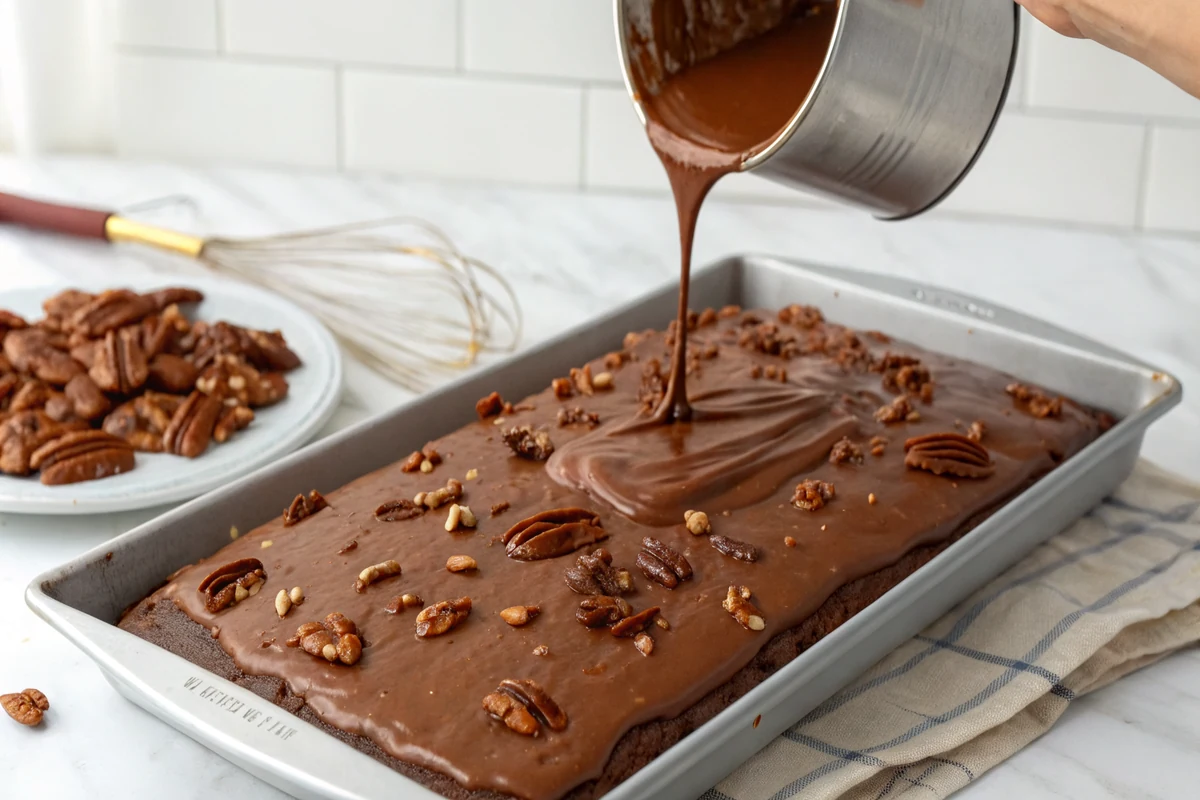
The single most important technique in Texas sheet cake is pouring the warm frosting onto the warm cake the moment both come together. This is the difference between a chocolate cake with frosting (good) and a Texas sheet cake (great).
The cake comes out of the oven at around 200F internal temperature. The frosting, made on the stove and pulled off heat, is at around 160F when ready to pour. When the two meet, the frosting partially absorbs into the top 1/4 inch of cake during the cooling phase. The result is a fudgy top layer that is neither cake nor frosting exactly - it is the in-between texture that defines Texas sheet cake.
Timing matters. Make the frosting during the last 5 minutes of the cake's bake time, so the frosting is ready the moment the cake comes out of the oven. If the cake cools too much before the frosting is ready, microwave the frosting at 30% power for 20 seconds to re-warm. If the frosting sets too thick to pour, whisk in 1-2 teaspoons more hot buttermilk.
Do not chill the cake before frosting. Cold cake does not absorb frosting and the texture defaults to standard layer-cake-with-frosting. The whole architecture of the dessert depends on the warm-on-warm pour.
Texas Pecans in the Frosting
Chopped Texas pecans in the frosting are the canonical Hill Country touch. Without pecans, you have a chocolate sheet cake. With pecans, you have a Texas sheet cake. The distinction is not trivial - the pecans add texture, nutty depth, and a layer of toasted complexity that the cocoa alone cannot deliver.
Use 1 cup of chopped pecans for the canonical version. San Saba pecans (from San Saba, Texas, often labeled 'Texas Native Pecans' or 'San Saba Halves') are the canonical choice. The pecan tree is the official state tree of Texas, and the San Saba region claims to be the pecan capital of the world. Roughly half of the US pecan harvest comes from Texas growers.
Chop the pecans medium-fine for this recipe - not whole halves (too chunky), not pecan dust (too fine). About 1/4-inch pieces is right. Toasted pecans add even more depth; spread the chopped pecans on a sheet pan and toast at 350F for 5-7 minutes until fragrant, then add to the frosting. The toasting is optional but recommended.
Alternatives if pecans are unavailable: chopped walnuts (close substitute, slightly different flavor), chopped almonds (more delicate, less Texan), or omit nuts entirely (still good, less complex). Hazelnuts would also work and give a Nutella-ish twist. Avoid macadamia nuts (too soft) and peanuts (clashes with the cocoa).
Serving: Small Squares, Coffee on the Side
Texas sheet cake is meant to be cut into small squares. A 15-by-10 jelly roll pan yields 24 squares (a 6-by-4 grid), each square about 2.5-by-2.5 inches. The small size is intentional - the cake is rich enough that a larger slice overwhelms.
For a church potluck or family supper, plate the squares on a large platter and stack two-high if needed. For a more formal presentation, plate individual squares on dessert plates with a fork. For a serve-yourself buffet, leave the cake in the pan and provide a spatula.
Coffee is the canonical drink pairing. A cup of strong black coffee or coffee with cream balances the cake's sweetness beautifully. Cold milk works for kids. A glass of cold buttermilk is the deep-Texas-Hill-Country move that doubles down on the buttermilk theme.
Vanilla ice cream is the optional indulgence - Blue Bell Homemade Vanilla scooped on top of a warm square is the Texas-canonical move for a Sunday family dinner. Whipped cream is acceptable.
For wider Texas dessert context, see Texas pecan pie, buttermilk pie, and Texas trash pie - all part of the Hill Country dessert canon that this sheet cake belongs to.
Storage and the Cake-Tastes-Better-Tomorrow Truth
Texas sheet cake holds beautifully and benefits from a day's rest. Like 15 Bean Soup and Texas chili, this cake tastes better on day two than on day one. The frosting fully absorbs into the cake's top layer overnight, the flavors marry, and the dessert reaches its peak texture.
Counter storage: cover the pan loosely with foil or plastic wrap. Keeps 3 days at room temperature. The cake is shelf-stable at room temperature because of the high sugar content. Cover loosely so the top stays glossy rather than tacky.
Refrigerator storage: cover tightly with plastic or transfer cut squares to an airtight container. Keeps 1 week refrigerated. The cake firms up significantly in the fridge - some Texans prefer the cold-fudgy texture, others bring squares back to room temperature before serving. Both are acceptable.
Freezer storage: wrap cut squares individually in plastic, then transfer to a freezer-safe container or zip-top bag. Keeps 3 months at 0F. Thaw at room temperature for 30 minutes or in the microwave at 30% power for 20 seconds per square. The texture survives freezing well; the frosting may develop a slight sugar bloom (white speckles) that does not affect taste.
Variations Worth Trying
Texas sheet cake with coffee. Replace the 1 cup of water in the batter with 1 cup of strong brewed coffee. The coffee deepens the chocolate flavor without making the cake taste like coffee. A classic upgrade.
Bourbon-pecan Texas sheet cake. Add 2 tablespoons of Texas bourbon (Garrison Brothers, Balcones) to the batter, and another 1 tablespoon to the frosting. The oak-vanilla notes pair beautifully with chocolate. A grown-up version for adult gatherings.
White Texas sheet cake. Replace the cocoa powder in both the batter and frosting with 1 teaspoon almond extract. The cake becomes a white sheet cake with an almond-pecan frosting. Popular at Texas weddings as a wedding-cake alternative.
Cream cheese Texas sheet cake. Replace 4 oz of the butter in the frosting with 4 oz cream cheese, softened. The frosting tilts toward a chocolate cream-cheese-frosting profile and pairs beautifully with red velvet variations.
Spiced Texas sheet cake. Add 1 teaspoon ground cinnamon and 1/4 teaspoon ground cayenne to the dry ingredients. The cake leans Mexican-chocolate with subtle heat at the back. Pair with vanilla ice cream and a glass of horchata.
Mistakes to Avoid
Skipping the buttermilk. Whole milk produces a less tender, less complex cake. The 1950s original is built around buttermilk. Use buttermilk substitute (1 cup milk + 1 tablespoon vinegar, rest 5 minutes) only if you genuinely have no buttermilk.
Frosting cold cake. The pour-while-warm technique is non-negotiable. Cold cake does not absorb the frosting and you lose the fudgy top layer that defines Texas sheet cake.
Overbaking. The cake continues setting as it cools. Pull at 18-22 minutes with a few moist crumbs on the toothpick. Past that point the cake dries out and the fudgy texture is lost.
Using a 9-by-13 dish instead of a jelly roll pan. The thicker batter changes the texture from fudgy-thin to standard chocolate cake. Use the right pan for the canonical result.
Boiling the cocoa mixture too long. The 'bring to a rolling boil then pull off' is a 30-second action, not a sustained boil. Over-boiling browns the butter and turns the chocolate slightly bitter.
Skipping the pecans. Without pecans you have a generic chocolate sheet cake. The pecans are what make it Texas.
Kitchen Notes from My Hill Country Sundays
I make this cake about once a month, usually for a Sunday family supper or a birthday in my circle. The whole dessert takes 45 minutes from cold ingredients to frosted-and-cooling, which fits the after-church window perfectly. Cut squares stay good on the counter for 3 days, which means Monday and Tuesday lunches at the office have something to look forward to.
The single change that improved my version most was switching from milk to real cultured buttermilk in both the batter and the frosting. The slightly tangy back-of-the-tongue note balances the chocolate sweetness in a way that whole milk cannot replicate. Worth keeping a quart of buttermilk in the fridge specifically for cake nights and for buttermilk biscuits.
The Hurst's-style brand strategy applies to pecans too. Track down San Saba pecans (sold at Texas H-E-B stores and at Walker Honey Farm) rather than generic supermarket pecans. The difference in flavor and oil content is noticeable.
The most useful piece of gear for this recipe is a USA Pan jelly roll pan. The light aluminum browns evenly and the rolled-rim edges make the pan easy to lift and pour from. About $22 and lasts a lifetime. For more Texas chocolate recipes, see the canonical Texas sheet cake (very close cousin of this version) and my Texas chocolate sheet cake which uses a slightly different frosting technique.
Tips for the Best Buttermilk Texas Sheet Cake
Five batches in, you start noticing the small dials. These are the moves I keep returning to in my Hill Country kitchen, the ones that lift this dessert from good to memorable.
- Use full-fat cultured buttermilk. Low-fat buttermilk works but the texture is slightly less tender. Powdered buttermilk substitutes (Saco brand) work in a pinch but the flavor is flatter.
- Bloom the cocoa. The boil-and-pour method blooms the cocoa for deeper chocolate flavor. Skipping this step (just adding cold cocoa to flour) gives a less intense cake.
- Pour frosting at the 60-second window. The cake must be warm out of the oven and the frosting must be warm off the stove. Both warm at the same time is the canonical pour window.
- Toast the pecans before adding to frosting. 5-7 minutes at 350F. The toasting adds a layer of nutty depth that takes the dessert from generic to memorable.
- Cut into 24 small squares. The cake is rich enough that larger slices overwhelm. The small-square format is also Texas-canonical for potluck portability.
For the closely related canonical version (essentially the same cake under a cleaner slug), head to Texas sheet cake. For the frosting recipe in isolation (useful for other cakes), see Texas sheet cake frosting.
Texas Sheet Cake with Buttermilk Recipe
Ingredients
- For the cake batter:
- 2 cups (250 g) all-purpose flour
- 2 cups (400 g) granulated sugar
- 1 teaspoon baking soda
- 1/2 teaspoon kosher salt
- 1 cup (227 g) unsalted butter
- 1 cup (240 ml) water
- 1/4 cup (20 g) unsweetened cocoa powder (Dutch-process or natural; both work)
- 1/4 cup (60 ml) neutral oil (canola, vegetable, or light olive)
- 1 cup (240 ml) full-fat cultured buttermilk, well shaken
- 2 large eggs, lightly beaten, room temperature
- 1 teaspoon pure vanilla extract
- For the cocoa-pecan frosting:
- 1/2 cup (113 g) unsalted butter
- 1/4 cup (20 g) unsweetened cocoa powder
- 1/3 cup (80 ml) buttermilk (or whole milk for a less tangy frosting)
- 3 1/2 cups (440 g) powdered sugar, sifted
- 1 teaspoon pure vanilla extract
- 1 cup (115 g) chopped Texas pecans (San Saba pecans if available)
- Pinch of kosher salt
- Equipment:
- Jelly roll pan (15 by 10 by 1 inch) or large quarter sheet pan, ungreased or lightly greased
- 2 medium saucepans, large mixing bowl, whisk, rubber spatula, sifter (optional)
Instructions
- Preheat oven to 350F and grease the pan. Preheat oven to 350F (175C) and position a rack in the center. Lightly grease a 15-by-10-by-1-inch jelly roll pan (or a similar quarter sheet pan) with butter or non-stick spray. Some Texans bake this cake in an ungreased pan; lightly greased works better for clean release. Dust the bottom and sides of the pan with flour and tap out excess if you want extra insurance against sticking.
- Whisk the dry ingredients. In a large mixing bowl, whisk together the all-purpose flour, granulated sugar, baking soda, and kosher salt until completely combined and uniform. The bowl should be large enough to hold all the wet ingredients you will add next. Set aside while you make the cocoa mixture.
- Bring butter, water, cocoa, oil to a boil. In a medium saucepan, combine the 1 cup of butter, 1 cup of water, 1/4 cup cocoa powder, and 1/4 cup of neutral oil. Place over medium-high heat and whisk constantly. Bring the mixture to a rolling boil, then immediately pull off the heat. The total time is 3-4 minutes; do not let the mixture boil more than 15 seconds once it reaches the boiling point. The mixture should be glossy, deep chocolate brown, and uniformly emulsified.
- Pour the cocoa mixture into the dry ingredients. Carefully pour the hot cocoa mixture into the bowl of dry ingredients. Whisk gently until just combined and no streaks of dry flour remain. The batter will be loose and glossy. Do not over-whisk - excess mixing develops gluten and gives a tough crumb. About 30 seconds of whisking is right.
- Add buttermilk, eggs, vanilla. Add the buttermilk, lightly beaten eggs, and vanilla extract to the bowl. Whisk gently to combine, 20-30 seconds, until the batter looks smooth and uniform. The batter will be quite thin compared to other cake batters - this is correct for Texas sheet cake. The thin batter is what gives the cake its dense fudgy crumb after baking.
- Bake at 350F for 18 to 22 minutes. Pour the batter into the prepared jelly roll pan and spread evenly to all four corners with a rubber spatula. The batter should be about 1/2 inch deep across the pan. Bake on the center rack for 18 to 22 minutes. Begin checking at 18 minutes. The cake is done when a toothpick inserted in the center comes out with a few moist crumbs (not wet batter, not completely clean - the crumb-on-toothpick state is the signal). The cake should spring back gently when pressed in the center. Do not overbake; the cake continues setting as it cools.
- Make the frosting while the cake bakes. About 5 minutes before the cake is done baking, start the frosting. In a medium saucepan, combine the 1/2 cup butter, 1/4 cup cocoa powder, and 1/3 cup buttermilk. Place over medium heat and whisk constantly until the butter melts and the mixture reaches a gentle simmer. Remove from heat immediately. Sift in the powdered sugar gradually, whisking after each addition. Add the vanilla, chopped pecans, and a pinch of salt. Whisk until smooth and glossy. The frosting should be pourable but not watery - similar to thick syrup. If it is too thin, add 1/4 cup more sifted powdered sugar; if too thick, add 1 tablespoon more buttermilk.
- Pour frosting onto the warm cake immediately. Pull the cake out of the oven. Within 60 seconds, pour the warm frosting over the warm cake, spreading gently with a spatula to cover the surface evenly. The cake should still be hot to the touch. The pour-while-warm step is the canonical Texas Hill Country technique - the warm frosting soaks into the top 1/4 inch of cake as both cool, creating the signature fudgy texture. If you wait for the cake to cool first, the frosting sits on top as a separate layer and the texture is wrong.
- Cool 30 minutes, slice into 24 squares. Let the frosted cake cool in the pan for at least 30 minutes before slicing. The frosting will set from glossy-wet to glossy-set. Once cooled, cut the cake into 24 small squares (a 6 by 4 grid). Texas sheet cake is meant to be served in small squares because it is rich; large slices overwhelm. Each square is roughly 2.5 by 2.5 inches.
Frequently Asked Questions
What's the difference between this version and regular Texas sheet cake?
The buttermilk version is the canonical 1950s Hill Country original. Buttermilk in the batter gives a more tender crumb and slight tang that balances the chocolate. Many modern simplified versions of Texas sheet cake skip the buttermilk in favor of milk or water. Both still produce a delicious cake, but only the buttermilk version is the authentic 1950s Hill Country recipe. The standard Texas sheet cake recipe on this site uses essentially the same buttermilk-based approach.
Can I use milk instead of buttermilk?
Yes, but the cake is no longer 1950s canonical. The texture is slightly less tender and the slight tang that balances the chocolate is missing. If you have no buttermilk, the closest substitute is 1 cup whole milk + 1 tablespoon white vinegar or lemon juice, stirred and rested for 5 minutes until curdled. The vinegar-milk substitute is acceptable but real cultured buttermilk gives noticeably better results.
Why pour the frosting while the cake is still warm?
The warm-on-warm technique is what creates Texas sheet cake's signature fudgy top layer. The hot frosting partially absorbs into the top quarter-inch of cake during the cooling phase. If you wait for the cake to cool before frosting, the frosting sits on top as a separate layer and you get standard chocolate-cake-with-frosting (still good, but not Texas sheet cake). The 60-second pour window after the cake comes out of the oven is the canonical move.
Can I use a 9-by-13 baking dish?
Yes, but the cake will be thicker and bakes longer (28-32 minutes instead of 18-22). The texture turns more like a standard chocolate cake rather than the fudgy-thin sheet cake. The jelly roll pan (15 by 10 by 1 inch) is the canonical vessel and produces the authentic texture. If you only have a 9-by-13, the recipe still works but expect a different result.
Is this recipe gluten-free?
No. Standard all-purpose flour contains wheat. For gluten-free, substitute 1 cup of King Arthur Measure for Measure Gluten-Free Flour for the 2 cups of all-purpose flour (the ratio is the same; King Arthur is calibrated 1:1). Bob's Red Mill 1-to-1 Gluten-Free Baking Flour also works. The texture is slightly different (less rise) but the cake is still excellent. The other ingredients (butter, buttermilk, cocoa, sugar, eggs, pecans) are naturally gluten-free.
Can I make this dairy-free?
Difficult but possible. Replace the butter with vegan butter (Miyoko's, Earth Balance). Replace the buttermilk with full-fat coconut milk + 1 tablespoon lemon juice or apple cider vinegar (stir and rest 5 minutes). The cake's texture is significantly different and the flavor leans coconut, but it remains a credible Texas-style chocolate sheet cake. The frosting needs the same substitutions: vegan butter + coconut-milk buttermilk substitute.
How long does the cake keep?
Loosely covered on the counter, 3 days. Tightly covered in the refrigerator, 1 week. Wrapped individually and frozen, 3 months. The cake tastes better on day 2 than day 1 because the frosting has fully absorbed into the cake's top layer and the flavors marry overnight. Plan to make a day ahead for important events.
Can I freeze Texas sheet cake?
Yes. Wrap cut squares individually in plastic wrap, then transfer to an airtight freezer container or zip-top bag. Keeps 3 months at 0F. Thaw at room temperature for 30 minutes or microwave at 30% power for 20 seconds per square. The texture survives freezing well; the frosting may develop a slight sugar bloom (white speckles) that does not affect taste.
Why does my Texas sheet cake taste flat?
Two common causes. First, the buttermilk was substituted with milk; the slight tang and acidity are what brighten the chocolate. Use real cultured buttermilk. Second, the cocoa was not bloomed (the boil-and-pour step was skipped or shortened). The hot liquid hitting the cocoa releases the deep chocolate notes; cold cocoa added to flour produces a flatter flavor. Follow the boil-and-pour technique exactly for best results.