Southern Comfort Food
Fried Green Tomatoes
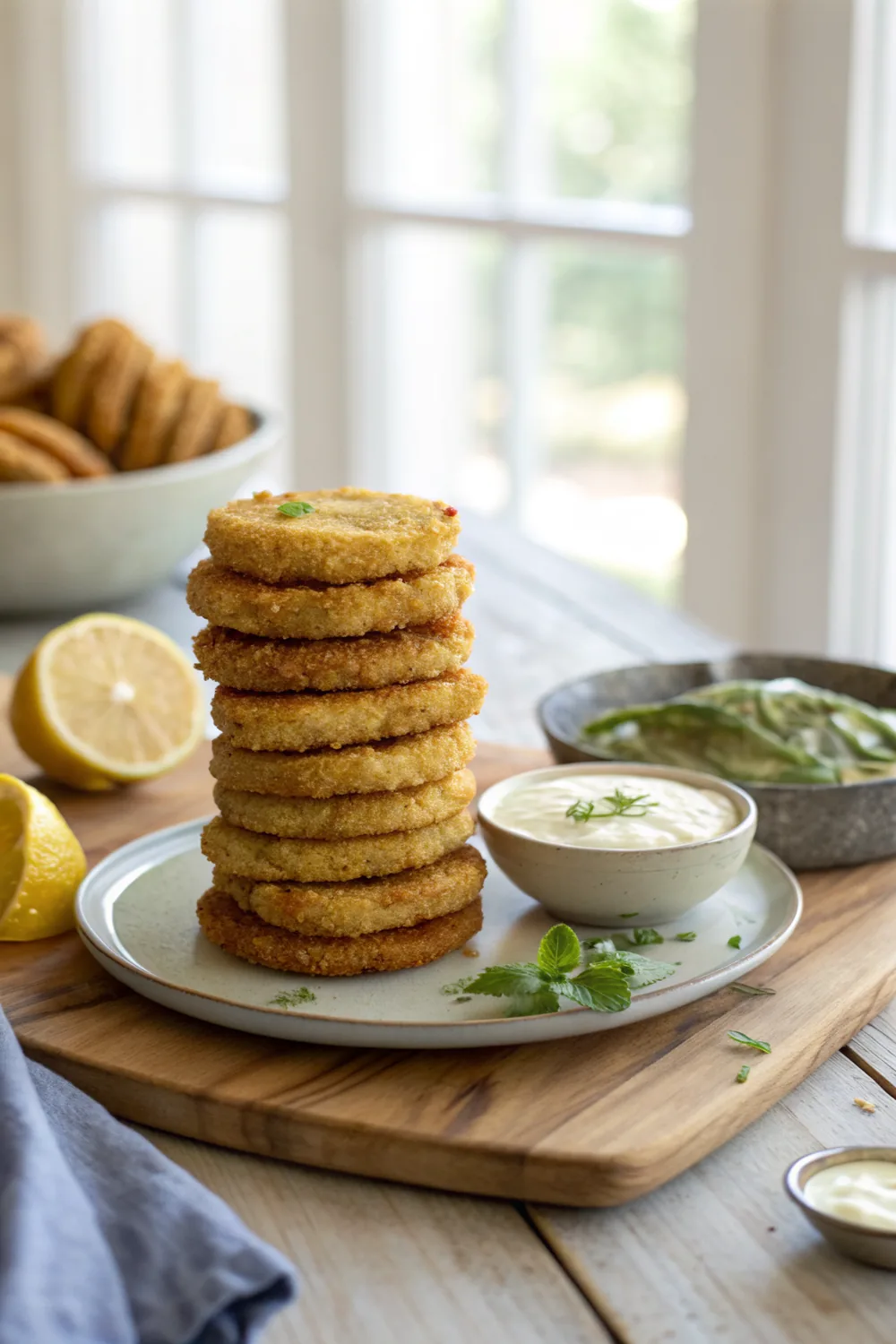
Chef Mia's fried green tomatoes: half-inch slices salted and dried, double-dredged in flour and cornmeal, fried in cast iron at 350F. The crust stays on.
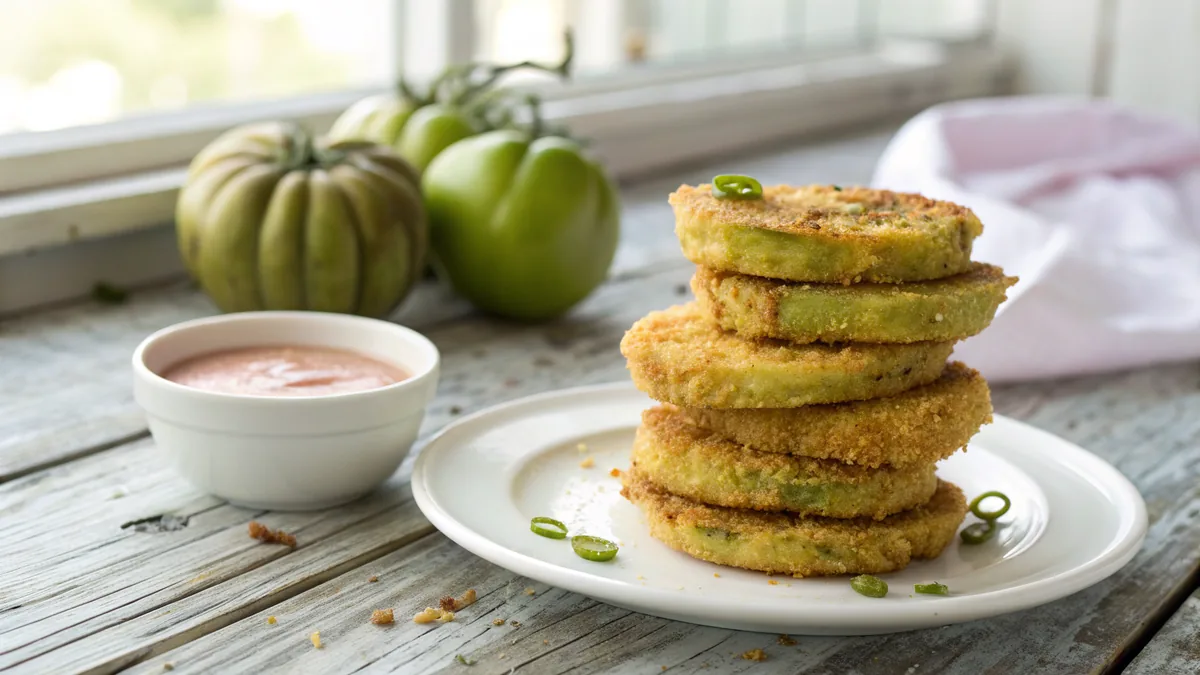
Quick answer: Fried green tomatoes are half-inch slices of firm, unripe tomato, salted for ten minutes and patted dry, coated in a double dredge of seasoned flour, buttermilk and egg, then a cornmeal and flour mix, and shallow-fried in a cast iron skillet in a quarter inch of oil at 350F for about 3 minutes per side. The salt draws out the water that would otherwise steam the crust loose, the flour layer gives the buttermilk something to grip, and the cornmeal layer fries into a crackly, golden shell around a slice that stays tart and just tender. Drain on a wire rack, salt while hot, and serve with a spoonful of comeback sauce.
The first fried green tomato I ever ate came off a paper plate at a church supper outside Lockhart, and I remember being confused by it. It looked like a hush puppy that had been flattened, it crunched like fried okra, and then the inside was sour and juicy in a way no fried thing had any right to be. That contrast, the hot crackly shell against a slice of tomato that tastes like July before it has fully happened, is the entire reason the dish exists. It is not a way to rescue a tomato that did not ripen. It is a dish that needs the tomato to be green.
Most versions I see go wrong in one of two ways. Either the coating slides off in the pan in a sad sheet, because the tomato was wet and the dredge had nothing to hold, or the slices come out limp and greasy, because the oil was too cool and the tomato spent too long in it. Both problems have the same cure: treat the tomato like the water balloon it is. Salt it, dry it, give it a flour layer before the wet dip, and fry it hot and fast in a skillet that holds its heat. Everything in this recipe follows from that.
This is the same buttermilk and cornmeal logic that runs my fried okra, but the two dishes are built differently. Okra is a small pod dredged once and fried in a crowd; a green tomato is a wide, wet, heavy slice that needs a double dredge, one slice at a time, and a bigger, hotter skillet. If you have made the okra, you will recognize the moves. If you have not, this is the better place to learn them, because the tomato shows you every mistake immediately.
Why the Tomato Has to Be Green
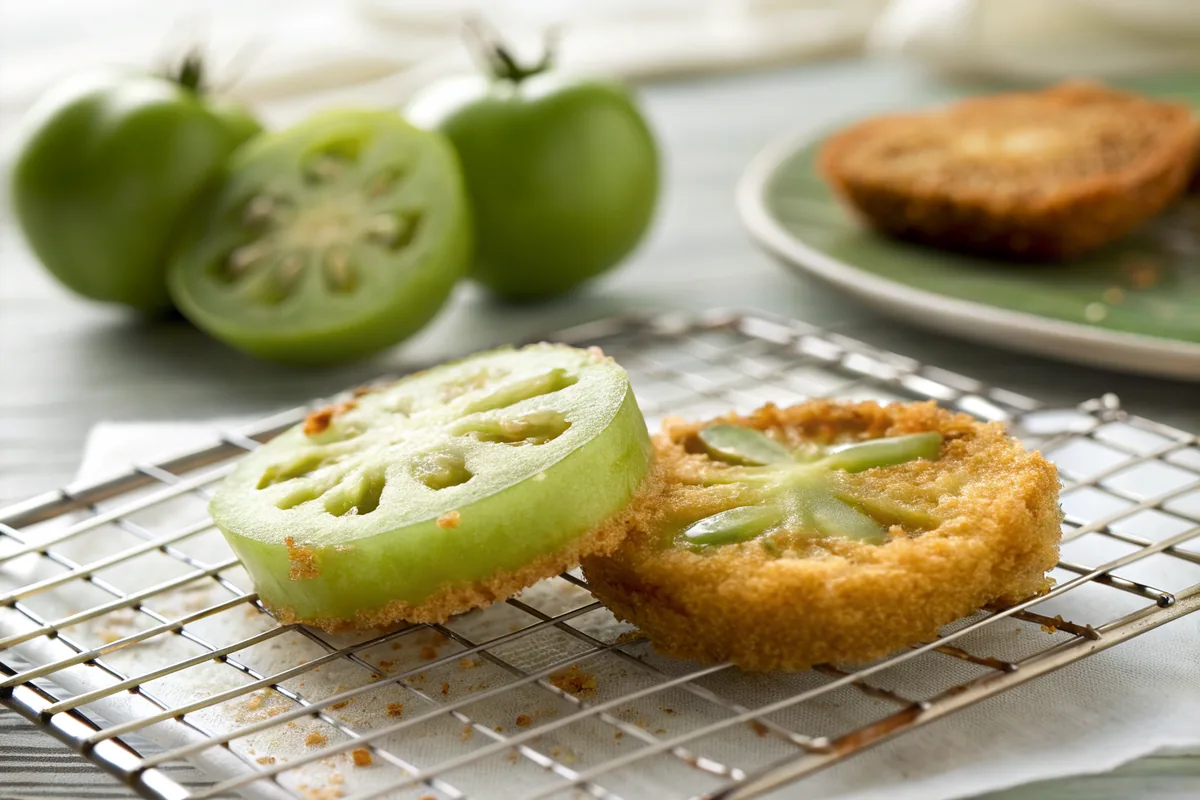
A green tomato is an unripe tomato, and that word covers a lot of ground. The one you want is fully grown but has not started to ripen at all: pale green, sometimes with a faint white blush at the shoulders, and hard enough that pressing it with a thumb does nothing. That firmness comes from pectin that has not yet been broken down by the ripening enzymes, and it is what lets a slice survive a dredge, a hot skillet, and a spatula without collapsing into sauce.
The flavor is the other half. An unripe tomato is high in malic and citric acid and low in sugar, so it tastes sharp, grassy, and clean, closer to a tomatillo or an underripe plum than to a summer tomato. That tartness is what the crust is built to frame. Fry a half-ripe tomato, one showing pink, and the sugar has already started to develop, the flesh has softened, and you get a wet, sweet, sagging slice that fights its own coating. This is the single most common reason fried green tomatoes disappoint at home: the tomatoes were too far along.
Green tomatoes show up two ways in Texas. In early summer, gardeners and farm stands thin their vines and sell the culls, which is the traditional source. In late October, right before the first frost, everyone with a tomato plant strips it bare and suddenly has ten pounds of green fruit and nothing to do with it, which is how the dish became an autumn ritual as much as a summer one. Grocery stores in the South often stock them year-round; look near the tomatillos rather than with the red tomatoes.
One thing to be clear about: heirloom varieties that stay green when ripe, like Green Zebra or Aunt Ruby's German Green, are not what you want. They are ripe, soft, and sweet. If a green tomato gives at all under your thumb or smells like a tomato when you cut it, it is too ripe for this. The right one smells like almost nothing and cuts with a crisp, apple-like resistance.
Half-Inch Slices, and Why Thinner Fails
Slice thickness decides the whole texture. At a half inch, a slice has enough body to hold its shape, enough flesh to stay juicy inside while the outside crisps, and enough surface for the crust to get properly golden in the three minutes a side that the tomato can tolerate. Thinner slices, a quarter inch or less, cook through before the crust browns and turn to mush under the coating. Thicker slices, closer to three quarters of an inch, brown outside before the middle warms and eat like a raw tomato in a crust.
Cut straight across the equator, not through the stem end, so each slice has the same structure: a ring of firm outer wall, the seed pockets, and the core. Discard the very top and bottom slices, which are mostly skin and core and never fry evenly. A large tomato gives four good slices, sometimes five. A serrated knife makes the cleanest cut through the skin without pressing the slice out of shape.
Leave the skin on. It is thin on a green tomato and it is doing structural work, holding the edge of the slice together through the salting, the dredge, and the flip. A peeled slice frays at the rim and sheds coating. If the skin bothers you at the table, it will not, because by the time it is fried it is indistinguishable from the crust.
Salt First: The Ten Minutes That Keep the Crust On
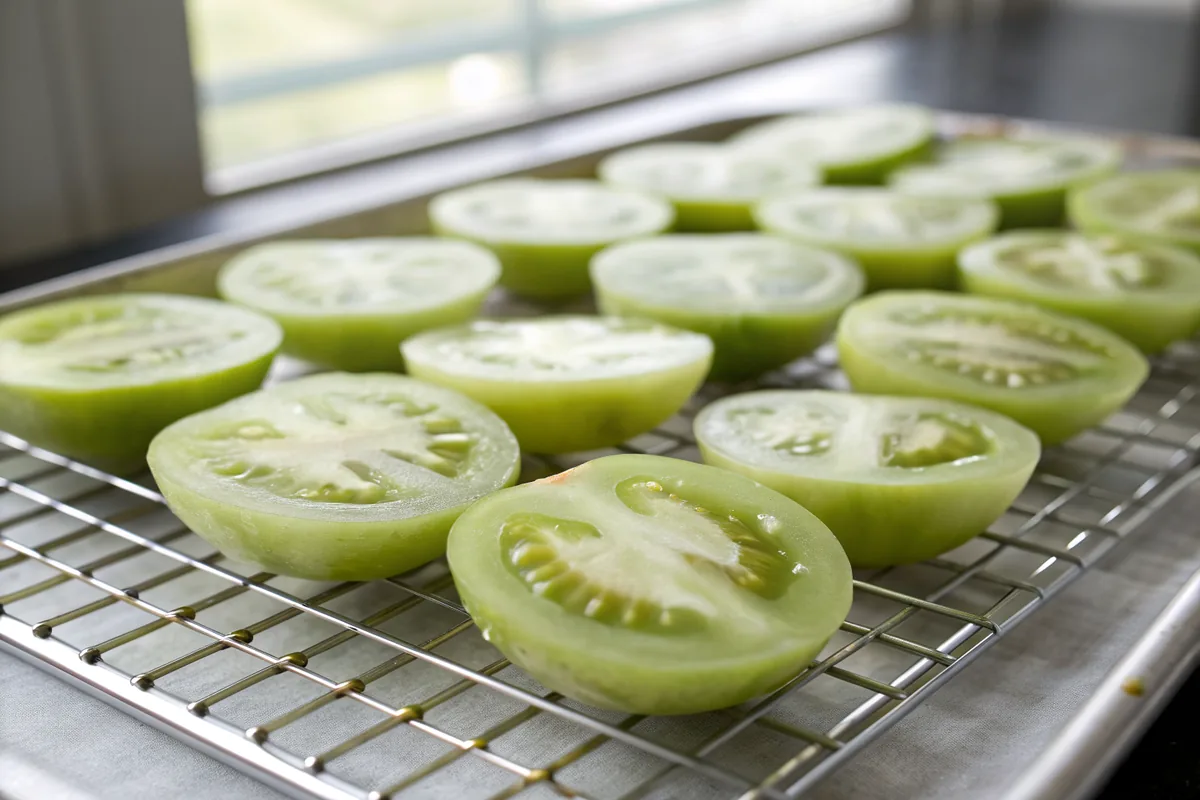
A green tomato is roughly 93 percent water, and a dredge does not stick to water. If you coat a freshly cut slice and fry it, the moisture on the surface turns to steam the moment it hits the oil, and that steam pushes the coating off from underneath. You end up with a golden shell floating in the pan and a naked slice of tomato beside it. Every cook who has given up on this dish has seen that happen.
Salting the slices for ten minutes before dredging pulls a surprising amount of that surface water out through osmosis. You will see it bead up within a few minutes. Patting the slices dry afterward gives the flour a dry, slightly tacky surface to cling to, and the crust then stays where you put it through the flip and the drain. The salt also seasons the tomato itself, which matters, because the flesh inside the crust gets no seasoning from the coating.
Ten minutes is the window. Less and the water has not moved; more, past about twenty, and the slices start to soften and lose the firmness that makes them worth frying. Do not rinse the salt off, and do not skip the drying. Blotting is the step, not the salting alone. Press gently with paper towels until the surface no longer feels wet, then move straight to the dredge.
This is where a green tomato differs most from okra. An okra pod is small and its slime lives inside; you fry it fast and dry from the start and never salt it early, which is a rule I hold to on my fried okra page for exactly the opposite reason. Okra weeps if salted; a tomato needs to. Same kitchen, same skillet, opposite first move, and knowing which is which is most of what separates the two dishes.
The Double Dredge: Flour, Buttermilk, Cornmeal
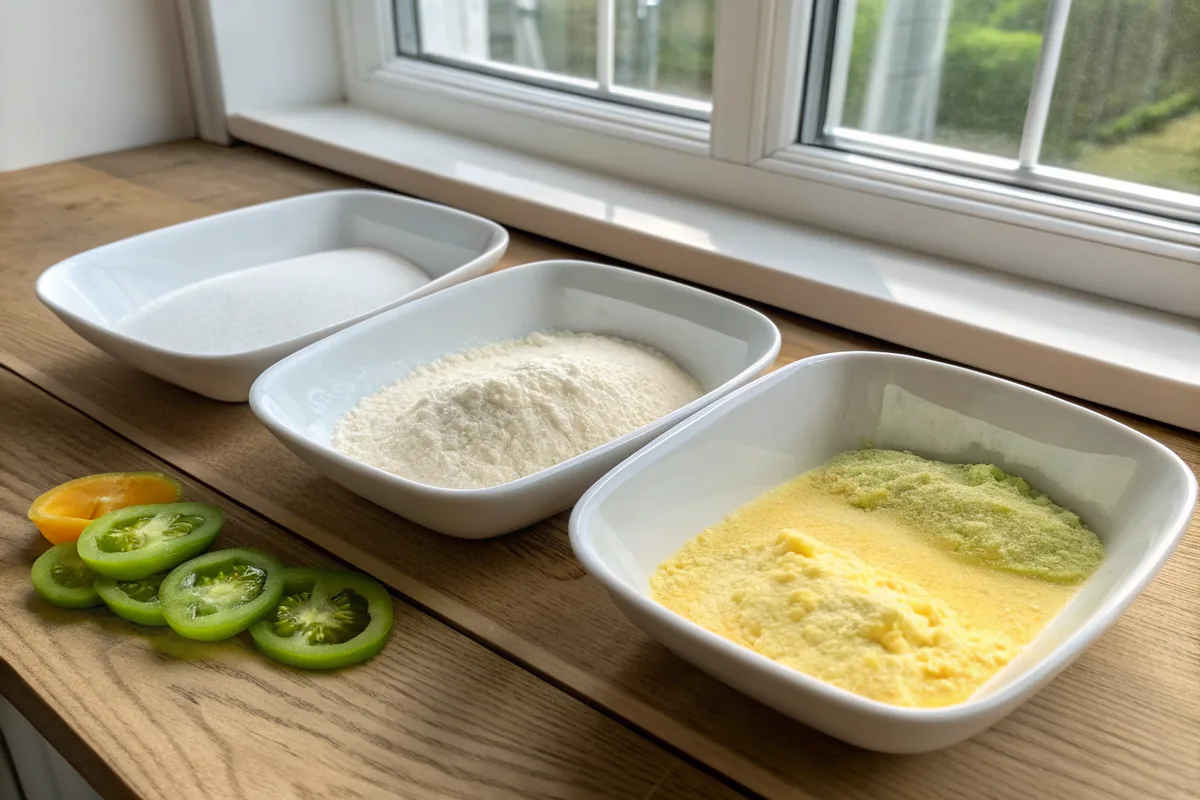
There are three coatings floating around Southern kitchens. The plain cornmeal dredge, one pass, is the oldest and the most fragile. The flour-only version fries up pale and soft, more like a batter. The double dredge, flour first, then the wet dip, then a cornmeal and flour mix, is the one that produces a crust thick enough to crackle and stable enough to survive the pan, and it is the only method I use on a tomato.
The first flour layer is the anchor. A bare tomato slice, even a dry one, is too smooth for buttermilk to stay on; it beads and runs. A dusting of flour absorbs a little surface moisture and turns tacky, and the buttermilk sticks to that. It should be a thin, even coat, shaken off hard. Any clumps of flour under the wet dip become pockets of raw paste inside the finished crust.
The wet dip is buttermilk beaten with an egg. The egg is the glue, its proteins setting in the hot oil and welding the cornmeal to the flour beneath. Buttermilk alone works but the coating is looser; egg alone is heavy and browns too fast. Together they give you a crust that clings and colors evenly. A teaspoon of hot sauce in the dip seasons the middle layer without tasting hot.
The outer coat is cornmeal cut with flour, two to one. Pure cornmeal fries into something coarse and sandy that falls off in chunks; the flour fills the gaps between the granules and binds the whole layer into a continuous shell. Fine or medium grind both work. Stone-ground medium grind gives a craggier, more rustic surface; fine grind is smoother and a touch more delicate. Coarse grind, the kind for polenta, stays gritty and never fully crisps in the short fry time, so leave it for the cornbread, where it belongs.
Season the cornmeal layer like it is the only seasoning, because from the eater's side it nearly is. Salt, black pepper, garlic powder, smoked paprika for color and a little cayenne for warmth. Press the coating on with your fingertips rather than just turning the slice in it; the pressure sets the cornmeal into the wet layer so the crust comes out of the pan in one piece.
Cast Iron, a Quarter Inch of Oil, and 350F
This is a shallow fry, not a deep fry, and a 12-inch cast iron skillet is the right pan for it. Cast iron holds heat, which matters more here than anywhere else in Southern frying, because each cold, wet tomato slice pulls the oil temperature down hard the moment it lands. A thin pan drops to 300F and stays there, and the slices soak up oil instead of searing. Cast iron drops less and recovers faster. If yours needs replacing, the skillets on my Texas cast iron guide are the ones I fry in.
A quarter inch of oil is enough to come halfway up a half-inch slice, which is what you want: the bottom half fries in oil while the top half sets from the heat rising through the pan. Flip once and the second side gets the same treatment. More oil than that and the slices float and tip; less and the crust scorches where it touches the metal while the sides stay pale.
350F is the target and it is worth measuring. At 350F the crust sets in the first thirty seconds, before the tomato inside starts to weep, and browns fully in three minutes, which is about as long as a half-inch slice can spend in hot oil before it goes soft. At 325F the fry takes five minutes and the tomato steams inside its own coating. At 375F the cornmeal darkens before the tomato has warmed through. Use a clip thermometer if you have one; if not, a pinch of the cornmeal mix should sizzle on contact and brown in about half a minute.
Peanut oil is my first choice for its high smoke point and clean flavor, then vegetable or canola. Replacing a couple of tablespoons of the oil with bacon drippings adds the flavor most old Southern recipes assume without saying so. Do not use butter; its milk solids burn well below 350F. Olive oil is a waste of good olive oil and smokes at the wrong temperature.
Four or five slices at a time, with clear space between them. Crowding does two bad things at once: it tanks the oil temperature, and it traps steam between the slices so the crusts on the touching sides stay soft. Between batches, skim out any loose cornmeal with a slotted spoon so it does not burn and speckle the next slices, and give the oil a minute to climb back to temperature.
The Rack, the Salt, and the 15-Minute Clock
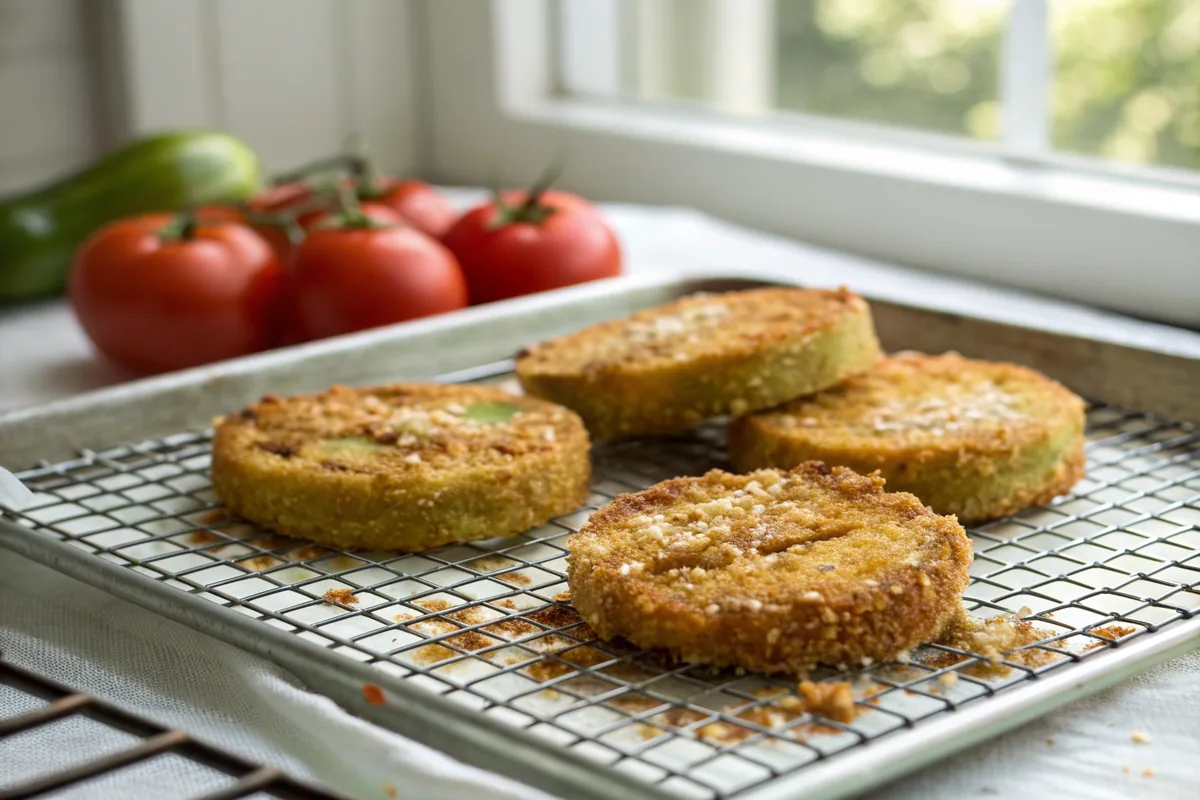
A fried green tomato is at its peak for about fifteen minutes, and everything after the fry is about protecting those minutes. Move the slices from the oil straight to a wire rack set over a sheet pan, never onto paper towels. Paper traps the steam coming off the underside and softens the crust from below in under a minute. On a rack, air moves under the slice and the crust stays crisp on both faces.
Salt them the moment they leave the pan, while the surface is still glossy with oil. Salt sticks to hot oil and slides off a cooled crust. A fine sprinkle is all it takes, since the tomato was salted before dredging and the coating is seasoned. A squeeze of lemon over the platter right before it goes to the table is the one addition I never skip; the acid lifts the richness of the fry and sharpens the tomato underneath.
If you need to hold a batch while you fry the rest, keep the rack and sheet pan in a 200F oven with the door cracked. Twenty minutes is the limit before they start to dry out. For a crowd, fry in two skillets at once rather than trying to hold a large batch; the dish does not wait well and the second skillet is cheaper than the disappointment.
How Texas Eats Them
The dish is Deep South by birth, spread across the region by home cooks, church cookbooks, and roadside cafes long before the 1987 novel and the 1991 film put its name on a marquee. In Texas it arrived with the same wave of Southern migration that brought fried okra, black-eyed peas, and buttermilk biscuits west, and it settled into the same places: the meat-and-three plate, the Sunday table, and, later, the appetizer list at every barbecue joint that added a fryer.
The classic plate is a stack of slices with a sauce. Comeback sauce, the Mississippi mayonnaise and ketchup blend with pickle brine and hot sauce, is what I make. Remoulade works, ranch is what half of Texas reaches for without apology, and a spoonful of pimento cheese melting over a hot slice is a Carolina move that deserves to travel. A little bowl of restaurant-style salsa is the Tex-Mex option, and it is better than it sounds, since the tomato in the salsa and the tomato in the crust are cousins.
The sandwich is the other classic: two fried green tomato slices in place of the raw tomato in a BLT, on toasted white bread with thick bacon and mayonnaise. It is the best BLT you will eat and the only one worth building in October. A single slice on a split buttermilk biscuit with a smear of comeback sauce is the breakfast version.
As a side, fried green tomatoes sit on the Southern supper plate next to fried chicken or smothered pork chops, a pot of black-eyed peas, and a wedge of cornbread. On a barbecue tray they play the same crunchy, acidic role that fried okra does, cutting the fat of brisket and sausage, and they belong in the same rotation with a creamy coleslaw. The rest of that table is mapped on the Southern comfort food hub.
Eggs are the third life. A fried green tomato under a poached or fried egg, with a spoon of the comeback sauce or a hollandaise if you are showing off, is a brunch dish in every serious Southern restaurant now, and the leftover slices from supper are exactly what you want for it the next morning, reheated on a rack in a hot oven.
Variations That Work
Panko crust. Swap the cornmeal mix for panko breadcrumbs seasoned the same way and press them on firmly. It fries lighter and shatters more than a cornmeal crust, closer to a Japanese katsu than a Southern plate. Good, and not the same dish.
Beer batter. Whisk a cup of flour with a cup of cold lager and a teaspoon of salt, dip the floured slices, and deep-fry in two inches of oil at 365F. This is the fish-fry version, puffy and soft, and it needs the full oil depth so the batter can float and set. Fine for a crowd at a lake house; not what I want on a supper plate.
Cajun. Double the cayenne, add a teaspoon of dried thyme and oregano to the cornmeal, and serve with a remoulade heavy on Creole mustard. A dish of these with a pile of boiled shrimp is a Gulf Coast picnic.
Green tomato and pimento cheese stack. Fry the slices, then layer three of them with pimento cheese between each while they are hot enough to soften it. Cut in half like a sandwich. This is a Carolina steakhouse appetizer and it is ridiculous, which is the point.
Air fryer. Dredge as written, spray both sides generously with oil, and cook at 400F for 8 minutes, flipping halfway. The crust dries rather than fries and comes out lighter and less golden, more like a baked crumb. Better than no fried green tomatoes; nowhere near the skillet.
Storage, Reheating, and What Not to Freeze
Leftover fried green tomatoes keep two days in the refrigerator, on a plate lined with a paper towel and covered loosely. They will be soft when cold. Reheat them on a wire rack over a sheet pan in a 400F oven for 8 to 10 minutes, or in an air fryer at 375F for 4 minutes, and the crust comes back most of the way. Never the microwave, which turns the coating to paste.
Uncooked green tomatoes keep for weeks. Whole, unrefrigerated, in a cool dark spot, they will hold green for two to three weeks and slowly ripen after that. To keep them green longer, refrigerate them; cold stops the ripening. Slice them only on the day you fry.
You can salt, dry, and dredge the slices up to an hour ahead and hold them on a rack in the refrigerator, which is useful for a party. The coating actually sets a little better with the rest. Do not freeze anything here, cooked or coated. The tomato's water crystallizes, the cell walls collapse on thawing, and you get a slice that has already turned to sauce before it reaches the pan.
Mistakes That Ruin Fried Green Tomatoes
Tomatoes that were too ripe. A blush of pink or a give under the thumb means sugar and softness have arrived, and the slice will weep and sag in the pan. Hard, pale, and scentless is the rule.
Skipping the salt and the pat-dry. Wet tomato, no anchor for the flour, crust slides off in the oil. Ten minutes of salt and a firm blot solve the problem the dredge cannot.
Slicing thin to cook them faster. A quarter-inch slice turns to mush under the coating before the outside browns. Half an inch is the number.
One dredge instead of three. A single pass through cornmeal gives a thin coat that falls off in patches. Flour, then buttermilk and egg, then cornmeal, pressed on.
Oil too cool. Below 325F the crust soaks instead of sears, the tomato steams inside it, and the slices come out greasy and limp. Measure, and let the oil recover between batches.
Crowding the skillet. Slices touching each other trap steam on their sides and drag the temperature down. Four or five at a time, with air between them.
Draining on paper towels. Steam from underneath softens the crust in a minute. A wire rack over a sheet pan, every time.
Salting after the slices have cooled. Salt bounces off a cool crust. The moment they leave the oil, while the surface still glistens.
Fried Green Tomatoes Recipe
Ingredients
- 4 large, firm green tomatoes (about 2 pounds / 900 g), pale green with no blush
- 1 1/2 teaspoons kosher salt, for the slices, plus more for finishing
- For the first dredge:
- 1/2 cup (2 1/4 oz / 65 g) all-purpose flour
- 1/2 teaspoon kosher salt
- For the wet dip:
- 3/4 cup (6 oz / 180 ml) buttermilk
- 1 large egg
- 1 teaspoon hot sauce
- For the cornmeal coat:
- 1 cup (5 oz / 140 g) fine or medium yellow cornmeal
- 1/2 cup (2 1/4 oz / 65 g) all-purpose flour
- 1 teaspoon kosher salt
- 1 teaspoon freshly ground black pepper
- 1/2 teaspoon garlic powder
- 1/2 teaspoon smoked paprika
- 1/4 teaspoon cayenne
- For frying:
- About 1 cup (8 oz / 240 ml) peanut oil, vegetable oil, or a mix of oil and bacon drippings
- For the comeback sauce:
- 1/2 cup (4 oz / 115 g) mayonnaise
- 2 tablespoons ketchup
- 1 tablespoon dill pickle brine
- 1 teaspoon hot sauce
- 1/2 teaspoon smoked paprika
- 1/4 teaspoon garlic powder
- Freshly ground black pepper
Instructions
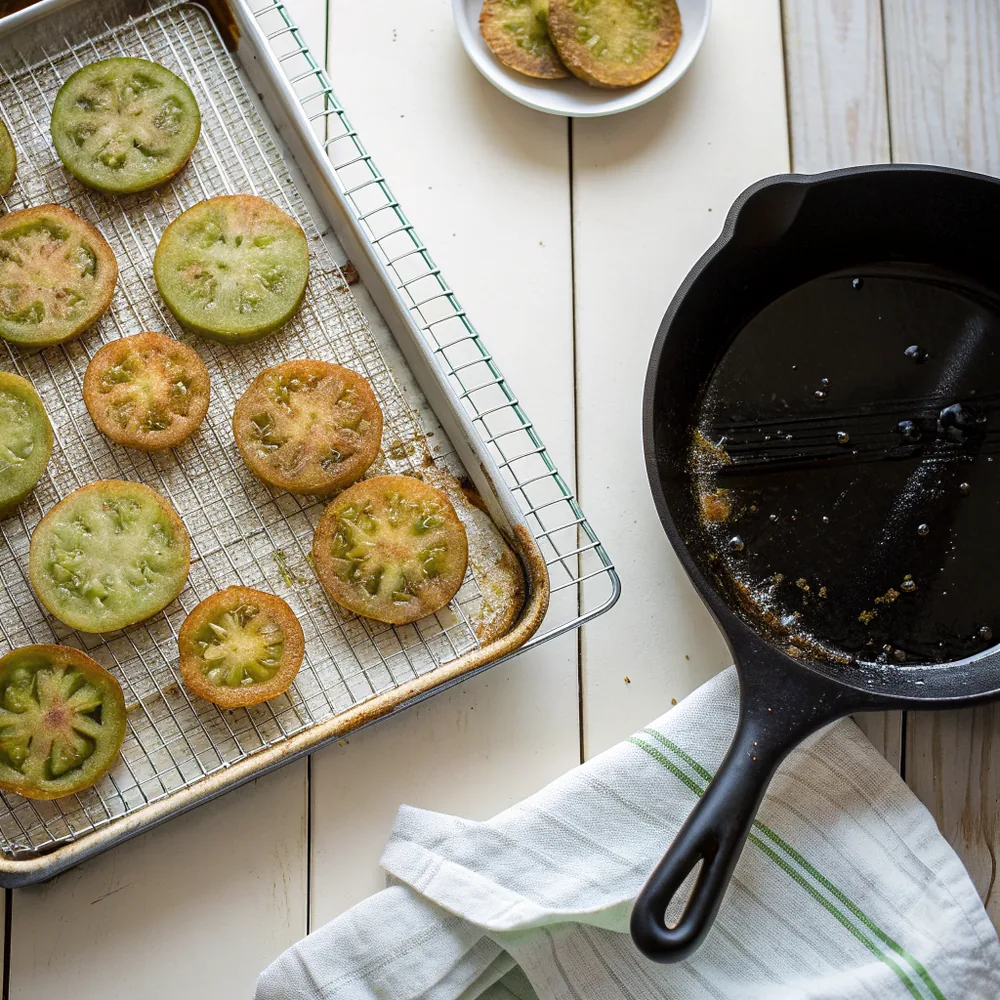
- Slice and salt the tomatoes. Cut the tomatoes crosswise into 1/2-inch slices, discarding the thin top and bottom ends. Lay the slices in a single layer on a wire rack set over a sheet pan and sprinkle both sides with the 1 1/2 teaspoons of salt. Let them sit 10 minutes. Beads of water will rise to the surface.
- Pat them dry. Press each slice gently between paper towels until the surface is dry to the touch. Do not rinse. This step is the difference between a crust that stays on and a crust that slides off.
- Set up three stations. Put the flour and salt for the first dredge in a shallow dish. Whisk the buttermilk, egg, and hot sauce in a second. Stir the cornmeal, flour, salt, pepper, garlic powder, paprika, and cayenne together in a third. Line them up in that order next to the stove with a clean rack at the end.
- Start the oil. Set a 12-inch cast iron skillet over medium-high heat and add oil to a depth of 1/4 inch. Bring it to 350F on a thermometer, or until a pinch of the cornmeal mix sizzles on contact and browns in about 30 seconds. Adjust the heat to hold it there.
- Dredge in flour first. Working with one slice at a time, press it into the seasoned flour on both sides and shake off the excess. It should look dusty, not caked. This thin layer is what the buttermilk clings to.
- Dip, then coat in cornmeal. Dip the floured slice in the buttermilk mixture, let the excess run off for a second or two, then lay it in the cornmeal mix. Press the coating on firmly with your fingertips, flip, and press the other side. Set it on a plate and repeat. Coat only as many as will fit in the skillet at once.
- Fry in a single layer. Lay the slices in the hot oil without crowding, 4 or 5 at a time, and leave them alone for 3 minutes. Lift a corner to check: it should be deep golden with darker specks. Flip once with a thin spatula and fry the second side 2 to 3 minutes.
- Drain on a rack and salt. Move the finished slices to the clean wire rack and salt them immediately while the surface is still glistening. Skim any loose cornmeal from the oil, let the temperature come back to 350F, and fry the next batch.
- Stir the comeback sauce and serve. Whisk the mayonnaise, ketchup, pickle brine, hot sauce, paprika, garlic powder, and a few grinds of pepper in a small bowl. Serve the tomatoes hot, within 15 minutes of frying, with the sauce alongside.
Frequently Asked Questions
What kind of tomatoes are used for fried green tomatoes?
Ordinary unripe tomatoes, picked while fully grown but before any ripening has started. They should be hard, pale green with no pink blush, and nearly scentless when cut. Any standard red variety works while it is green; beefsteak and other large slicing types give the best wide slices. Heirlooms that stay green when ripe, like Green Zebra, are soft and sweet and do not work. Look for green tomatoes at farm stands in early summer and in the fall before the first frost, or near the tomatillos in a Southern grocery store.
Why does the breading fall off my fried green tomatoes?
Water. A green tomato is over 90 percent water, and a coating cannot stick to a wet surface; the moisture turns to steam in the oil and pushes the crust off from underneath. Salt the slices for ten minutes before dredging to draw out surface water, pat them completely dry, then dredge in flour before the wet dip so the buttermilk has something to grip. Press the cornmeal on firmly, fry at 350F so the crust sets in the first thirty seconds, and flip only once with a thin spatula.
Do you have to salt green tomatoes before frying?
Yes, if you want the crust to stay on. Ten minutes of salt pulls water out of the slices so the flour can grip a dry surface, and it seasons the tomato itself, which the coating cannot do. Pat the slices dry afterward without rinsing. Do not go past twenty minutes, because the slices begin to soften and lose the firmness that makes them fry well. This is the opposite of fried okra, which weeps and turns slimy if salted early, so the two dishes start with different first moves.
What is the best oil for frying green tomatoes?
Peanut oil, for its high smoke point and neutral flavor, with vegetable or canola oil as a close second. A couple of tablespoons of bacon drippings mixed into the oil adds the flavor that most traditional Southern recipes assume. Use a quarter inch of oil in a cast iron skillet and hold it at 350F. Avoid butter, which burns at this temperature, and olive oil, which smokes and adds a flavor that fights the tomato.
Can you make fried green tomatoes in an air fryer?
You can, and they are decent, but they are not the same dish. Dredge the slices as written, spray both sides generously with cooking oil, and air-fry at 400F for about 8 minutes, flipping halfway. The crust dries rather than fries, so it comes out paler and lighter, more like a baked crumb than a crackling shell. If a skillet is available, use it; the air fryer is best for reheating leftovers, where it does bring the crust back well.
What do you serve with fried green tomatoes?
A dipping sauce first: comeback sauce, remoulade, ranch, or a spoon of pimento cheese melting on top. As a side, they go next to fried chicken, smothered pork chops, black-eyed peas, and cornbread on a Southern supper plate, or on a barbecue tray in the crunchy, acidic role that fried okra usually plays. Two slices in place of the raw tomato make the best BLT of the year, and a slice under a fried egg with a little sauce is a proper Southern brunch.
Can fried green tomatoes be made ahead?
Only partly. You can slice, salt, dry, and fully dredge the tomatoes up to an hour ahead and keep them on a rack in the refrigerator; the coating sets a little better with the rest. Fry them just before serving, since they peak within fifteen minutes of leaving the oil. Cooked leftovers keep two days refrigerated and reheat well on a rack in a 400F oven for 8 to 10 minutes, or in an air fryer at 375F for 4 minutes. Do not freeze them at any stage.
Are fried green tomatoes the same as fried okra?
They share a kitchen and a method, buttermilk and cornmeal shallow-fried in cast iron, but they are built differently. Okra is a small pod, dredged once, never salted early, and fried in a crowd. A green tomato is a wide, heavy, wet slice that needs salting and drying first, a three-layer dredge of flour, buttermilk and egg, and cornmeal, and a bigger, hotter skillet with room between the slices. The tomato is tart and juicy inside its crust; okra is vegetal and dry. Same table, two different dishes.