Southern Comfort Food
Southern Black-Eyed Peas
Chef Mia's Southern black-eyed peas: smoked ham hock, no overnight soak, 90-minute simmer to silky peas and real potlikker. New Year menu included.
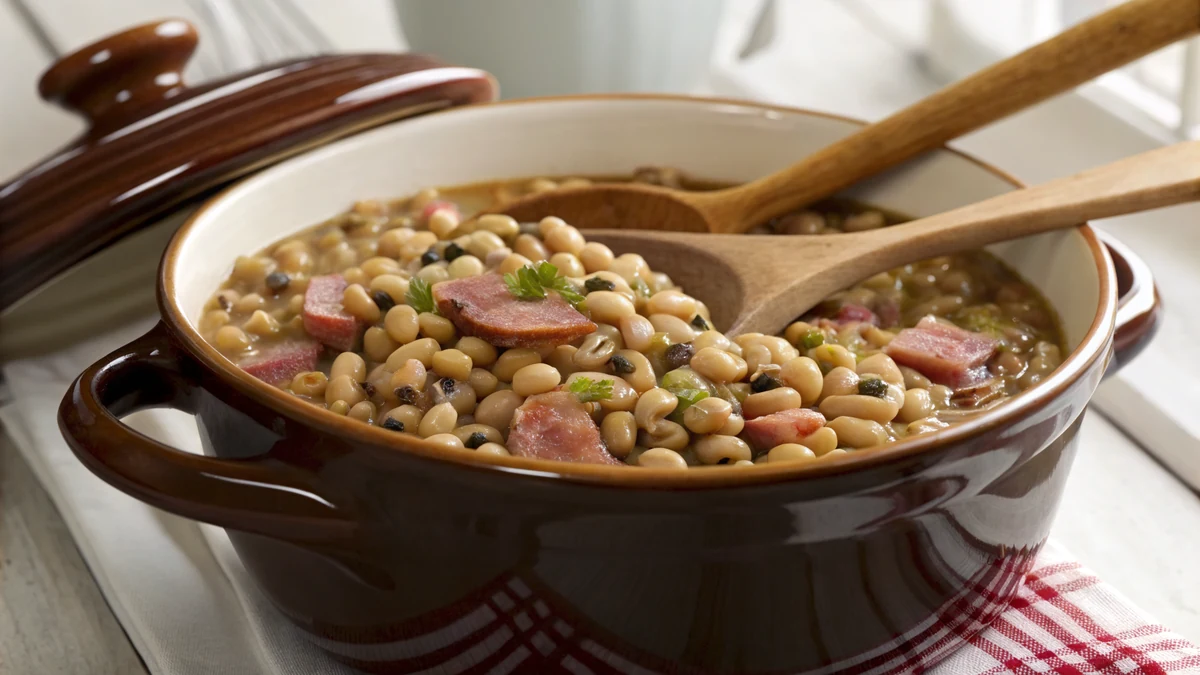
Quick answer: Southern black-eyed peas are simmered with smoked pork until the peas turn silky and the broth becomes potlikker, and the honest secret is that they need no overnight soak: black-eyed peas are thin-skinned and cook from dry to creamy in about 90 minutes. Start the smoked ham hock in water first, 30 minutes alone so it opens up, then add rinsed dry peas, aromatics, and simmer gently, lid cracked, never at a rolling boil, until the peas are tender and a few have burst to thicken the pot. Salt at the halfway mark, finish with black pepper and a teaspoon of cider vinegar to wake the whole pot up. Serves 8 with cornbread, and it is the mandatory good-luck dish of the Texas New Year table.
Black-eyed peas are the one dish my family never argued about. Brisket rubs, chili beans, whether a tamale needs sauce, all contested territory. But January 1st meant a pot of black-eyed peas simmered with a smoked hock, cornbread on the side, greens if my grandmother had her way, and every adult at the table telling the same joke about needing all the luck they could get. In San Marcos that pot went on before the parade and came off after, and the house smelled like smoke and onions all day.
Somewhere along the way, black-eyed peas got filed under once-a-year obligation food, eaten on New Year's Day out of superstition and forgotten by February. That filing is a mistake. Cooked properly, and properly is not difficult, they are one of the best pots in the Southern bean canon: creamier than pintos, quicker than any true bean, with an earthy, faintly mineral flavor that takes smoke better than almost anything else you can simmer.
The two things this recipe insists on run against most printed versions. First, no soak: black-eyed peas are not actually beans but cowpeas, thin-skinned and quick-cooking, and soaking buys you maybe fifteen minutes while costing texture and flavor. Second, the hock goes in first, alone, for a thirty-minute head start, because a smoked hock needs more time than the peas do, and the usual everything-at-once method leaves the pork tight and the broth thin exactly when the peas hit perfect. Get those two sequenced right and the rest is a gentle simmer and patience.
No Soak Required: Cowpea Chemistry
The overnight-soak instruction gets copied from bean recipe to bean recipe like a family curse, and for black-eyed peas it is simply wrong, so here is the case for skipping it with confidence.
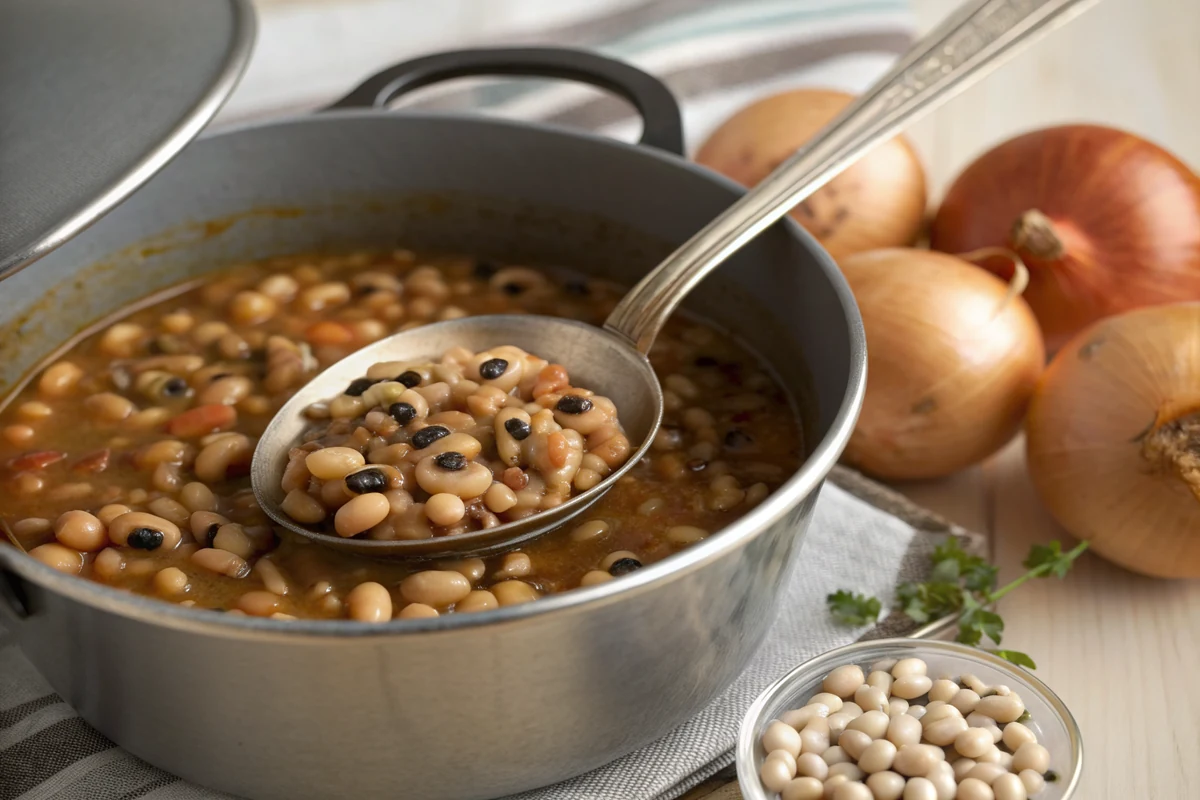
Black-eyed peas are not true beans. They are cowpeas, a different genus that came to the American South from West Africa in the 1700s, and the practical difference is the seed coat: cowpea skins are dramatically thinner and more water-permeable than the armor on a pinto or a kidney bean. Water penetrates dry black-eyed peas readily during cooking, which is why they go from bag to tender in 60 to 90 minutes while a pinto wants two and a half hours.
What does soaking buy you with a pea like that? Fifteen, maybe twenty minutes of stove time. What does it cost? The thin skins hydrate faster than the interiors and start sloughing off during the soak itself, so soaked peas shed and split in the pot, and a share of the earthy, minerally flavor that makes the dish leaches into soak water most people pour down the drain. The trade is all cost, no benefit.
The one soak-adjacent step that does matter is picking them over. Black-eyed peas are field peas, harvested and processed close to the dirt, and a pound bag reliably contains a pebble or two, some split shriveled peas, the occasional tiny clod. Two minutes on a sheet pan saves a cracked tooth, and the rinse afterward clears field dust that would otherwise cloud the likker.
If your peas are genuinely old, years in a pantry, no soak fixes that; ancient legumes cook forever and unevenly no matter the prep. Buy from a store that turns its stock, check the bag date where printed, and a pound of this year's crop will make the schedule on this page look conservative.
The Ham Hock Does Three Jobs, on Its Own Clock
The smoked ham hock is the flavor engine of the pot, and the mistake in most recipes is scheduling it like an aromatic when it is actually a second protein with its own timeline.
Job one is smoke. A hock spends hours in a smokehouse before it reaches you, and that smoke is water-soluble; a simmering hock releases it steadily into the broth until every pea tastes faintly of the smokehouse without a smoker in sight. Job two is body: the skin and joints are packed with collagen that melts into gelatin, giving the potlikker its glossy, lip-sticking richness. Job three is the meat itself, the shredded reward stirred back through at the end.
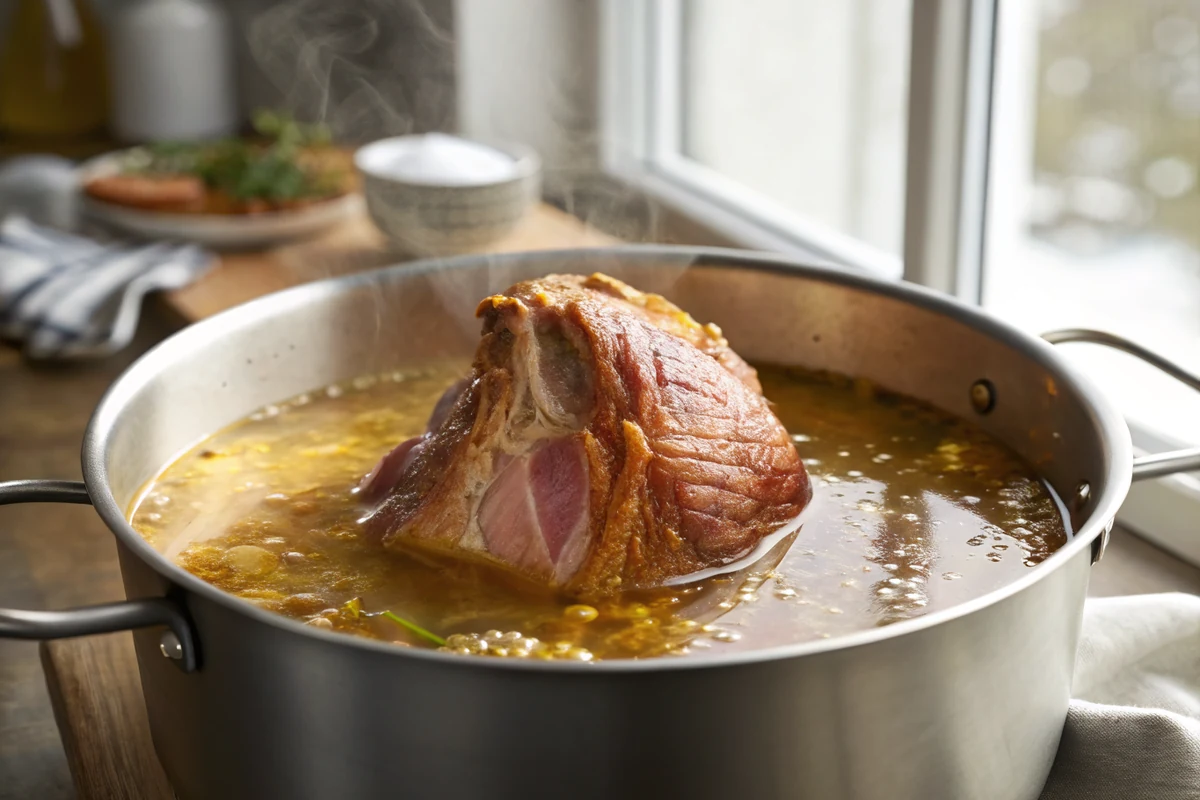
All three jobs run slower than a pea cooks, which is the entire argument for the 30-minute head start. Drop hock and peas together and the peas finish while the hock is still tight: broth thin, gelatin unextracted, meat rubbery and clinging to the bone. With the head start, the timelines converge, and the hock that comes out at the 2-hour mark shreds with a fork and has given the pot everything.
Substitutions, ranked honestly: smoked turkey wings or necks are the equal of the hock in every way, arguably better for meat yield, and the standard swap for tables avoiding pork. Thick-cut bacon, chopped and rendered first, gives good smoke but no gelatin, so the likker runs thinner. Salt pork gives richness but no smoke. Leftover smoked brisket trimmings, if your freezer runs the way mine does after a brisket weekend, are a gloriously Texan answer. And for a meatless pot, a spoonful of smoked paprika plus a parmesan-style rind gets you surprisingly far, though nobody will mistake the result for the original.
The Simmer and the Potlikker
Between the head start and the bowl there is one long, gentle, boring stretch, and protecting its boringness is the technique.
The target is a bare simmer, small lazy bubbles breaking the surface every second or two, lid cracked to let steam moderate the temperature. A rolling boil ruins the pot from three directions: it strips the thin skins off the peas, it churns the bottom layer into mash while the top stays firm, and it emulsifies the fat into a greasy cloudiness instead of leaving the likker glossy and clear. If the pot ever gallops while your back is turned, drop the heat and forgive it; ten gentle minutes settles things.
Potlikker deserves its own paragraph, because it is not a byproduct, it is half the dish. The broth left when the peas are done, smoky from the hock, thickened with gelatin and burst-pea starch, seasoned by everything that passed through, is arguably the most prized liquid in Southern cooking; there are century-old arguments about whether it belongs to the peas or the cornbread. The deliberate move at the end of this recipe, crushing a ladle of peas against the pot wall, is potlikker engineering: the released starch takes the likker from brothy to almost-gravy, the texture that clings to cornbread instead of soaking uselessly past it.
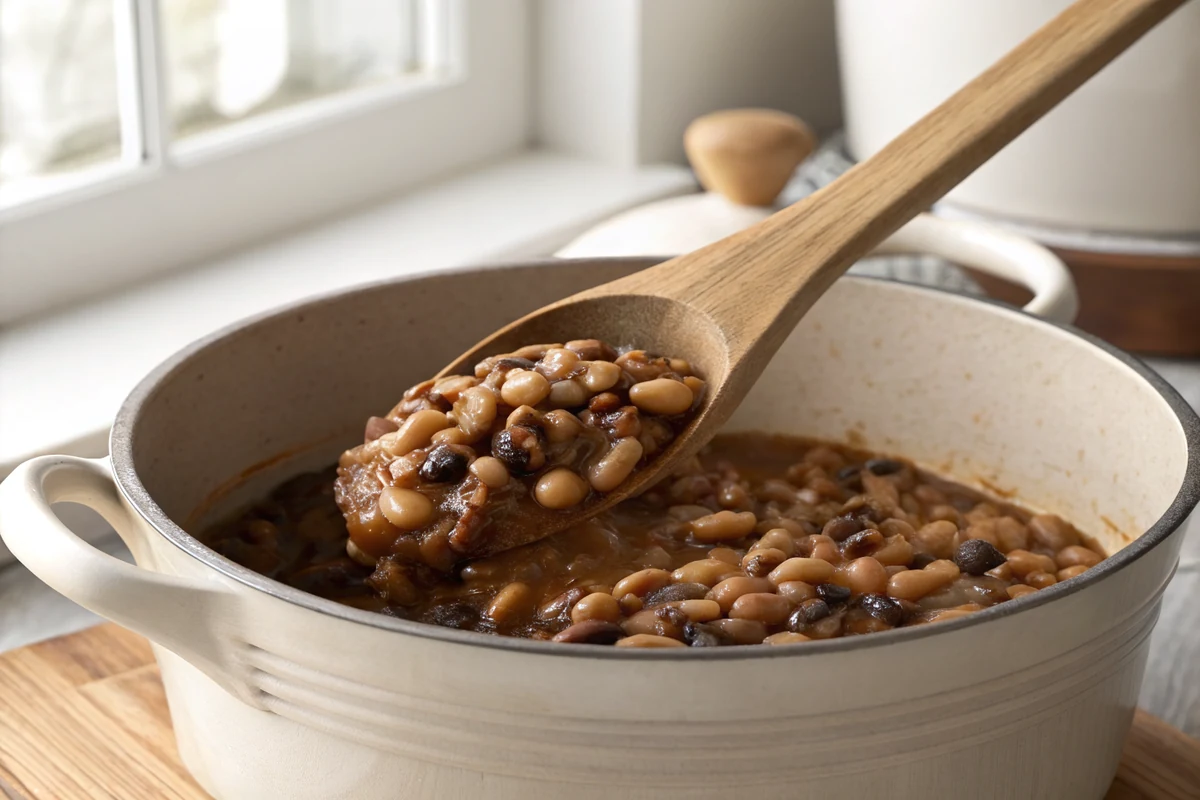
Water management is simple: peas covered by an inch at all times, topped up with hot water, never cold, which shocks the simmer and toughens the peas mid-cook. Expect to add a cup or two across the cook as the likker concentrates. The finished pot should be peas sitting in likker, not peas floating in soup and not peas mounded dry; you are aiming for stew logic, spoonable with substance.
The vinegar finish, one teaspoon of cider vinegar stirred in off the heat, is the step people skip and then wonder why the pot tastes muted. Long-simmered smoky dishes drift flat as the hours pass; a whisper of acid at the end resets everything, the same physics as a squeeze of lime on rich food. You should not taste vinegar. You should just notice the smoke got louder.
New Year's Day: The Folklore and the Menu
Black-eyed peas on January 1st is the most durable food superstition in the American South, and in Texas it is close to civic infrastructure; H-E-B builds end-cap displays of dried peas in the last week of December, and my grandmother would no more skip the pot than skip church.
The custom's usual origin story dates to the Civil War, peas as the humble field crop left behind when finer stores were taken or burned, eaten in lean Januaries and credited with survival. Folklorists trace threads back further, through West African foodways that brought the cowpea across the Atlantic, and to older new-year luck traditions. As with most food folklore, the documentation is thinner than the conviction; what is certain is that by the early twentieth century the peas-for-luck rule was general across the South, and it has not loosened since.
The ledger, as it was taught to me: peas for coins, greens for folding money, cornbread for gold, pork for progress, because a pig roots forward and a chicken scratches backward. Some tables drop a clean dime into the pot, luck to whoever finds it; if children are eating, announce the dime, for reasons an emergency room can explain. Eat at least 365 peas for a year of covered days. Nobody counts. Everybody claims to.
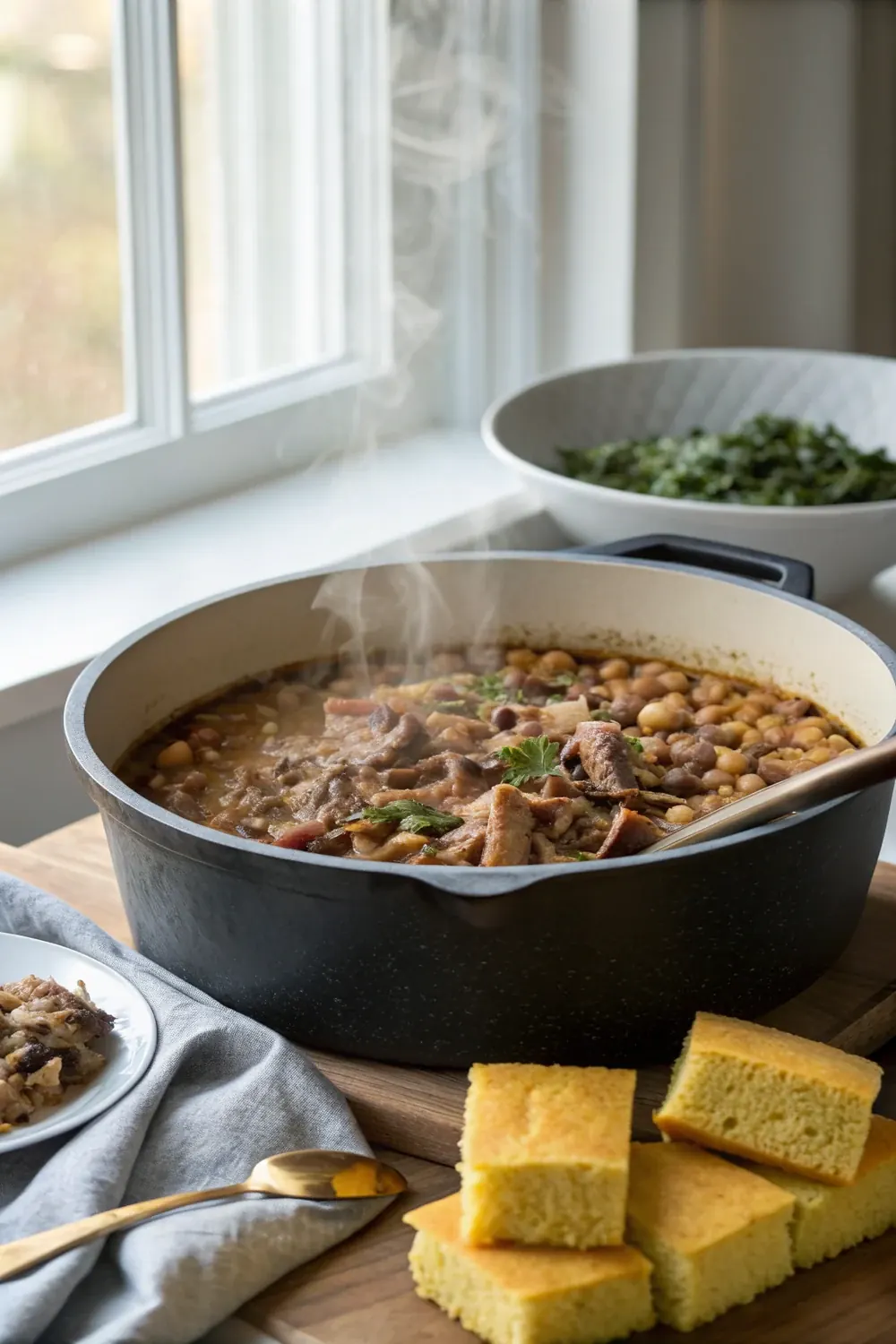
As a menu, the tradition assembled itself into something genuinely good long before anyone worried about nutrition: this pot of peas, a skillet of cast iron cornbread for the gold and the mopping, a pot of simmered collard greens for the folding money, and if the holiday table runs Texan, a platter of pulled pork or sliced smoked sausage standing in for the progress pig. It is the rare superstition that eats like a feast.
The pot also earns its place the other 364 days. Peas and cornbread is a complete Tuesday supper in the same way pinto beans and cornbread is, and the two pots trade weeks in my kitchen all winter.
Hot Pot, Cold Salad: Peas Versus Texas Caviar
Texas has two canonical black-eyed pea dishes, and they sit at opposite poles of the pantry, so it is worth being clear about which one a given occasion wants.
This page is the hot pole: dried peas, long simmer, smoke, collapse, potlikker, a pot that wants a cold week and a wedge of cornbread. My Texas caviar is the cold pole: cooked-and-cooled peas tossed raw-crisp with peppers, onion, and a tangy dressing, then marinated into a scoopable salad that improves for two days in the fridge and travels to cookouts in a single container. Same pea, opposite thermodynamics, and neither substitutes for the other; the caviar has no smoke and needs none, the hot pot has no crunch and wants none.
The two even divide the calendar between them: the hot pot owns New Year's Day and the cold months, the caviar owns the potluck-and-cookout season when nobody wants a simmering stockpot in the kitchen. A Texan with both recipes has black-eyed peas covered from January 1st to December 31st, which, given the folklore, is presumably the point.
One practical crossover: if you cook a pound of peas plain, no hock, half for tonight's hot pot and half cooled for tomorrow's caviar, the math works, but salt the caviar half separately and more aggressively; cold dishes eat seasoning.
Where They Sit in the Texas Bean Lineup
The black-eyed pea pot joins a crowded and distinguished field of Texas bean cookery, and each pot has a lane, so here is the map for deciding which one tonight actually is.
Pinto beans are the default Texas pot: earthier, longer-cooking, the barbecue-plate standard. Charro beans are pintos gone festive, brothy and loaded with bacon, chorizo, tomato, and chile, the Tex-Mex party pot. Ranch-style beans are the chili-gravy cousin, pintos in a red guajillo sauce, built to sit next to brisket. Southern white beans are the mild, creamy, ham-simmered comfort pot of the group. The black-eyed pea pot is the quick one and the smoky-earthy one: fastest from bag to bowl by an hour or more, thinner-skinned and silkier than any of the true beans, and the only one carrying a folklore mandate.
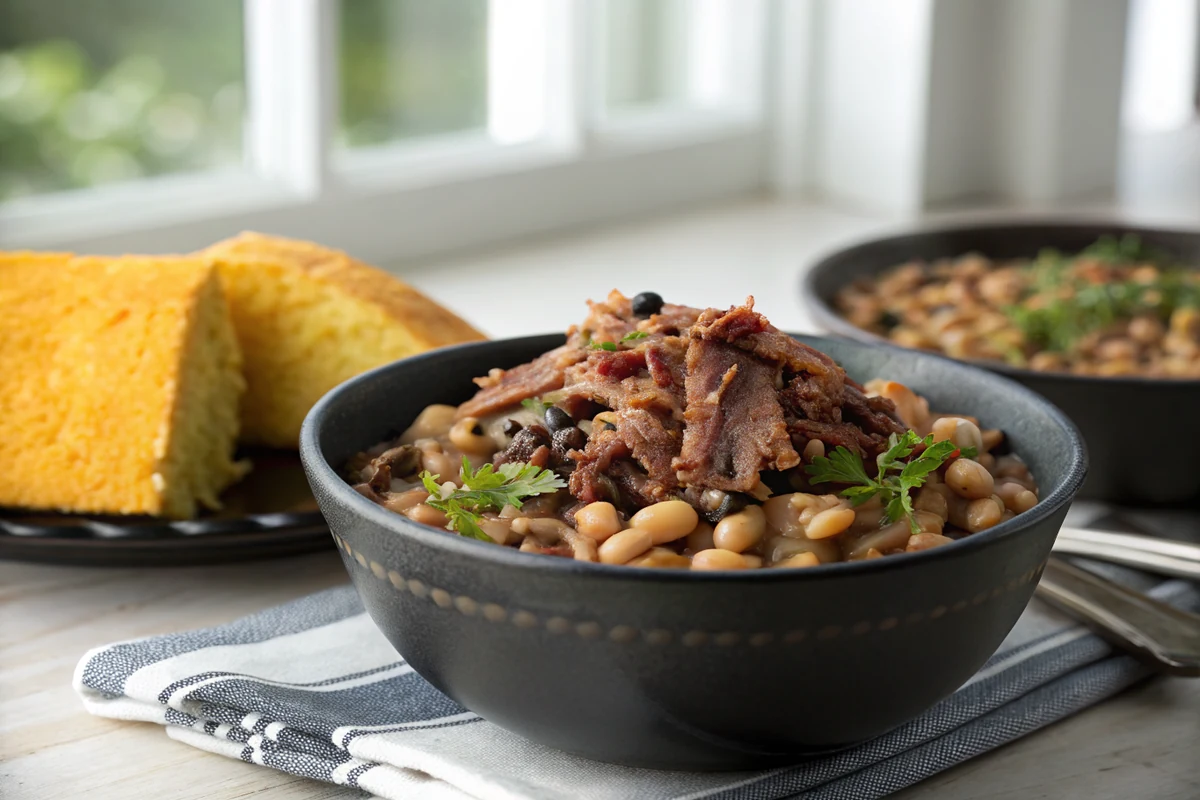
Menu logic follows the lanes. Next to smoked meat, pintos or ranch-style usually win the plate. Under a Tex-Mex spread, charros. But for a standalone supper where the pot is the meal, black-eyed peas and cornbread compete only with 15 bean soup for the title, and they win on speed every time. For the bigger Southern-table picture, the whole Southern comfort food collection is built around exactly this kind of pot.
If you keep only two dried legumes in the pantry, make them pintos and black-eyed peas. Between those two bags, a hock in the freezer, and a cornbread skillet, you are never more than two hours from a real supper.
Day Two, Freezing, and the Leftover Ladder
Like every smoky simmered pot, black-eyed peas are better on day two, and they cascade through leftovers so well that I deliberately cook a full pound for a household that will not finish it fresh.
The overnight improvement is real mechanics, not folklore: the peas keep drinking seasoned likker as they cool, the gelatin sets and redistributes, and the smoke rounds into corners it had not reached by dinnertime. Reheat gently on the stove with a splash of water, and refresh the finish, a few grinds of pepper, two drops of vinegar, because both fade in the fridge. Refrigerated, the pot holds four days easily.
Freezing is excellent and the likker is the trick: freeze peas submerged in their liquid in pint or quart containers, likker covering the peas, and they return from the freezer three months later essentially undamaged. Peas frozen drained go mealy. Thaw overnight in the fridge and reheat gently; the likker may gel solid when cold, which is a compliment to your hock, not a problem.
The leftover ladder, in descending order of dignity: bowl two, straight reheat over fresh cornbread. Then peas folded into a skillet of rice with the likker as the cooking liquid, which lands you a stone's throw from Hoppin' John. Then a mash of drained peas fried in bacon fat as a crispy-bottomed cake, the Southern cousin of refried beans and a genuinely great breakfast under a fried egg. And last, the pot's final act: thin what remains with broth, add whatever greens and sausage exist, and call it soup. No pot of black-eyed peas has ever needed a fifth idea.
Mistakes That Ruin Black-Eyed Peas
Soaking overnight. Costs skins, texture, and flavor to save fifteen minutes. Cowpeas are not pintos; cook them from dry.
Everything in the pot at once. The peas finish while the hock is still tight and the broth is still water. Thirty-minute head start for the pork, always.
Boiling instead of simmering. A galloping pot strips skins, mashes the bottom layer, and clouds the likker with emulsified fat. Lazy bubbles only.
Salting at the start, or not until the end. Early salt plus a reducing smoky broth equals a salt bomb; end-only salt leaves every pea bland inside its skin. Halfway is the answer.
Cold water top-ups. Shocking a simmering pot of legumes with cold water sets their skins tough. Top up hot, from the kettle.
Skipping the pick-over. The pebble is real. Two minutes on a sheet pan is cheaper than a crown.
Draining off the potlikker. Pouring away the likker is pouring away the hock, the smoke, and half the dish. If the pot ran too thin, crush more peas against the wall instead.
Forgetting the vinegar. One teaspoon, off heat, at the end. The difference between a pot that tastes tired and one that tastes finished is exactly that spoon.
Southern Black-Eyed Peas Recipe
Ingredients
- For the pot:
- 1 lb (450 g) dried black-eyed peas, picked over and rinsed (no soaking)
- 1 smoked ham hock (about 12 oz), or 2 smoked turkey wings
- 8 cups (2 L) water, plus more as needed
- 1 large yellow onion, diced
- 1 celery stalk, diced
- 3 garlic cloves, minced
- 1 jalapeno, seeded and minced (optional, Texas-leaning)
- 1 bay leaf
- 1/2 teaspoon dried thyme
- 1 1/2 teaspoons kosher salt, added halfway, plus more to taste
- 1/2 teaspoon black pepper
- 1 teaspoon apple cider vinegar, at the finish
- For serving:
- Cornbread, sliced green onions, hot sauce at the table
Instructions
- Give the hock its head start. Put the ham hock and 8 cups of water in a heavy pot and bring to a gentle simmer, lid cracked, for 30 minutes before anything else goes in. A smoked hock is mostly skin, connective tissue, and dense muscle; it needs more total time than the peas do, and this head start is what turns the water into smoky broth instead of leaving the pork tight and stingy at the end.
- Pick over and rinse the peas. While the hock simmers, spread the dry peas on a sheet pan and pull out any pebbles, split shriveled peas, or field debris; a pound of peas usually hides one or two surprises. Rinse in a colander until the water runs clear. Do not soak them; black-eyed peas are thin-skinned cowpeas that cook from dry in about 90 minutes, and soaked peas blow out their skins before their insides finish.
- Sweat the aromatics. In a skillet, sweat the diced onion and celery in a spoonful of oil over medium heat for 5 minutes until translucent, then add the garlic and optional jalapeno for a final minute. You can throw everything in raw, plenty of grandmothers did, but the five-minute sweat rounds the onion into the broth and is the single cheapest upgrade to the finished pot.
- Add peas and aromatics to the pot. Add the rinsed peas, sweated vegetables, bay leaf, and thyme to the hock pot. The water should cover the peas by a generous inch; top up with hot water if needed. Bring back to a bare simmer, small lazy bubbles, not a boil, and set the lid cracked a finger's width.
- Simmer gently, 60 to 90 minutes. Hold that lazy simmer, stirring every 20 minutes or so, gently, from the bottom. A rolling boil is the enemy of whole peas; it bangs them together, strips their skins, and turns the top layer to mash while the bottom scorches. Start testing at 60 minutes: a done pea crushes between tongue and palate with no chalky center, creamy the whole way through.
- Salt at the halfway mark. At about 45 minutes, stir in the salt. Salting at the start with a smoked hock risks a salty pot as the broth reduces; salting at the end leaves the peas bland inside no matter how seasoned the likker gets. Halfway is the compromise that seasons the interior of every pea and lets you judge the hock's own salt contribution before committing.
- Pull and shred the hock. When the peas are tender, lift out the hock, and when it is cool enough to handle, pull the meat from the skin and bone, shred it, and stir it back through the pot. A properly timed hock gives up a surprising amount of meat and collapses willingly; discard the skin and bone, or crisp the skin in a skillet as a cook's treat.
- Finish the potlikker. Crush a ladleful of peas against the side of the pot and stir; those burst peas thicken the likker from broth to something closer to gravy. Add the black pepper and the teaspoon of cider vinegar, then taste. The vinegar is not a flavor, it is a switch: it sharpens the smoke and salt without announcing itself. Adjust salt now and let the pot rest 10 minutes off heat.
- Serve over or beside cornbread. Serve in bowls with plenty of potlikker, green onions scattered over, hot sauce within reach, and cornbread mandatory, either underneath the peas, crumbled in, or alongside for mopping. On New Year's Day, greens on the same table complete the folklore ledger: peas for coins, greens for folding money.
Frequently Asked Questions
Do black-eyed peas need to be soaked before cooking?
No. Black-eyed peas are cowpeas, not true beans, with thin permeable skins that let water in readily during cooking; they go from dry to tender in 60 to 90 minutes of gentle simmering. Soaking saves only about fifteen minutes and actively hurts the pot: the thin skins hydrate faster than the interiors and slough off, and flavor leaches into discarded soak water. Rinse, pick out any pebbles, and cook them straight from the bag.
What meat is best in southern black-eyed peas?
A smoked ham hock is the classic: it delivers smoke, collagen for a glossy potlikker, and shreddable meat, provided you give it a 30-minute simmering head start before the peas go in. Smoked turkey wings or necks match it job for job and are the standard non-pork swap. Rendered thick-cut bacon gives smoke but a thinner likker; salt pork gives richness without smoke. Leftover smoked brisket trimmings are a superb Texas answer.
What is potlikker?
Potlikker is the broth left in the pot after simmering peas or greens with smoked meat: smoky from the hock, silky with dissolved collagen, thickened by starch from burst peas, and seasoned by the whole cook. In Southern tradition it is treasured, not discarded, and it is the reason cornbread attends this meal, for mopping. To thicken it deliberately, crush a ladleful of cooked peas against the pot wall and stir; the released starch takes it from broth to near-gravy.
Why do you eat black-eyed peas on New Year's Day?
The Southern tradition holds that black-eyed peas eaten on January 1st bring luck for the year, peas standing for coins, usually alongside greens (folding money), cornbread (gold), and pork (progress, because a pig roots forward). The custom is usually traced to Civil War-era scarcity, with older threads running back through the West African foodways that brought the cowpea to the South. The documentation is thinner than the conviction, but the menu it produced is genuinely excellent, which may explain its endurance better than luck does.
How long do black-eyed peas take to cook?
From dry, 60 to 90 minutes at a gentle simmer, no soak needed, and about 2 hours total for this recipe including the ham hock's 30-minute head start. Start testing at the hour mark: a done pea crushes creamy between tongue and palate with no chalky center. Very old peas from the back of a pantry can take dramatically longer regardless of method, so buy from a store with turnover. Keep the simmer lazy; a rolling boil strips skins and mashes the pot.
When should you salt black-eyed peas?
Halfway through the simmer, about 45 minutes in for this recipe. Salting at the start risks an over-salted pot, because the smoked hock contributes salt continuously while the broth reduces; waiting until the end leaves the peas bland inside no matter how seasoned the likker becomes. The halfway salt seasons each pea internally and lets you judge the hock's contribution before committing. The old claim that early salt prevents softening is largely myth, but the reduction math is real.
What do you serve with black-eyed peas?
Cornbread is non-negotiable, for the potlikker as much as the plate; a cast iron skillet cornbread is the classic partner. Sliced green onions and hot sauce at the table, simmered greens alongside if the meal leans traditional, and on New Year's Day a platter of pork, pulled, sliced, or sausage, completes the luck menu. As a side, the pot pairs naturally with fried chicken, pork chops, or smoked meat, anywhere a pinto pot would also be welcome.
Can you freeze cooked black-eyed peas?
Yes, and they freeze better than almost any other pot on the stove, with one rule: freeze the peas submerged in their potlikker, which protects them completely; peas frozen drained turn mealy. Portion into pint or quart containers, likker covering the peas, for up to three months. Thaw overnight in the fridge and reheat gently with a splash of water. Cold likker often sets to a jelly, which is the gelatin from a good hock and melts right back to gloss.