Southern Comfort Food
Fried Okra
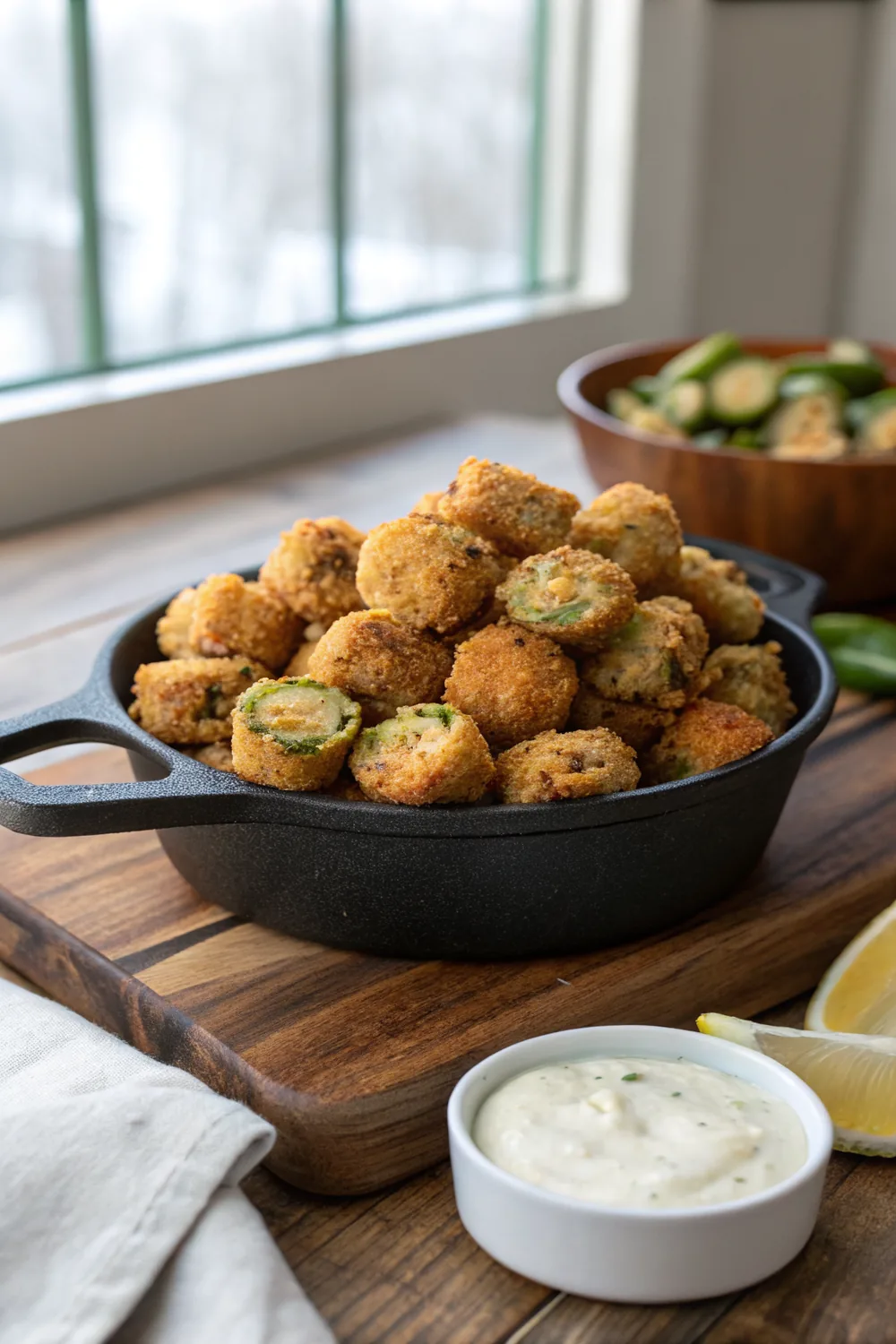
Chef Mia's fried okra: buttermilk dip, seasoned cornmeal dredge, shallow-fried in cast iron at 350F. Dry pods and no early salt mean crisp, never slimy.
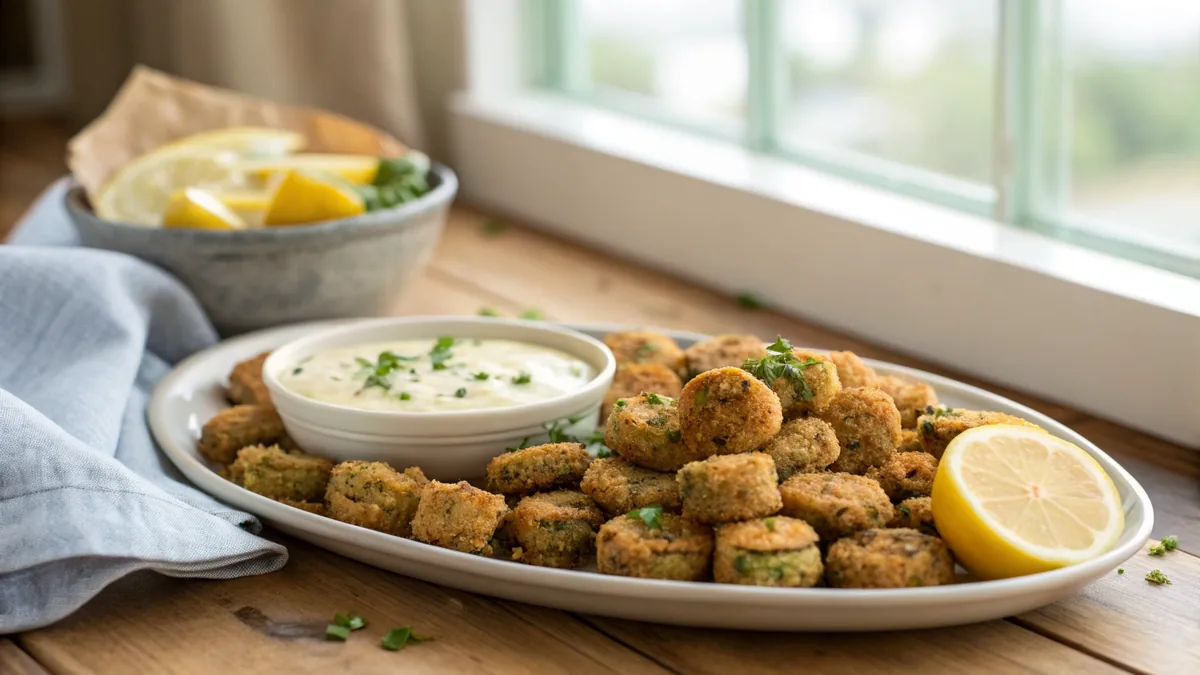
Quick answer: Fried okra is a cornmeal-dredged, shallow-fried side: fresh pods cut into half-inch rounds, dipped in buttermilk, rolled through seasoned cornmeal and flour, and fried in a half inch of 350F oil in a cast iron skillet until deep golden, about 3 to 4 minutes a batch. The slime that scares people off is preventable at four points: buy small firm pods, dry them completely before cutting, keep salt off the raw okra (it goes in the dredge and on at the finish, never on bare pods), and hold the oil at 350F so the crust sets before the interior can weep. Fry in a single layer, turn once, then drain on a wire rack, never on a pile of paper towels, and salt the second it leaves the oil. Fifteen minutes of prep, four minutes a batch, and it stays audibly crisp for a good half hour. Serves 6 as a side.
There are two places fried okra shows up in my life, and they could not look more different. One is the Sunday table, a platter passed hand to hand after church, the way my people have eaten it for generations across the South. The other is the metal tray at a Central Texas barbecue joint, a paper boat of golden rounds wedged between the brisket and the pickles, where it has quietly become one of the great hot sides of the barbecue line. Same dish, same skillet, same cornmeal.
And yet fried okra is the side people are most scared to make at home, because everybody has met the bad version: pale, greasy, and slick in the middle, the coating sliding off in wet sheets. Every one of those failures traces back to the same substance, the mucilage inside the pod, and the good news is that slime is not a fact of okra. It is a fact of technique. Dry pods, no early salt, oil that is actually hot, and a crust that goes on in the right order will beat it every single time.
My version comes out of a Lockhart garden that buries us in okra every July and August, when the plants outgrow me and the pods go from pickable to woody in about three days. It is a buttermilk dip, a seasoned cornmeal and flour dredge, and a shallow fry in the same cast iron skillet I use for everything else. No deep fryer, no gallon of oil, no gadgets. Just the four anti-slime rules and a skillet you already own.
Why the Cast Iron Skillet Beats the Deep Fryer
Most written fried okra recipes assume a deep fryer or a Dutch oven with two quarts of oil, and I think that assumption is exactly backwards. Okra is small, light, and cooks in under four minutes. It does not need to swim. A half inch of oil in a wide cast iron skillet gives every round direct contact with hot metal through a thin layer of fat, which browns the cornmeal crust faster and harder than floating in a deep pot ever will.
The skillet matters as much as the depth. Cast iron holds an enormous amount of heat in its walls, and that stored heat is what saves you at the worst moment of any fry: the second the cold, damp-ish okra hits the oil and the temperature tries to nosedive. In a thin aluminum pan that dive takes the oil to 300F and your okra goes greasy. In a heavy skillet the metal itself pushes the temperature back up before the crust can start absorbing instead of frying. If you are choosing between pans, my rundown of the cast iron skillets worth owning covers the 12-inch workhorses that do this job best.
There is also a family logic at work here. The buttermilk dip, the seasoned dredge, the shallow cast iron fry: this is the exact same station and the exact same skillet as chicken fried steak, just pointed at a vegetable. If you have made one, your hands already know the other. In my kitchen they often happen the same night, steak first, okra in the same oil while the gravy comes together.
The practical wins are real too. Two cups of oil instead of two quarts means the skillet is at temperature in five or six minutes, cleanup is one pan, and the leftover oil strains through a coffee filter into a jar for the next fry. Cornmeal-fried oil stays clean enough to reuse twice more, as long as you fished out the loose crumbs between batches.
The one discipline shallow frying demands is batch size. A 12-inch skillet takes a third of this recipe at a time, one layer, gaps between the rounds. Pile it two deep and the top layer steams while the bottom layer burns. Three relaxed batches beat one crowded disaster every time, and the 200F oven hold means batch one is still crisp when batch three comes out.
Where the Slime Comes From, and the Four Fixes
Okra slime has a name, mucilage, and a purpose: it is soluble fiber the plant uses to store water, the same stuff that makes okra the world's great gumbo thickener. It lives in the walls and seed chamber of the pod, and it activates on two triggers, moisture and heat over time. Long, wet, low-temperature cooking is the mucilage's favorite environment, which is why stewed okra is silky and badly fried okra is slick. Frying done right never gives it the chance.
Fix one is dryness. Wash the pods when you get home from the market, not when you start cooking, and dry them completely, towel first, then air. Water sitting on the skin migrates into the cut surfaces the moment your blade opens the pod, and wet cut surfaces are where the slick starts. Bone-dry okra cut with a dry blade produces barely any of it.
Fix two is the one almost nobody teaches: no salt touches the raw okra, ever. Salt pulls water out of vegetable cells by osmosis, which is a gift when I am draining tomatoes for pico and a disaster on a pod whose water arrives as mucilage. Salted raw okra sits in its own slick within ten minutes and no dredge on earth will stick to it. All the salt in this recipe lives in the dredge, where it seasons through the crust, and in the flaky finish at the end.
Fix three is the cut. Half-inch rounds expose the minimum cut surface that still cooks through quickly. Slice thinner and you have opened more chamber per bite than the crust can seal; split pods lengthwise and you have opened the whole thing. If your pods are small and tender, frying them whole with just the cap trimmed exposes almost no cut surface at all, which is the lowest-slime version there is, and I cover that choice below.
Fix four is temperature. At 350F the crust sets in the first thirty seconds, forming a fried shell around each round before the interior gets hot enough to release anything. At 300F that shell takes three times as long to form, and in the meantime the okra inside is stewing in its own moisture. When people tell me their okra came out slimy even though they dried it and skipped the salt, the answer is nearly always an unmeasured, too-cool skillet of oil.
Picking Okra: Three-Inch Pods, July Through August
Okra is a hot-weather crop that genuinely loves a Texas summer, which is why it is one of the few vegetables at its absolute peak here in July and August, when everything else in the garden is begging for mercy. The plants shrug off 100F afternoons and produce so fast that gardeners pick every single day. If you grow it, you know the phenomenon: miss two days and the pods have gone from perfect to baseball bat.
Size is the whole story at the market. You want pods 2 to 3 inches long, and I will take 2 over 4 every time. Okra turns fibrous from the tip down as it grows, and a big glossy 5-inch pod that looks like a prize is usually all wood inside; no amount of frying tenderizes lignin. Small pods are also younger, which means tighter seed chambers and less developed mucilage. Everything about small okra is on your side.
The freshness test is the snap. A fresh pod's tip breaks off clean with an audible snap when you bend it, like a good green bean. If the tip flexes and folds, the pod has been sitting, and okra deteriorates fast off the plant, going limp and bruising black within a few days even refrigerated. Look for uniform bright green, fuzzy skin, no dark streaks or soft spots, and buy it the day or two before you fry it.
Store it cold and dry: unwashed, in a paper bag or a loosely closed produce bag in the crisper, three or four days at most. Moisture in storage is the enemy, both for slime later and for the black spotting that shows up wherever damp okra touches itself. And wash-then-dry well before cooking, per fix one, never wash-and-straight-to-the-board.
A note for the rest of the year: frozen cut okra can make respectable fried okra, better than tired fresh pods from a long truck ride, but it needs its own handling. Do not thaw it. Thawed okra collapses into exactly the wet mess we have spent this whole page avoiding. Dredge it frozen, straight from the bag into buttermilk and cornmeal, and give the oil an extra few degrees of head start since frozen okra pulls the temperature down harder.
Rounds or Whole Pods
Cut rounds are the fried okra of my childhood and of every barbecue tray I have ever seen: bite-sized, maximum crust per pound, easy to eat by the handful from a paper boat. Every cut face grabs dredge, so rounds give you the highest ratio of crunchy shell to soft green center. They are also the format that fits a spoon, a burger, or a kid's fist. When people say fried okra, this is the picture in their head, and it is the main recipe on this page.
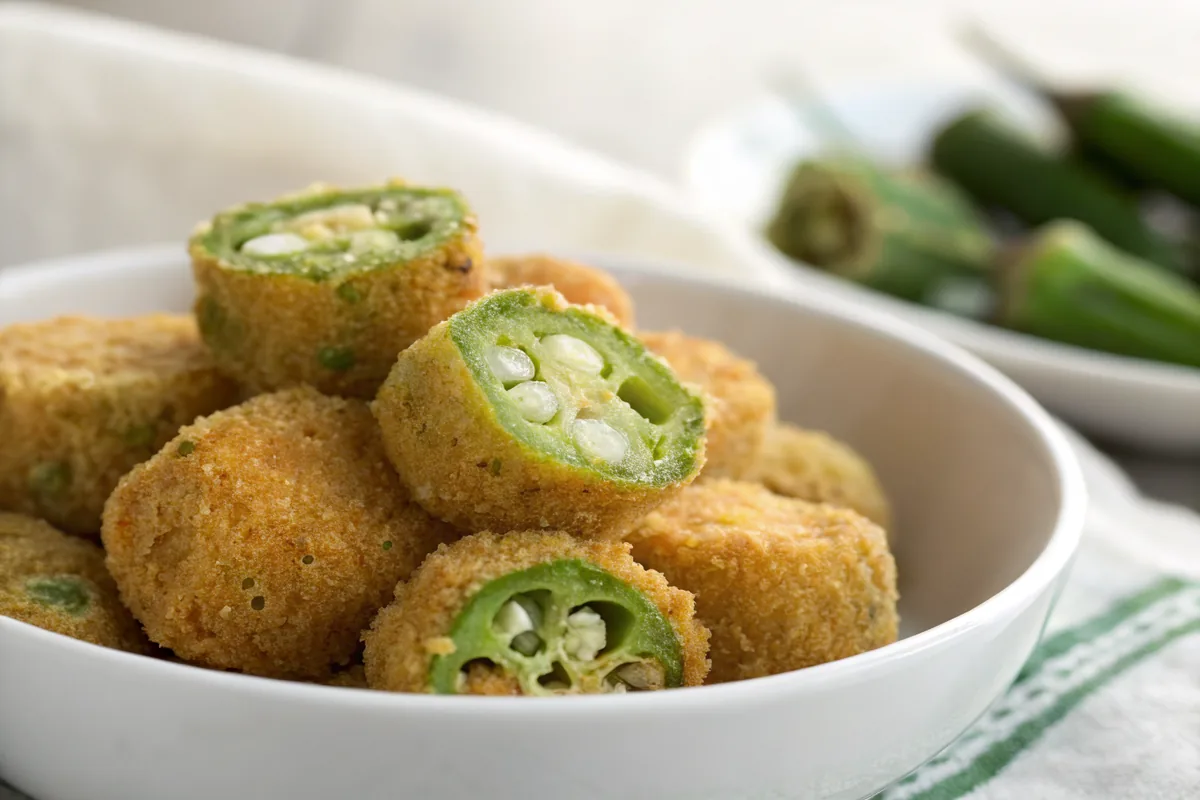
Whole pods are the version I make when the garden hands me a flush of perfect 2-inch okra. Trim the cap flush without opening the chamber, leave the tip on, dip and dredge the whole pod. With almost no cut surface, there is nowhere for mucilage to surface, so whole-pod fried okra is essentially slime-proof, and the pods stay juicier inside because the shell is sealed. They take about a minute longer in the oil, 4 to 5 minutes, and they want a half-flip so both sides meet the skillet bottom.
The whole-pod version also happens to be the better party trick. A pile of whole crusted pods with a cold, creamy dip reads like something a restaurant charges twelve dollars for, and eating them like fries, cap end as the handle, converts okra skeptics faster than any argument. If someone at your table claims to hate okra, hand them a whole fried pod before you say a word.
My honest rule: rounds when the okra is mixed sizes or bigger than 3 inches, whole when I have a batch of small uniform pods picked that day. Both use the identical buttermilk, dredge, oil, and temperature. Nothing else on this page changes.
The Buttermilk and Cornmeal Dredge, in Order
The crust is two stations, wet then dry, and the order of operations inside them is what decides whether the coating stays on the okra or stays in the skillet. Buttermilk first: full-fat, in a wide bowl, with a shot of hot sauce if your table likes a whisper of vinegar heat. Buttermilk does two jobs no substitute does at once. Its acidity and body cling to the slick skin of okra where plain milk or egg slides off, and it hydrates the cornmeal into a shell instead of a dust.
The dry side is cornmeal with a flour assist, two parts fine yellow cornmeal to one part all-purpose, and that ratio is the Southern signature. Cornmeal alone fries into a beautiful crunch but adheres poorly, shedding in flakes. Flour alone grips well but fries into a soft jacket, more corn dog than okra. Two-to-one gives you the corny crunch with enough gluten and starch to weld it on. All the seasoning, the kosher salt, black pepper, garlic powder, and cayenne, goes into this dish, never onto the raw pods.
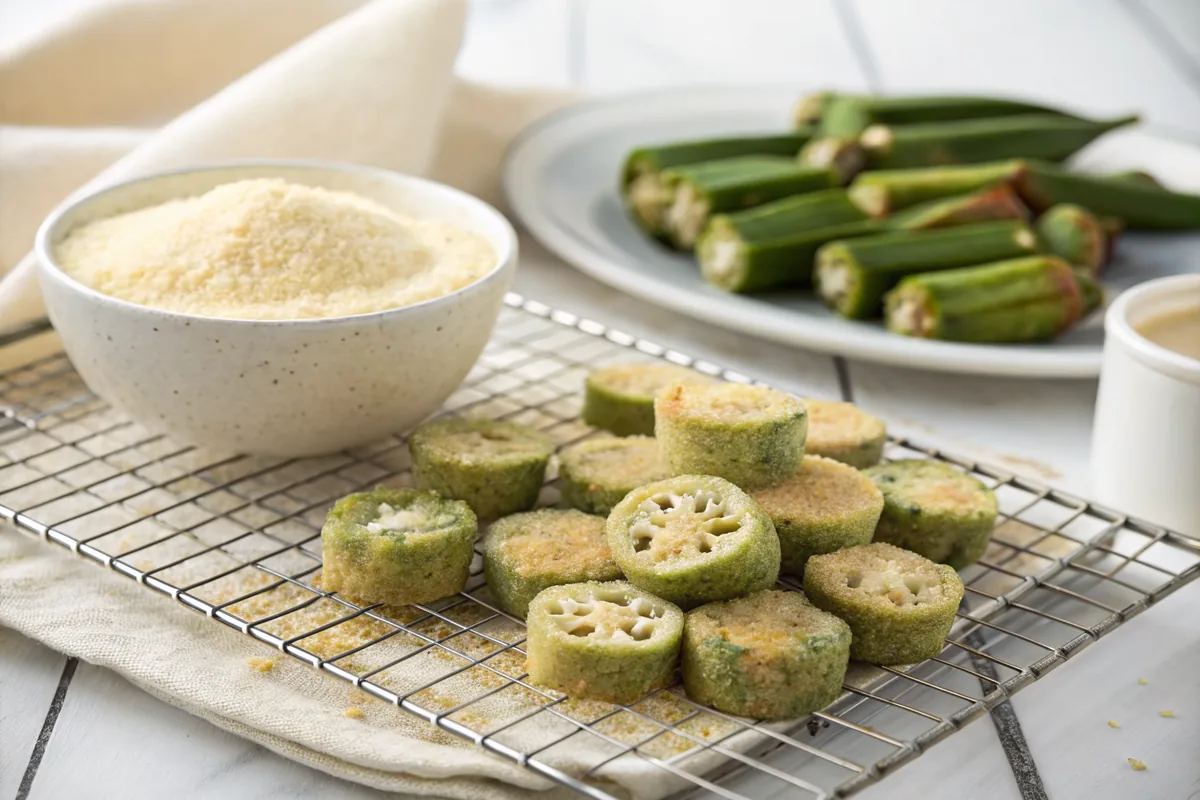
Work in handfuls, not piece by piece and not all at once. A big handful into the buttermilk, out with a slotted spoon so the excess drains, then scattered over the dredge and tossed with a light press. The drain step matters: rounds carrying too much buttermilk turn the dredge around them into paste, and after two or three handfuls the whole dish clumps. If the dredge starts pilling up anyway, whisk in a spoonful of fresh cornmeal and carry on.
Then the step everyone skips: the coated okra rests on a wire rack for 10 minutes while the oil heats. In those minutes the buttermilk soaks into the cornmeal and the coating changes from loose powder to a tacky, set shell. Rounds fried straight from the dredge shed crust the moment they are turned; rested rounds hold onto it through the flip, the drain, and the ride to the table. It is the same rest that makes buttermilk fried chicken crust stay put, scaled down to vegetable size.
One more habit worth stealing from the chicken fryers: one hand wet, one hand dry. The left hand lifts okra from buttermilk and drops it on the dredge; the right hand tosses and moves it to the rack. Mix the jobs and within five minutes you have breaded your own fingers past the knuckle.
Frying at 350F: The Temperature That Kills Slime
350F is not a suggestion, it is the mechanism. At that temperature the wet cornmeal shell dehydrates and sets within the first half minute, sealing each round inside its own crust before the interior heats enough to weep. The okra inside then steams gently in its own shell for the remaining three minutes, coming out juicy and green instead of slick. Every degree below about 335F stretches that sealing window and hands the advantage back to the mucilage.
Clip a thermometer to the skillet if you own one; the oil is shallow enough that you want the probe tip in the fat, not touching iron. Without one, use a test round. Dropped into ready oil it bubbles hard and immediately and floats within seconds. Lazy bubbles mean wait. Violent spitting and instant darkening mean the oil overshot toward 400F, so cut the heat and give it a minute. Cornmeal browns fast, and at 400F the crust goes mahogany before the okra inside is cooked.
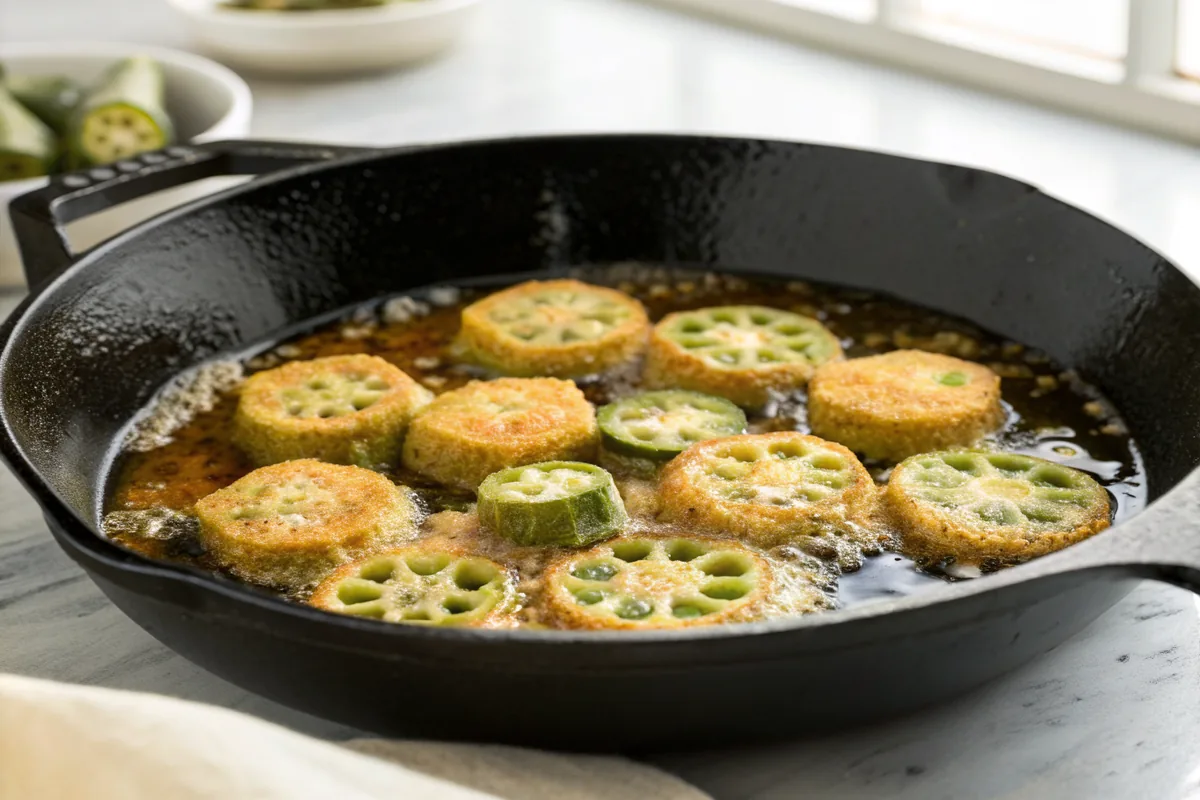
Batch discipline is temperature discipline. A third of the recipe per batch in a 12-inch skillet keeps the oil's dive shallow enough that cast iron pulls it right back. Add the okra, then leave it alone for a full two minutes; poking early is how crust gets scraped off on the pan bottom. Turn with a spider or slotted spoon, get color on the second side, and pull the batch when it is a shade lighter than you want, since it darkens for another thirty seconds off the heat.
Between batches, do two things: skim the loose crumbs, because stray dredge burns and seasons every later batch with bitterness, and watch the thermometer climb back to 350F before the next handful goes in. The pause feels fussy and takes ninety seconds. Skipping it is how batch two comes out pale and oily while you stand there wondering what changed.
Peanut oil is my first choice for its high smoke point and clean flavor, with plain vegetable or canola close behind. Save the bacon grease for seasoning a pot of greens; at a half-inch depth it smokes below 350F and fights the whole plan. And this fry is a fresh-oil job or a once-reused-oil job, not a fifth-life fryer oil job, because tired oil browns dark and greasy at any temperature.
Keeping the Crunch for 30 Minutes
Fried okra dies two deaths, and both happen after the skillet. The first is the paper towel pile, where the bottom layer of okra sits on a wet towel in a cloud of its own trapped steam and goes soft in five minutes. The second is the covered dish, where a well-meaning lid turns a crisp batch into a steamed one on the drive to the potluck. Both are solved by the same two dollars of hardware: a wire rack set over a sheet pan.
On a rack, air moves under every round, steam escapes instead of condensing, and residual oil drips through instead of soaking back in. Salt goes on in the first ten seconds while the surface fat is still hot and glossy, because salt thrown at cooled okra bounces off. This is the entire holding system: rack, immediate salt, no cover, ever.
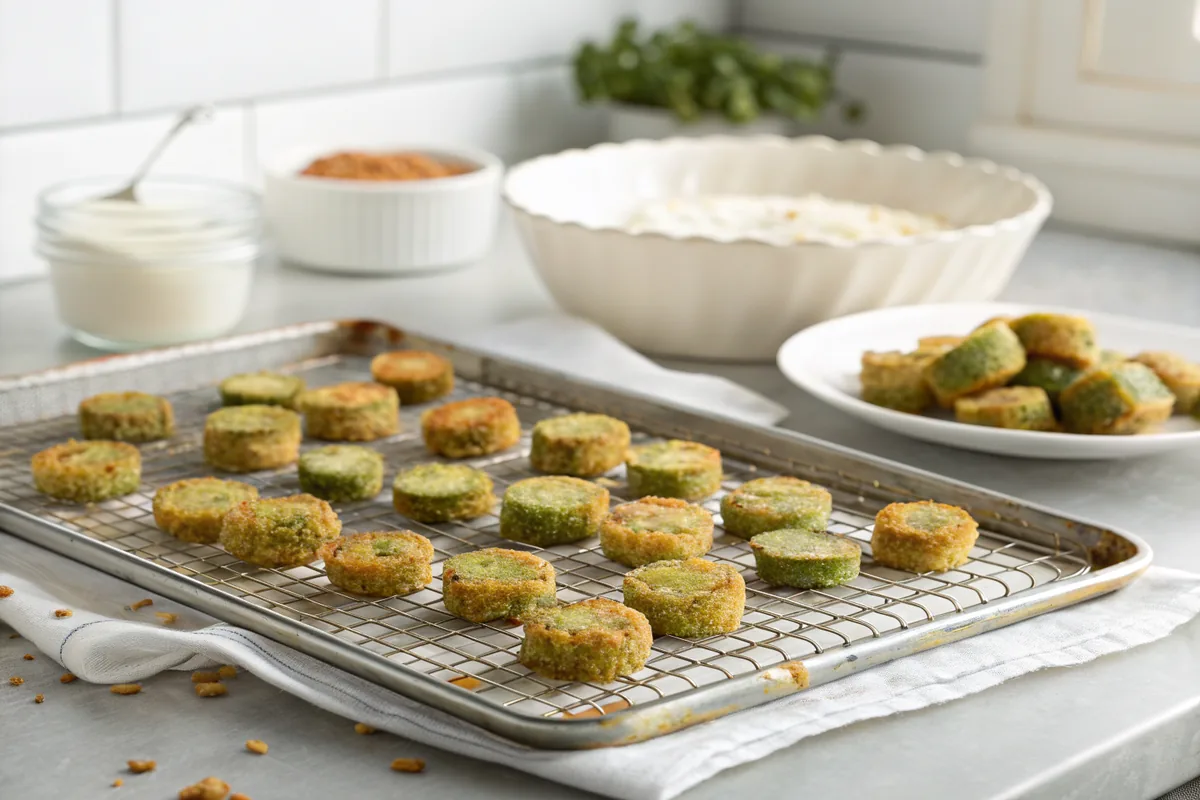
For a crowd, the rack goes into a 200F oven, uncovered, and the okra holds genuinely crisp for 30 minutes and acceptably for 45. That window is what lets you fry three batches, rest the cook, and still put one hot, uniformly crunchy platter on the table instead of feeding people in shifts. It is also what lets okra wait politely while a brisket gets sliced.
Leftovers are real but demoted, like most fried things. Refrigerate them uncovered until cold, then loosely covered, and bring them back in a 400F oven or air fryer for four to five minutes on, once again, a rack or a bare tray. They return to about ninety percent of their first-day crunch. The microwave returns them to the exact slippery texture this entire page was engineered to prevent, so do not.
From Sunday Supper to the BBQ Tray
Okra came to the American South from West Africa in the seventeenth and eighteenth centuries, carried along the routes of the slave trade, and it is one of the foundation crops of what became soul food. The word itself likely comes from the Igbo okuru, and gumbo takes its name from a Bantu word for the same pod. Frying it in cornmeal is the marriage of that African crop with the corn cooking of the South, and Black cooks perfected the dish generations before it reached any restaurant menu. When fried okra lands on a Texas table, that is the lineage on the plate.
In Texas the dish leads two lives. The first is the Sunday and weeknight supper life, next to smothered pork chops or a pot of black-eyed peas, with a skillet of cast iron cornbread on the same stovetop rotation. That is the version I grew up passing around a crowded table, where the platter never survived a second lap. The other fried vegetable on that table is my fried green tomatoes, which take the same buttermilk and cornmeal idea and build it up in three layers on thick, salted slices; the okra pod is dredged once and fried in a crowd, the tomato slice is dredged three times and fried alone.
The second life is newer and very Texan: the barbecue joint hot side. Somewhere along the way the meat markets figured out what home cooks always knew, that a rich, smoky tray of brisket and sausage wants something hot, crunchy, and vegetal beside it, and fried okra does that job better than almost anything. It has become a fixture on menus from small-town squares to the big city smoke temples, holding its own in the steam table pans next to the beans. I ranked where it sits in the pantheon in my guide to Texas BBQ sides, and it is higher than most people expect.
On a barbecue plate, okra plays the texture position. The classic tray builds contrast in pairs: something cool and sharp, which is where a creamy coleslaw earns its corner, something rich and molten like smoked mac and cheese, and something hot and crackling, which is the okra. Brisket bite, crunch, cool slaw, repeat. Nothing else on the tray makes noise when you bite it, and that turns out to matter.
Dips are optional but welcome. At home I put out a quick comeback-style sauce, mayonnaise cut with hot sauce, a little pickle juice, and black pepper, or just ranch, which no Texan has ever apologized for. A squeeze of lemon over the platter right before serving is the lightest touch and maybe the best one.
Mistakes That Ruin Fried Okra
Wet okra at the cutting board. Washing the pods and slicing them immediately is the original sin; water on the skin becomes slick on the cut face. Wash early, towel dry, air dry, then cut.
Salting the raw pods. Salt pulls moisture out of okra on contact and wrecks the dredge's grip within minutes. Every grain of salt in this dish belongs in the cornmeal mixture or on the finished fry.
Oil that was never actually 350F, and a crowded skillet on top of it. The most common failure and the least diagnosed, because nobody measured. Cool oil means a slow-setting crust, a stewing interior, and grease, and dumping two layers of okra into good oil creates the same problem by crashing the temperature. A ten-dollar thermometer, three patient batches, single layer, gaps between rounds.
Skipping the 10-minute rest after dredging. Unrested coating is loose powder, and loose powder stays in the skillet. The rest is free; it happens while the oil heats.
The paper towel pile and the covered dish. Both trap steam against the crust you just built. Wire rack over a sheet pan, salt immediately, hold uncovered in a 200F oven.
Giant okra, or frozen okra that was thawed first. A 5-inch pod is fibrous wood wearing a vegetable costume, and frying does not fix fiber: two to three inches, snap test at the market, no exceptions. And thawed frozen okra collapses into wet mush that no crust can save, so if frozen is what you have, it goes into the buttermilk still frozen, straight from the bag.
Fried Okra Recipe
Ingredients
- For the okra:
- 1 1/2 lbs (680 g) fresh okra pods, 2 to 3 inches long, washed and dried completely
- 1 cup (8 oz / 240 ml) full-fat buttermilk
- 1 teaspoon hot sauce, optional, stirred into the buttermilk
- For the dredge:
- 1 cup (5 oz / 140 g) fine yellow cornmeal
- 1/2 cup (2 1/2 oz / 70 g) all-purpose flour
- 1 1/2 teaspoons kosher salt (into the dredge, never onto the raw okra)
- 1 teaspoon freshly ground black pepper
- 3/4 teaspoon garlic powder
- 1/2 teaspoon cayenne pepper
- For frying and finishing:
- About 2 cups (16 oz / 475 ml) peanut or vegetable oil, enough for a 1/2-inch depth in a 12-inch skillet
- Flaky salt, for the moment it leaves the oil
Instructions
- Wash early and dry completely. Rinse the okra, then dry it like you mean it: roll the pods in a clean kitchen towel, then spread them out for 15 to 20 minutes while you set up the rest. Surface water is the number one slime trigger, because the mucilage inside the pod activates on contact with moisture. Bone-dry pods are the foundation of everything that follows.
- Trim and cut into rounds. Slice off the stem cap of each pod without opening the seed chamber, then cut the pods into 1/2-inch rounds. Half an inch is the sweet spot: thick enough that the centers stay green and juicy, thin enough that they cook through in the time the crust needs to brown. Do not salt them, and do not rinse them again.
- Build the dredge station. Pour the buttermilk into a wide bowl and stir in the hot sauce if using. In a second wide, shallow dish, whisk the cornmeal, flour, kosher salt, black pepper, garlic powder, and cayenne until evenly blended. Set a wire rack over a sheet pan at the end of the line to hold the coated okra.
- Dip, dredge, and shake. Working with a big handful at a time, drop the okra into the buttermilk, lift it out with a slotted spoon so the excess drains off, then scatter it over the cornmeal mixture. Toss and press gently until every round is coated, then transfer to the rack in a single layer, shaking off the loose dredge as you go. Loose crumbs burn in the oil and turn it bitter.
- Rest the coating 10 minutes. Leave the coated okra on the rack for 10 minutes while the oil heats. The rest lets the buttermilk hydrate the cornmeal and glue the crust to the okra, which is what keeps the coating from sliding off in the skillet. Rounds that go straight from dredge to oil shed half their crust.
- Heat the oil to 350F. Pour a 1/2-inch depth of oil into a 12-inch cast iron skillet and bring it to 350F over medium-high heat, checking with a thermometer clipped to the side. No thermometer? Drop in one test round: it should bubble hard and steadily the instant it lands. Below 350F the crust drinks oil and the interior stews, which is exactly where slime comes from.
- Fry in batches, single layer. Add a third of the okra, one round deep with space between pieces, and leave it alone for 2 minutes before turning. Fry 3 to 4 minutes total, turning once or twice, until the crust is a deep golden brown. Let the oil climb back to 350F between batches; crowding the skillet crashes the temperature and steams the okra instead of frying it.
- Rack, salt, and hold. Lift the okra out with a spider or slotted spoon onto a clean wire rack set over a sheet pan, never onto stacked paper towels, and hit it with flaky salt while the surface is still glistening. If you are frying multiple batches for a crowd, hold the finished rack in a 200F oven, uncovered, where it stays crisp for a solid 30 minutes.
Frequently Asked Questions
Why is my fried okra slimy?
One of four causes, usually stacked: the pods were wet when cut, salt touched the raw okra and pulled moisture out, the oil was under 350F so the crust never sealed, or the okra was old and oversized. The mucilage inside okra activates with moisture and slow heat, so the fix is mechanical: dry pods completely, keep all salt in the dredge and the finish, and fry hot enough that the shell sets in the first thirty seconds.
How do you keep fried okra from getting soggy?
Drain it on a wire rack set over a sheet pan, never on stacked paper towels, and never cover it. Towels and lids trap steam against the crust and soften it within minutes, while a rack lets air circulate and oil drip away. Salt it in the first ten seconds out of the oil, and for a crowd, hold the rack uncovered in a 200F oven, where the okra stays genuinely crisp for about 30 minutes.
Can I use frozen okra for fried okra?
Yes, and it beats tired out-of-season fresh pods, but with one rule: never thaw it. Thawed okra collapses into a wet mush that sheds any coating. Take cut frozen okra straight from the bag into the buttermilk, dredge it frozen, and fry at 350F, expecting the oil to dip harder and the batch to need an extra minute. Slightly smaller batches help the temperature recover. The crust hides most of the texture difference.
What oil is best for frying okra?
Peanut oil is the first choice: a high smoke point, clean neutral flavor, and it stays stable at 350F in a shallow skillet. Plain vegetable or canola oil is nearly as good and cheaper. Skip olive oil, which fights the cornmeal flavor and smokes low, and save bacon grease for seasoning greens, since at frying depth it smokes below target temperature. Strained through a coffee filter, the oil is clean enough to reuse for one or two more fries.
Do you have to soak okra in buttermilk?
A long soak is unnecessary, but the buttermilk dip itself is close to mandatory. Okra's smooth skin sheds plain milk, beaten egg, and water; buttermilk's acidity and body are what cling to the pod and hydrate the cornmeal into a shell that stays attached. A pass through the bowl and a drain on a slotted spoon is enough. What actually needs time is the other end: 10 minutes of rest after dredging, so the coating sets before it meets the oil.
Can you fry okra whole?
Yes, and whole pods are the most slime-proof format there is. Trim the stem cap flush without opening the seed chamber, leave the tip intact, then dip and dredge the whole pod. With almost no cut surface, the mucilage has nowhere to surface, and the sealed pod stays juicy inside its crust. Use small pods, 2 to 3 inches, fry 4 to 5 minutes at 350F, and serve them like fries with a creamy dip. Bigger pods are too fibrous to eat whole.
What do you serve with fried okra?
At home it sits next to anything Southern: fried chicken, pork chops, black-eyed peas, greens, and a wedge of cornbread. On a barbecue plate it plays the hot-and-crunchy position against rich brisket and sausage, alongside something cool like slaw and something molten like mac and cheese. For dipping, a comeback-style sauce of mayonnaise, hot sauce, and pickle juice is the classic, ranch is the Texas default, and a squeeze of lemon over the platter is the lightest finish.
How do you reheat fried okra?
In a 400F oven or air fryer, spread in a single layer on a wire rack or bare tray, for four to five minutes until the crust re-crisps. It comes back to about ninety percent of its original crunch. Store leftovers in the refrigerator uncovered until fully cold, then loosely covered, and eat them within two days. Never use the microwave, which steams the crust soft and brings back the exact slippery texture the frying method was built to prevent.