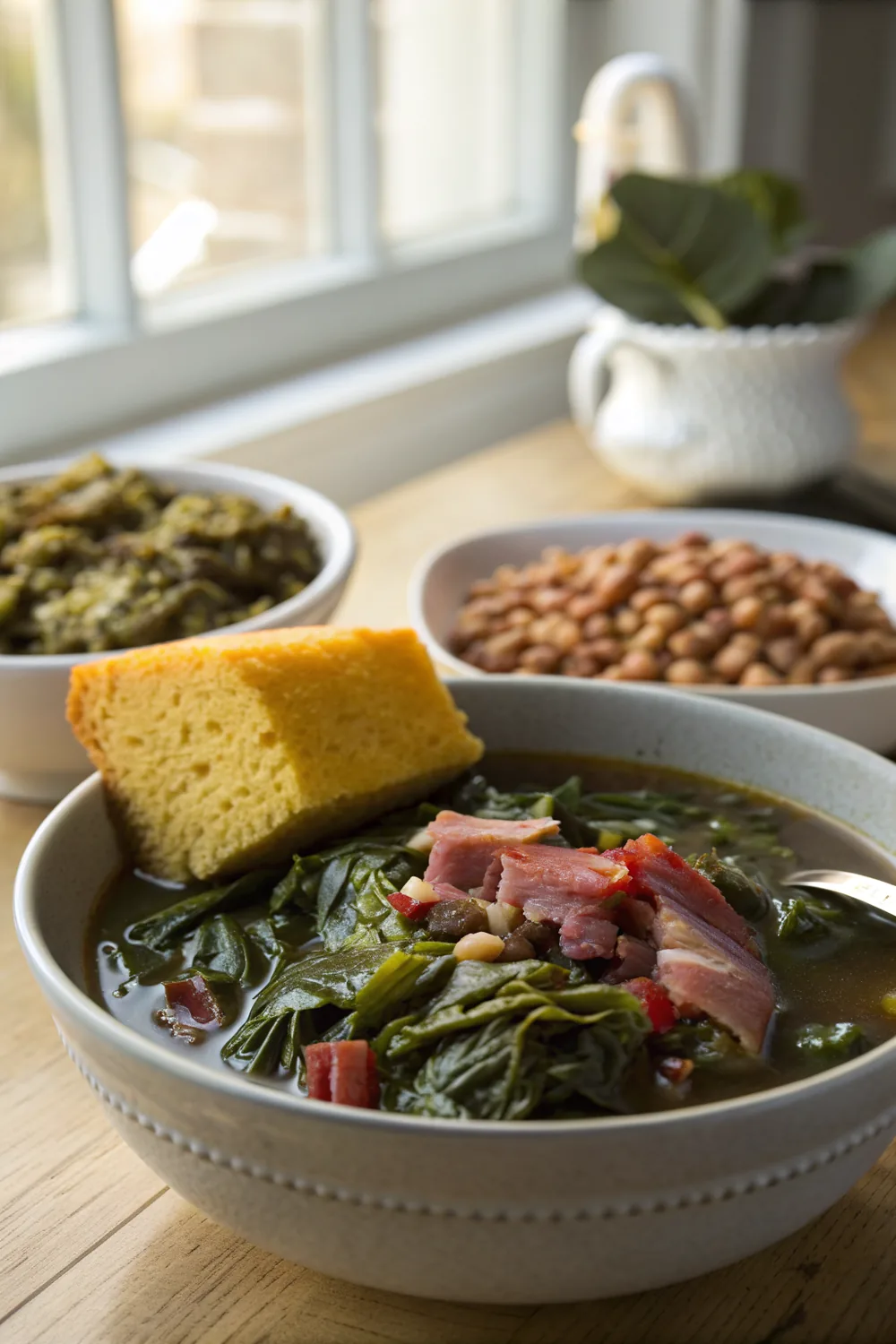
Southern Comfort Food
Southern Collard Greens
Chef Mia's Southern collard greens: washed three times, stems out, 2-hour simmer with a smoked ham hock, vinegar at the end. Real potlikker, no bitterness.
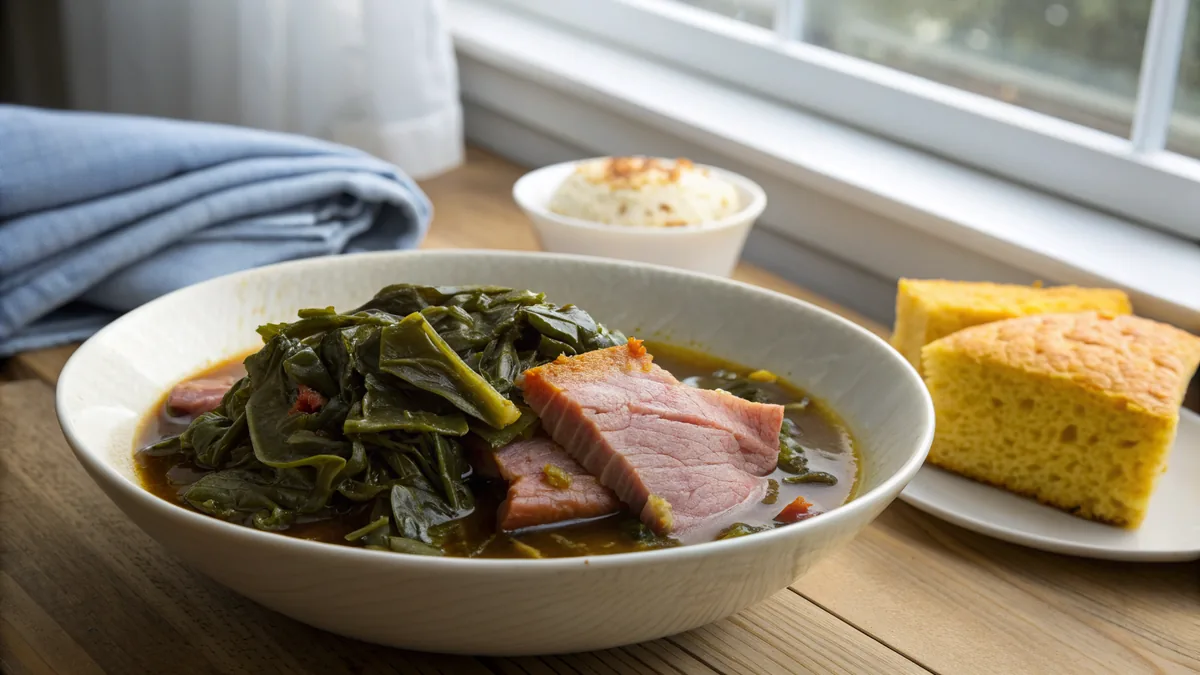
Quick answer: Southern collard greens are two large bunches of collards, washed in three changes of water, stripped from their stems and cut into ribbons, then simmered low for about two hours in a broth built from a smoked ham hock, onion, garlic, chicken stock, and a pinch of red pepper flakes, and finished at the end with apple cider vinegar and a little sugar. The long simmer turns a tough, bitter leaf silky and sweet, the hock gives up its smoke and collagen to the potlikker, and the vinegar at the finish brightens the whole pot. Serve them with cornbread for dunking, and the broth is as much the dish as the greens.
There is a pot of collard greens on every New Year's Day table I have ever sat at in Texas, and on most of the Sunday ones too, and I did not understand it as a child. The greens looked like something that had given up. It took an aunt in Bastrop handing me a wedge of cornbread and pointing at the broth in the bottom of the pot, not the greens, to change my mind. The potlikker was smoky and sweet and sharp with vinegar, and the greens in it were as soft as a braise and tasted like the smoke and the pork and the pot they had been cooking in for two hours. That is the dish. The leaf is only the vehicle.
Collards are the toughest, most bitter green in the Southern garden, and that is exactly why they are cooked this way. A raw collard leaf is thick, waxy, and full of the same sulfur compounds that make mustard and cabbage sharp. Twenty minutes of cooking does nothing but wilt it. Two hours of a low simmer in a smoky, salty, slightly acidic broth breaks the fibers down, drives off most of the bitterness, and pulls the sweetness out of the leaf. Every cook who has been disappointed by collards has usually pulled them off the stove an hour early.
This recipe is the companion to my Southern black-eyed peas, because the two pots share a hock, a table, and a holiday. Peas for coins, greens for folding money, cornbread for gold: that is the New Year's ledger, and the greens are the part most kitchens do worst. Here is how to do them right, with the potlikker treated as the point rather than the leftover.
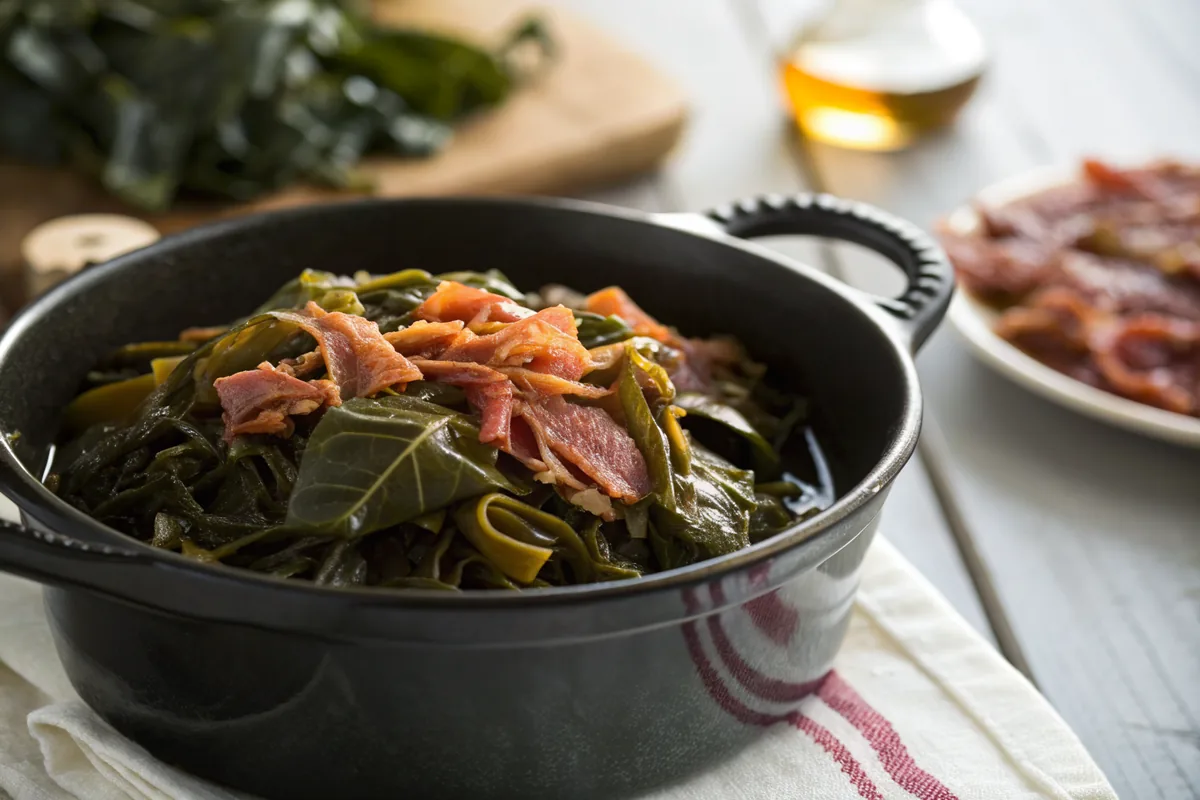
The Greens: Collards, and When to Buy Them
Collards are a loose-leaf cousin of cabbage and kale, with large, flat, blue-green leaves and a thick central rib. They grow all year in the South but they are at their best from late fall through early spring, after the first frost. Cold converts some of the plant's starch to sugar as a kind of antifreeze, and a frost-kissed collard is noticeably sweeter and less bitter than a September one. This is why the New Year's Day pot is so good and the July one so often is not.
Buy them by the bunch and look for leaves that are firm, deeply colored, and unblemished, with stems that snap rather than bend. Yellowing, holes, and limp leaves mean age. Smaller leaves are more tender and cook faster; the giant ones are fine but need the full simmer. Two large bunches, roughly two and a half to three pounds, cook down to about eight servings, which surprises everyone the first time because raw collards fill the whole counter.
Pre-washed bagged collards, already chopped, are a real shortcut and I use them on weeknights. They are usually cut with a lot of stem, so pick through and pull out any thick pieces, and give them one rinse anyway. Frozen collards work for the simmer but come out softer and lose the silky texture; if that is what you have, cut the cooking time by a third.
Mustard greens and turnip greens are the two neighbors on the shelf and they cook the same way with one difference: they are more tender and more peppery, and they need about half the time. A mix of collards with a handful of mustard greens added for the last 30 minutes is a classic Texas move that gives the pot a sharper, more interesting bite. Kale cooks like collards but tastes flatter and is not a substitute anyone in the South would make on purpose.
Washing Three Times: Grit Is the Enemy
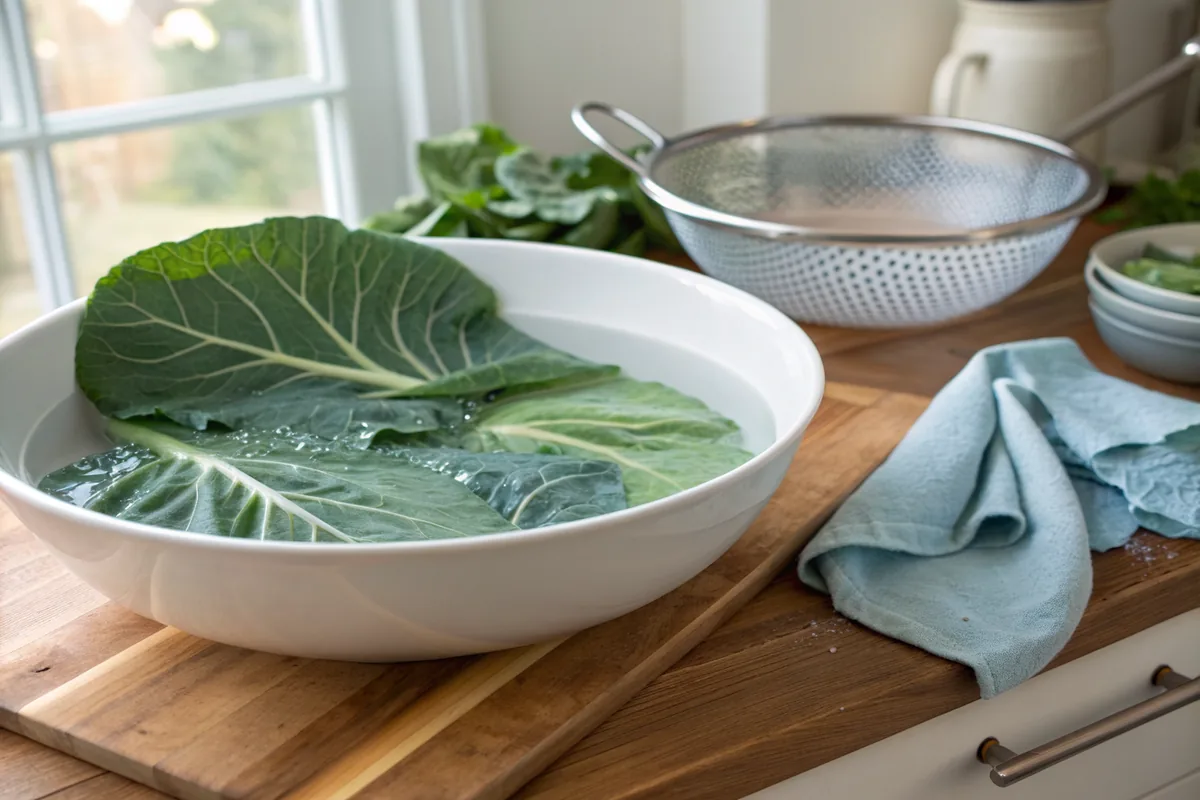
Collards grow low to the ground with big, ruffled leaves, and they hold sand and soil in every fold. A single rinse under the tap does not touch it. Nothing ruins a pot of greens like a gritty bite, and the only reliable method is to submerge the leaves in a large volume of cold water, agitate them hard, and then lift the greens out of the water rather than pouring the water off. The grit sinks; if you pour, it goes right back over the leaves.
Three changes of water is the rule, and the third should be clean when you look at the bottom of the sink. Muddy water on the second pass means a fourth wash. A tablespoon of salt or a splash of vinegar in the first water helps loosen the dirt and any insects hiding in the folds. This takes ten minutes and it is the least glamorous and most important step in the recipe.
Wash them whole, before stripping the stems, because the stem gives you something to hold and the whole leaf is easier to swish than a pile of ribbons. Then drain in a colander. They do not need to be dry; they are going into a pot of broth.
Stems Out, Ribbons Cut
The center rib of a collard leaf is thick, fibrous, and never quite tenderizes at the speed the leaf does. In the finished pot it reads as a woody string in the middle of otherwise silky greens. Strip it: fold the leaf in half along the rib and pull the leaf away in one motion, or run a knife down each side of the rib. Discard the thick lower two thirds; the thin upper part of the stem is fine to leave.
Stack the stripped leaves, roll them tightly into a cigar, and slice crosswise. Three-quarter-inch ribbons are the classic cut, wide enough to have some body in the bowl, narrow enough to fit on a spoon. Some cooks chop them into rough two-inch squares, which is also traditional and slightly more rustic. Do not cut them fine; small pieces overcook and go to mush before the broth develops.
There is an argument, mostly from vegetable-forward cooks, for slicing the stems thin and adding them to the pot first. It works, and it wastes nothing, but it adds a chewy element that the classic pot does not have. My grandmother's greens had no stems in them and neither do mine.
The Ham Hock and the Potlikker
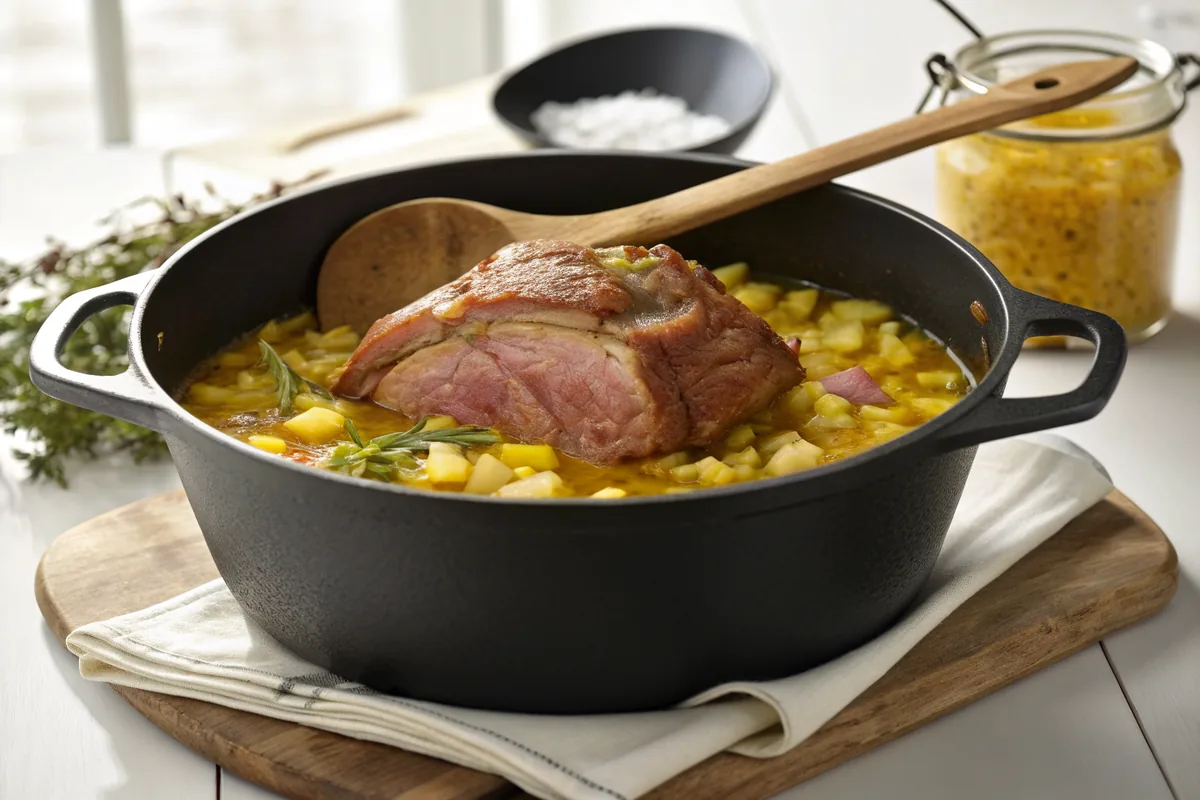
A smoked ham hock is the ankle of the pig, cured and smoked, and it is mostly skin, bone, connective tissue, and a little meat. That sounds unpromising and it is exactly right for this job. Over a long simmer the collagen in the skin and tendons converts to gelatin and gives the broth body; the smoke and the cure season everything in the pot; and the small amount of meat shreds into the greens at the end. One good hock does the work of a whole pound of bacon.
Give the hock a 45-minute head start before the greens go in. A hock straight from the package needs close to two and a half hours to become tender and the greens need about two, so starting the pork alone lines the two clocks up. Browning it first in a little bacon fat is optional but it deepens the color of the broth and adds a roasted note the plain boil does not have.
Smoked turkey wings or a smoked turkey leg are the standard substitute in kitchens that skip pork, and they are genuinely good, smokier than a hock and a little leaner. Use the same weight and the same head start. Thick-cut bacon, chopped and rendered, gives you the fat and the smoke but none of the gelatin, so the potlikker comes out thinner. A ham bone left over from a holiday ham is the luxury version and needs no browning at all.
The broth that results is potlikker, the Southern name for the liquid left after cooking greens, and in this house it is served, not drained. It carries the vitamins that leached out of the leaves, all of the smoke, and the sweetness the collards gave up, and it is what the cornbread is for. My Southern white beans page treats the bean broth the same way, and the same rule applies: the liquid is the dish.
The Two-Hour Simmer, and Why Shorter Fails
This is the step that separates Southern collards from every other cooked green, and it is where impatience does the most damage. Collards are fibrous, waxy, and full of glucosinolates, the sulfur compounds that give the cabbage family its edge. A quick saute leaves them tough and bitter. Thirty minutes softens them but keeps the bite. It takes somewhere between ninety minutes and two hours of a gentle simmer for the cell walls to fully break down, the leaves to turn dark and silky, and the bitterness to cook off into something deep and sweet.
Low and slow is the whole method. Once the greens are in and the pot comes back up, drop the heat until the surface barely trembles and partially cover it. A hard boil toughens the leaves and evaporates the potlikker you are trying to build. Stir every twenty minutes, pushing the top layer down, and taste a ribbon at 90 minutes. It should cut with the side of a spoon and taste sweet and smoky with no sharp edge. If there is any resistance or rawness, keep going; another half hour never hurt a pot of collards.
Add the greens in handfuls, not all at once. Raw collards take up an absurd volume and the pot will not hold them; push each batch down into the hot broth, let it wilt for a minute, then add more. Within ten minutes two bunches that filled the counter fit comfortably in a six-quart pot with the broth just covering them.
The liquid level matters. The greens should be just submerged at the start; as they cook down and release their own water the level rises slightly, and a partial lid keeps the rest from evaporating. If the pot looks dry at any point, add hot water or stock a cup at a time. You want roughly a cup of potlikker per serving at the end, not a dry pile of leaves.
Vinegar, Sugar, and Salt: The Finish
The last five minutes are where a good pot becomes a great one, and the order matters. Vinegar first: a tablespoon of apple cider vinegar stirred into the pot brightens the smoky, sweet broth and pulls the whole thing into focus. It should not taste sour; it should taste balanced. Many tables keep a cruet of pepper vinegar, hot peppers steeped in white vinegar, for each person to add their own, and that is the classic Texas condiment for greens.
Sugar is a small, quiet amount. A tablespoon of brown sugar rounds off whatever bitterness the simmer left behind and echoes the sweetness that frost gives a winter collard. It should never read as sweet. If your greens were cut after a hard frost you may need none at all; taste first.
Salt goes in last and cautiously. A smoked ham hock is cured and it seasons the pot as it cooks, so the potlikker may already be salty enough by the time the greens are done. Taste the broth, not the leaf, and add a quarter teaspoon at a time. This is the same rule that governs my turkey gravy and every bean pot on this site: anything cooked with cured pork gets salted at the finish or not at all.
Black pepper is generous, a full teaspoon, freshly ground, added with the vinegar. Red pepper flakes went in at the start with the garlic and by now have given up their heat to the broth. If you want more, a dash of hot sauce at the table is the traditional way to get it, not more flakes in the pot.
New Year's Day: Peas, Greens, Cornbread, Pork
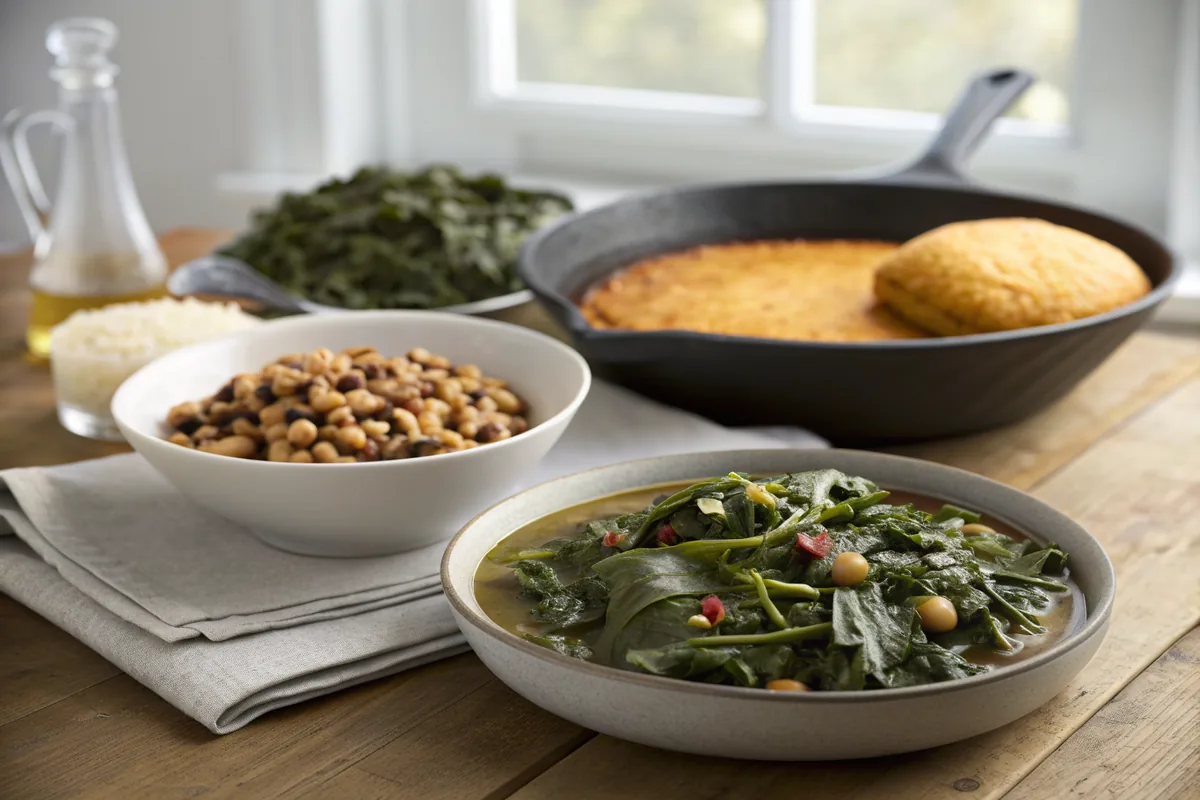
On January 1st across the South and all through Texas, the plate is fixed by tradition and everyone knows the ledger. Black-eyed peas for coins, greens for folding money because a cooked collard leaf looks like a dollar bill, cornbread for gold, and pork for progress, because a pig roots forward. Whether any of it works is beside the point. It is the one day of the year when the whole state eats the same supper, and the greens are the part most cooks get wrong by starting them late.
Start the greens first. They take the longest, they improve with a rest, and they can sit on the back burner for an hour after they are done. My black-eyed peas come off the stove second, about ninety minutes with their own hock and no soak. The cast iron cornbread goes into the oven twenty minutes before you sit down so it is hot enough to split and dunk. A platter of pulled pork or sliced smoked sausage carries the pork side of the ledger if the hocks in the two pots are not enough.
Some kitchens cook the peas and the greens in the same pot, and it is a respectable shortcut, but the two want slightly different things: the peas need their broth thick and starchy, the greens need theirs thin and vinegary. Two pots, two hocks, and a cornbread between them is how I do it. Sweet tea for the table, and if it is a cold morning, the biscuits and gravy come out at breakfast first so nobody is at the stove hungry.
The rest of the year the pot has no holiday to answer to. Collards are a Sunday side under fried chicken or smothered pork chops, a weeknight supper with nothing but cornbread and hot sauce, and the green on every barbecue plate in East Texas that takes the Southern side of the menu seriously. The wider table lives on the Southern comfort food hub.
Variations Worth a Pot
Smoked turkey. Replace the hock with a smoked turkey leg or two smoked wings, same weight, same head start. Leaner, a little smokier, and the version most Texas soul food cafes serve now. Add a tablespoon of butter at the end for the richness the pork would have given.
Vegetarian, done seriously. Skip the meat, use a good vegetable stock, and build the smoke with a teaspoon of smoked paprika, a dash of liquid smoke, and two tablespoons of olive oil at the start. Add a splash of soy sauce with the vinegar for depth. The potlikker is thinner without the gelatin, so simmer uncovered for the last 20 minutes to concentrate it.
Mixed greens. Two bunches of collards plus one of mustard or turnip greens, the mustards added for the last 30 minutes. Sharper and more layered; this is how many East Texas kitchens do it.
Spicy. Double the red pepper flakes and add a whole halved jalapeno to the pot at the start. Fish it out before serving. A Tex-Mex nod that works.
Bacon and onion, quick version. When there is no hock and no time, render six slices of chopped thick bacon, cook the onion in the fat, and simmer the greens in stock for one hour instead of two, adding a tablespoon of butter at the finish for body. It is not the same pot, but it is a good weeknight one.
Storage, Freezing, and Day Two
Collards are better the next day, and this is not a figure of speech. A night in the refrigerator lets the broth settle back into the leaves and the smoke deepen, which is why I always cook them a day ahead for a holiday. Store them in the potlikker in a covered container for up to 5 days. Reheat gently on the stove with a splash of water or stock if the broth has reduced.
They freeze better than almost any cooked vegetable. Portion them with their broth into freezer containers, leaving an inch of headspace, and freeze up to 3 months. Thaw overnight in the refrigerator and reheat on the stove. The texture holds because the greens are already fully soft; there is nothing left for the freezer to break.
Leftover potlikker on its own is worth keeping. It is the base for a pot of beans, a spoonful gives a bowl of bean soup a smoky lift, and warmed in a mug with a piece of cornbread crumbled into it, it is a Southern breakfast that predates most of what we call breakfast now.
Mistakes That Ruin Collard Greens
Pulling them off the stove early. Thirty or forty-five minutes leaves collards tough and sharp. Ninety minutes is the floor; two hours is normal. Taste a ribbon before you decide.
One rinse under the tap. Grit lives in the folds and it does not come out without submerging and lifting. Three full washes, and look at the bottom of the third.
Leaving the stems in. The thick rib never softens at the pace of the leaf and reads as a woody string in every bite. Strip them.
Salting at the start. A smoked hock salts the pot as it cooks and the broth concentrates. Taste at the end, then salt, a quarter teaspoon at a time.
Boiling hard. A rolling boil toughens the leaves and evaporates the potlikker. A bare simmer, partially covered.
Draining the broth. The potlikker holds the smoke, the sweetness, and most of the nutrition. Serve it in the bowl with the greens and hand out the cornbread.
Skipping the vinegar. Without acid at the end the pot tastes flat and heavy. One tablespoon of cider vinegar in the pot, and pepper vinegar on the table.
Cooking them in a small pot. Raw collards need room to be pushed down and wilted in batches. A six-quart Dutch oven, minimum, for two bunches.
Southern Collard Greens Recipe
Ingredients
- 2 large bunches collard greens (about 2 1/2 to 3 pounds / 1.2 to 1.4 kg total)
- 1 smoked ham hock (about 1 pound / 450 g), or 2 smaller ones
- 1 tablespoon bacon drippings or neutral oil
- 1 large yellow onion, diced
- 4 garlic cloves, sliced
- 1/2 teaspoon red pepper flakes
- 4 cups (32 oz / 950 ml) low-sodium chicken stock
- 2 cups (16 oz / 475 ml) water
- 1 tablespoon apple cider vinegar, plus more at the table
- 1 tablespoon brown sugar
- 1 teaspoon freshly ground black pepper
- Kosher salt, at the end and only after tasting
- Hot sauce and extra vinegar, for the table
- A skillet of cornbread, for serving
Instructions
- Start the hock. In a large heavy pot or Dutch oven, warm the bacon drippings over medium heat. Add the ham hock and let it brown a little on each side, 5 minutes. Add the onion and cook until soft and translucent, 5 to 6 minutes, then the garlic and pepper flakes for 1 minute more.
- Build the potlikker base. Pour in the chicken stock and water, bring to a boil, then lower to a bare simmer. Cover and let the hock cook 45 minutes on its own. This head start is what makes the pork tender by the time the greens are done and gives the broth its smoke before the leaves go in.
- Wash the greens three times. While the hock simmers, fill a clean sink or large bowl with cold water, submerge the collards, and swish them hard. Lift them out, leaving the grit behind, drain the water, and repeat twice more. The last water should be clean.
- Strip the stems and cut the ribbons. Fold each leaf in half along the stem and pull the leaf away from it, or run a knife down each side. Discard the thick stems. Stack several leaves, roll them into a cigar, and slice crosswise into ribbons about 3/4 inch wide.
- Add the greens in batches. Uncover the pot and add the greens a few handfuls at a time, pushing each addition down into the broth and letting it wilt before adding more. It looks like far too much; it is not. When all the greens are in, stir them into the broth and bring back to a simmer.
- Simmer low for 90 minutes. Cover partially and cook at a lazy simmer for 90 minutes, stirring every 20 minutes or so. The greens should be very soft, dark, and glossy, and the hock should be falling apart. Taste a piece; if there is any toughness or a raw, sharp edge, give them another 20 to 30 minutes.
- Pull the meat off the hock. Lift out the hock and let it cool for a few minutes. Pull the meat from the bone and skin, shred it, and stir it back into the pot. Discard the bone, skin, and any large pieces of fat.
- Finish with vinegar, sugar, and pepper. Stir in the cider vinegar, brown sugar, and black pepper. Now taste the potlikker and add salt a quarter teaspoon at a time; the hock has already salted the pot and it may need very little. Simmer 5 minutes more so the flavors settle.
- Serve with the broth. Ladle the greens into bowls with plenty of potlikker. Put hot sauce and a cruet of vinegar on the table, and a skillet of cornbread within reach for dunking and mopping.
Frequently Asked Questions
How long do collard greens need to cook?
About two hours at a gentle simmer, and ninety minutes is the absolute minimum. Collards are the toughest and most bitter of the Southern greens, and it takes that long for the fibers to fully soften, the leaves to turn dark and silky, and the sharp edge to cook off into sweetness. Taste a ribbon at ninety minutes: it should cut with the side of a spoon and have no raw, grassy bite. If it does, give the pot another twenty or thirty minutes. Mustard and turnip greens are more tender and need about half the time.
How do you get the bitterness out of collard greens?
Time, fat, acid, and a little sugar. A long, slow simmer of ninety minutes to two hours drives off most of the sulfur compounds that make raw collards bitter. Cooking them with a smoked ham hock or smoked turkey adds fat and smoke that round off what remains. At the end, a tablespoon of cider vinegar and a tablespoon of brown sugar balance any lingering edge. Buying collards after the first frost also helps, because cold weather makes the leaves naturally sweeter.
Do you have to strip the stems from collard greens?
Yes. The thick central rib is far more fibrous than the leaf and never softens at the same pace, so it reads as a woody string in an otherwise silky pot. Fold each leaf in half along the rib and pull the leaf away, or run a knife down both sides. The thin upper third of the stem is fine to leave. Some cooks slice the stems thin and cook them first, which wastes nothing but adds a chewy element that the classic Southern pot does not have.
What is potlikker?
Potlikker, sometimes written pot liquor, is the broth left in the pot after simmering greens with smoked pork. It holds the smoke and cure from the hock, the gelatin from its skin and bones, the sweetness the collards gave up, and most of the vitamins that leached out of the leaves during the long cook. In the South it is served with the greens, not drained off, and cornbread exists in large part to be dunked into it. A cup of potlikker per serving is about right.
What can I use instead of a ham hock in collard greens?
Smoked turkey wings or a smoked turkey leg are the standard substitute and work beautifully; use the same weight and give them the same 45-minute head start. A leftover ham bone is even better. Thick-cut bacon gives smoke and fat but no gelatin, so the broth is thinner. For a vegetarian pot, use vegetable stock with smoked paprika, a dash of liquid smoke, olive oil at the start, and a splash of soy sauce at the end, then simmer uncovered for the last 20 minutes to concentrate the broth.
Why do Southerners eat collard greens on New Year's Day?
Tradition holds that greens bring folding money in the coming year, because a cooked collard leaf looks like a dollar bill, while black-eyed peas bring coins, cornbread brings gold, and pork brings progress because a pig roots forward. The custom is strongest across the Deep South and all through Texas, where the four dishes make up the fixed January 1st supper. As a practical matter, winter is also when collards are at their best, sweetened by frost, so the tradition and the season line up.
Can you make collard greens ahead of time?
You should. Collards are better on the second day, after a night in the refrigerator lets the broth settle back into the leaves and the smoke deepen. Cook them a day ahead for any holiday, store them in their potlikker in a covered container for up to 5 days, and reheat gently on the stove with a splash of stock if the broth has reduced. They also freeze well with their broth for up to 3 months, since the greens are already fully soft and the freezer has nothing left to break down.
What do you serve with collard greens?
Cornbread above all, hot from a cast iron skillet, for dunking and mopping the potlikker. On New Year's Day they sit next to black-eyed peas and a platter of pulled pork or smoked sausage. The rest of the year they are the green on a Southern supper plate under fried chicken, smothered pork chops, or chicken-fried steak, and a natural side on an East Texas barbecue tray. Keep hot sauce and a cruet of pepper vinegar on the table so each person can sharpen their own bowl.