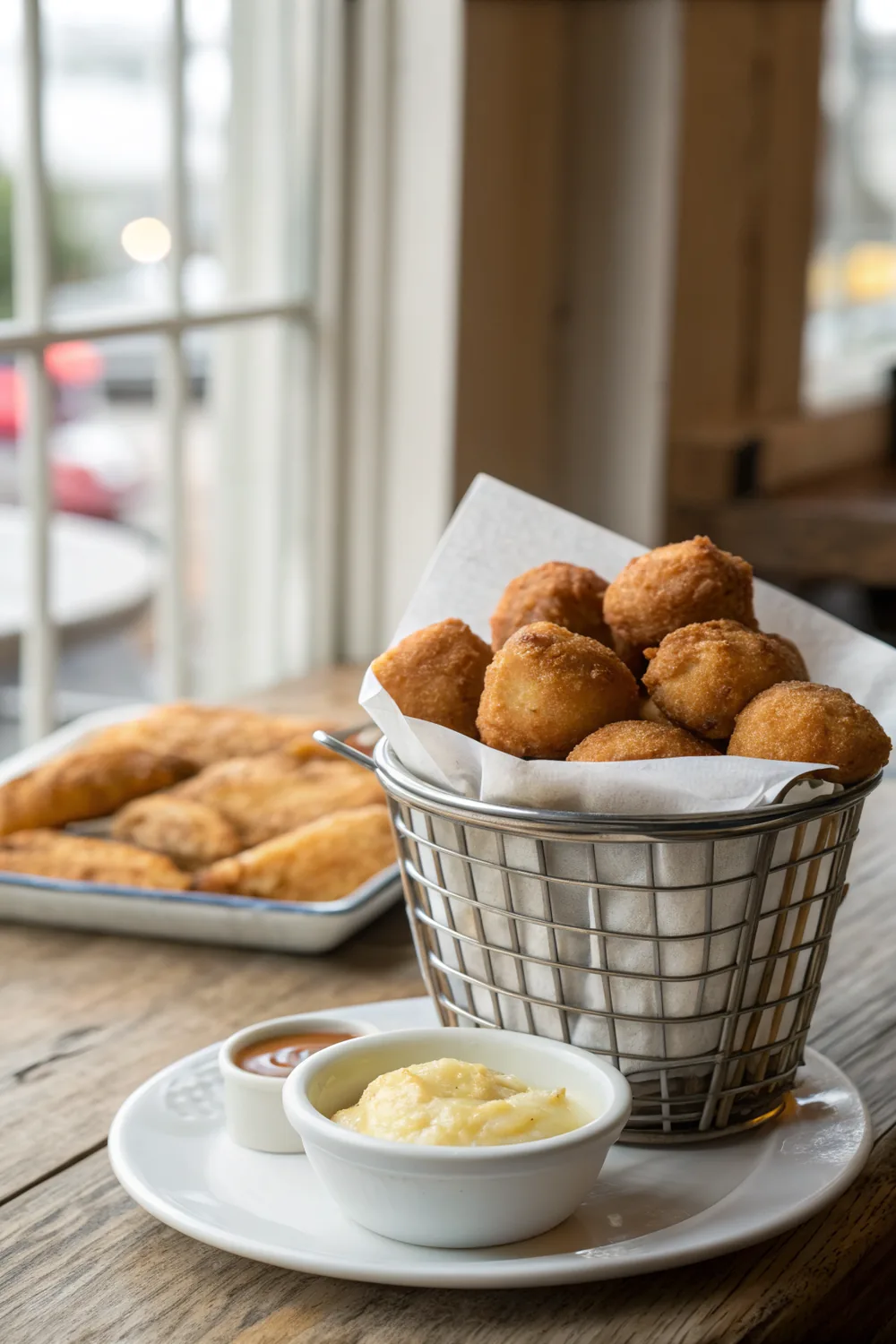
Southern Comfort Food
Hush Puppies
Chef Mia's hush puppies: 2-to-1 cornmeal to flour, buttermilk, grated onion, 10-minute rest, 3 minutes in 365F oil. Crisp shell, soft center, no sinkers.
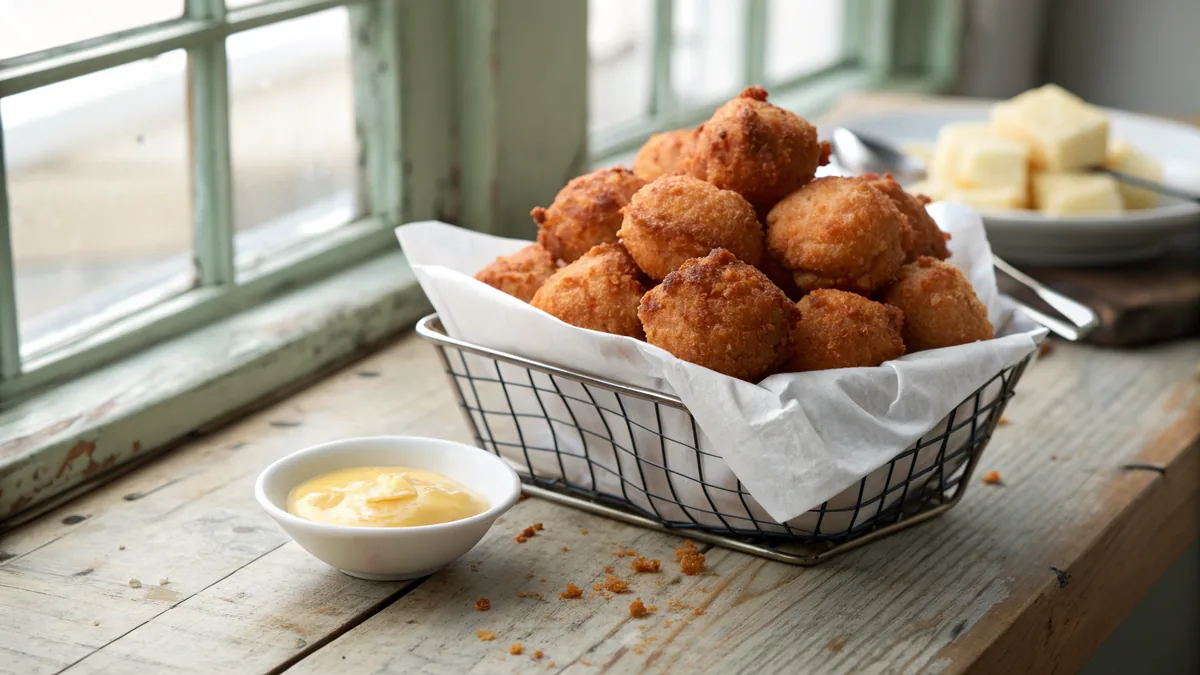
Quick answer: Hush puppies are small fritters of cornmeal batter, roughly two parts fine or medium cornmeal to one part flour, leavened with baking powder and a little soda, bound with buttermilk and an egg, flavored with grated onion, and deep-fried by the spoonful in about three inches of oil at 365F for three minutes until they are deep golden outside and soft and steamy inside. The batter rests ten minutes so the cornmeal hydrates, which is what keeps them from turning into dense, greasy sinkers. They are the fried cousin of cornbread, built to sit next to fried catfish and fried shrimp, and they are best within ten minutes of leaving the oil.
A hush puppy is cornbread that decided to be a fritter. Same cornmeal, same buttermilk, same egg, same leavening, but instead of going into a hot skillet and baking into a wedge, the batter goes into hot oil by the spoonful and fries into a golf ball with a crackling shell and a soft, steamy, onion-flecked middle. It is the required side at every fish fry, catfish house, and lake-house cookout from the Carolinas to the Texas Gulf Coast, and it is the one cornmeal dish that never, under any circumstances, goes in the oven.
The failure mode is the sinker: a hush puppy that is dense, heavy, greasy, and raw in the center. It comes from a batter that was mixed and fried immediately, so the cornmeal never absorbed the liquid, or from oil that was too cool, so the fritter soaked instead of set. Both fixes are simple and both are in the recipe. Ten minutes of rest and a thermometer are the whole difference between a basket that disappears and a basket that gets pushed to the side.
I keep two cornbread recipes on this site, the cast iron skillet cornbread and the authentic Texas cornbread, and the batter here shares most of their DNA. The differences are exactly the ones that let it fry: a little more flour for structure, an onion for flavor, a thicker consistency so it holds a ball shape, and heat from all sides at once. If you have made either of those cornbreads, you already know the ingredients. What changes is what you do with them.
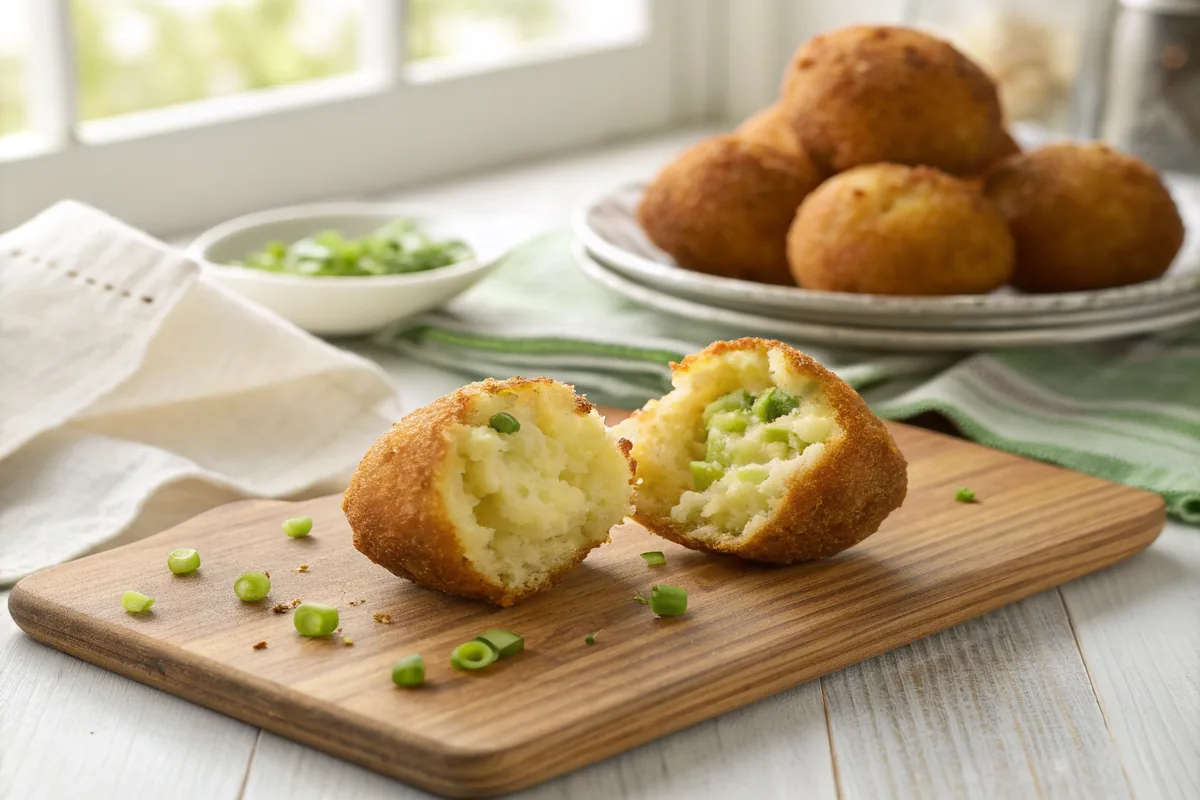
Hush Puppies Are Fried Cornbread, and That Changes Everything
The ingredient list for a hush puppy and the ingredient list for a skillet cornbread are nearly the same piece of paper. Cornmeal, flour, leavening, salt, buttermilk, egg. What separates them is the cooking, and the cooking dictates three small changes in the batter that make all the difference. A cornbread batter is pourable, because it spreads into a skillet and sets slowly from the bottom and the edges in a 425F oven. A hush puppy batter has to hold its shape in oil for the first thirty seconds until the outside sets, so it is stiffer, with more flour and less liquid.
The second change is onion. Cornbread rarely has it; a hush puppy almost always does, grated so it disappears into the batter and leaves its juice behind. Frying concentrates that onion sweetness in a way baking never would. The third is that a hush puppy has no crust in the cornbread sense, no crackly bottom from hot bacon fat in a skillet, and instead has a shell all the way around, because it cooks in 365F oil from every side at once. That shell is thinner and crisper than any cornbread crust and it is the reason the dish exists.
So: same corn, different shape, different heat, different bread. My Texas cornbread is a savory, sugarless wedge baked in preheated bacon fat; my cast iron skillet cornbread is the everyday version with a slightly softer crumb. Neither of them should ever be fried, and a hush puppy should never be baked. The oven turns hush puppy batter into dense, oniony muffins. The fryer turns cornbread batter into flat, greasy discs. Match the batter to the heat.
The Name, and Where the Dish Comes From
Nobody knows for certain where the name comes from, and the honest thing is to say so. The popular story, that cooks at fish fries tossed bits of fried cornmeal batter to the dogs to hush their whining, is charming, appears in print by the 1920s and 1930s, and has never been documented as an origin. Food historians have traced the term to the Southern coast, especially the Carolinas and Georgia, where fried cornmeal fritters called red horse bread or by other names were a fixture of fish camps and outdoor fish fries well before the hush puppy name took over.
What is certain is the lineage. Cornmeal fritters fried in hot fat run through the whole of Southern and African American cooking, and the hush puppy is the coastal, fish-fry branch of that family, cooked in the same oil as the catfish or the mullet, in the same cast iron pot, at the end of the fry when the oil was hot and seasoned. That is why the dish is inseparable from fried fish in every Southern state and why it always tastes a little better when it comes out of oil that has already fried something.
In Texas the hush puppy came up the Gulf Coast and in from the east with the catfish houses, and it settled into two homes: the fish fry, where it belongs to the fried catfish and fried shrimp, and the barbecue joint, where it turned up as a side alongside the beans and the slaw. A Central Texas smokehouse hush puppy tends to be a little sweeter and often has jalapeno in it, which is the state making the dish its own.
Cornmeal: Grind, Color, and the Two-to-One Ratio
Fine or medium yellow cornmeal is the right grind. Fine gives a smoother, more cake-like interior and a thinner, more even shell; medium, especially stone-ground, gives a craggier surface and a slightly rustic, gritty bite that a lot of Southern cooks prefer. Both work at the same ratio. Coarse cornmeal, the polenta grind, never hydrates in the short rest and fries into something sandy with a raw, gritty middle; keep it for the cornbread, where it has twenty minutes in the oven to soften.
Yellow versus white is a regional argument that does not change the method. The Carolinas and coastal Georgia lean white; Texas and most of the Deep South lean yellow. Yellow cornmeal gives a deeper golden color and a slightly sweeter corn flavor. Use what your cornbread uses. Self-rising cornmeal mix, common in Southern grocery stores, already contains flour, leavening, and salt; if that is what you have, use two and a quarter cups of it, skip the flour, baking powder, soda, and salt, and proceed.
The ratio is roughly two parts cornmeal to one part flour, and it matters. All cornmeal, the old fish-camp way, fries into something crumbly and fragile that falls apart on the spoon. All flour is a doughnut. Two to one gives you enough gluten from the flour to hold a ball together in the oil and enough cornmeal for the flavor and the shell. Some recipes go one to one for a softer, more uniform fritter; I find it loses the corn.
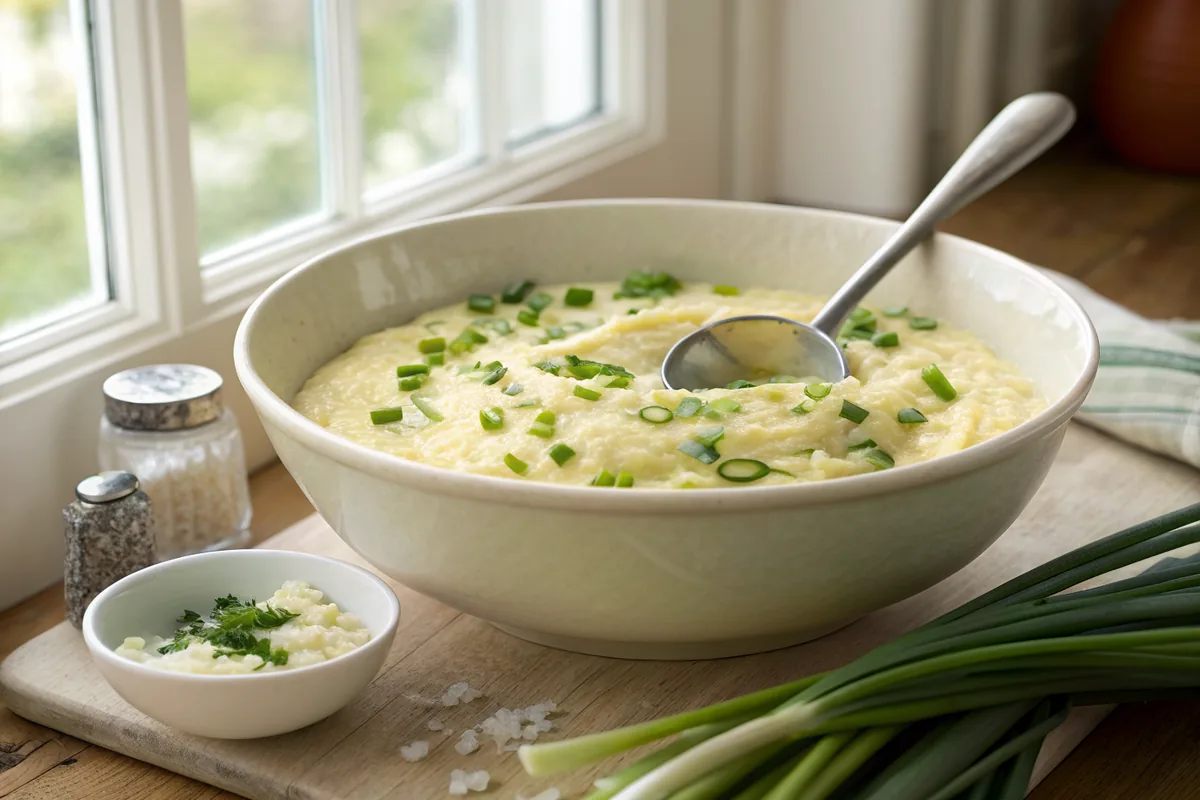
Buttermilk, Egg, Onion, and the Sugar Question
Buttermilk does three things. Its acid reacts with the baking soda for lift, so the fritter is light rather than leaden. Its fat and proteins tenderize the crumb. And its tang balances the sweetness of the corn and the onion. Regular milk with a tablespoon of vinegar or lemon juice is the standard substitute and it works, though the flavor is flatter. Plain yogurt thinned with a little milk is closer.
One egg binds a batch of about two dozen. It gives the batter enough structure to survive the drop into the oil and sets into the shell as it fries. Two eggs makes them cakier and more uniform, closer to a corn muffin, which some people prefer and which I find loses the crackle. One egg, beaten into the buttermilk before it meets the dry ingredients.
Onion is the hush puppy's signature and grating it is the trick. Diced onion stays in raw chunks that steam and go soft inside the fritter; grated onion, on the large holes of a box grater, dissolves into the batter and leaves both its flavor and its juice, which slightly loosens the batter and adds a sweetness that carries through the fry. Sliced green onions on top of that add color and a fresher bite. A minced jalapeno, seeds out, is the Texas addition and it belongs.
Sugar is the argument. Coastal Carolina hush puppies are often noticeably sweet; the classic Deep South fish-camp version has none; Texas splits down the middle, with barbecue-joint hush puppies leaning sweet and catfish-house ones leaning savory. A tablespoon of sugar in this batch is a compromise that rounds the corn without reading as dessert. If you make your cornbread with no sugar, as I do on the Texas cornbread page, leave it out here too and let the onion carry the sweetness. If you serve them with honey butter, the sugar in the batter is redundant.
The Ten-Minute Rest Is the Whole Trick
Cornmeal is not flour. It absorbs liquid slowly, and a batter that is mixed and fried immediately goes into the oil with the cornmeal still dry inside a wet slurry. Two things happen. The batter is looser than it should be, so it spreads and sinks and picks up oil before the shell forms, and the cornmeal finishes hydrating inside the fritter using the steam that should have been making it light. That is a sinker: dense, greasy, raw in the middle. Every bad hush puppy in the world started with a batter that was not given time.
Ten minutes, uncovered, on the counter while the oil heats. In that time the cornmeal swells, the batter thickens noticeably, and the leavening starts to work. When you go back to it, it should hold a mound on a spoon and drop off in one piece. Twenty minutes is fine. Longer than about thirty, the baking powder has spent itself and the fritters come out flatter; if you need to hold the batter, refrigerate it and add a half teaspoon of baking powder before frying.
If the batter looks too loose after the rest, stir in a tablespoon of cornmeal. If it looks too stiff to drop, a tablespoon of buttermilk. The target is a batter that is clearly thicker than cornbread batter and clearly softer than biscuit dough. It should not be pourable and it should not be kneadable.
Oil at 365F, Three Inches Deep, Six at a Time
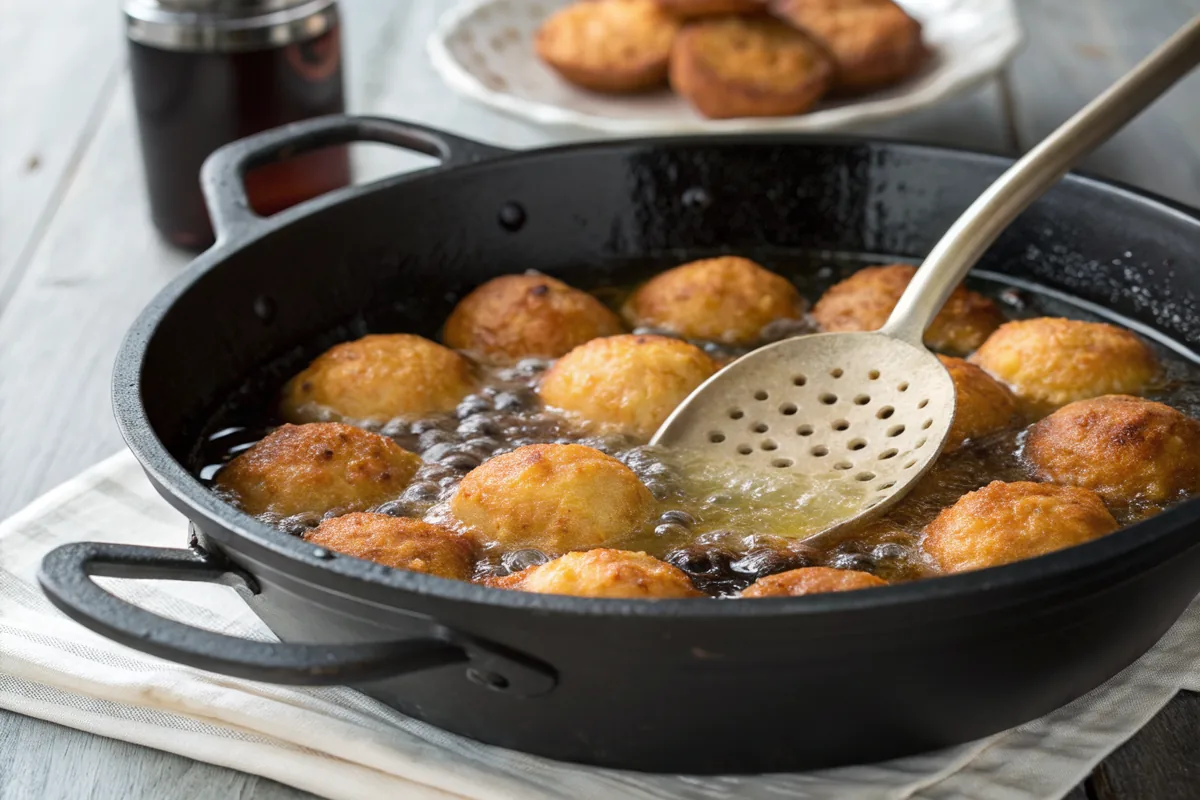
Hush puppies are deep-fried, not shallow-fried, and this is the one place they part ways from the rest of the Southern cornmeal canon. They need to float free in the oil so the shell forms evenly on all sides; a fritter sitting on the bottom of a shallow pan gets a flat, dark spot and a pale top. Three inches of oil in a Dutch oven or a deep cast iron pot is enough for them to sink, bob up, and roll.
365F is the number, and it is slightly higher than the 350F I use for fried okra or fried green tomatoes. A hush puppy is a raw batter that has to set its shell in the first thirty seconds before the oil can penetrate, and that needs a bit more heat than a dredged vegetable. At 350F they take four minutes and pick up more oil; at 375F the outside darkens before the center cooks. Use a clip-on thermometer; a hush puppy is not a dish that gives you visual cues in time to fix them.
Peanut oil is the classic fish-fry oil and the best one here for its high smoke point and clean flavor. Vegetable or canola oil is fine. Lard is the old way and makes an excellent hush puppy with a slightly richer shell. If you are frying fish the same day, fry the hush puppies last, in the same oil, which is exactly how the dish was born. Do not use olive oil or butter, both of which burn.
Six to eight at a time, no more. Each spoonful of cold batter drops the oil temperature, and a crowded pot falls to 325F and stays there. They should have room to float without touching. Let the oil come back to 365F between batches, which takes about a minute, and skim out any stray bits of batter so they do not burn and speckle the next round.
Scooping, Rolling, and Knowing When They Are Done
A small cookie scoop, the spring-loaded kind that holds about a tablespoon and a half, is the best tool for a hush puppy and turns out uniform fritters that cook at the same rate. Two tablespoons, one to scoop and one to push the batter off, is the traditional method and works fine. Either way, dip the scoop or spoon in the hot oil first; the batter releases in one clean piece instead of dragging.
Size matters more than shape. A tablespoon and a half of batter makes a fritter about the size of a golf ball once it puffs, which cooks through in three minutes. Bigger than that and the center stays raw when the outside is done; you end up with a dark shell around wet batter. Smaller and they overcook and dry out. Uneven, craggy shapes are correct and better than smooth ones, since the ridges crisp more.
They sink when they hit the oil and float within about thirty seconds once the shell sets and the leavening puffs them. From there, nudge them with a slotted spoon to roll over every minute or so, because the side above the oil will not color on its own. Three minutes total, give or take thirty seconds depending on size, until they are a deep, even gold and sound hollow when tapped with the spoon. Break the first one of each batch open to check: the center should be soft and steamy with no wet streak.
Drain on a wire rack over a sheet pan, not on paper towels, which trap steam under the fritter and soften the shell. Salt lightly while they are hot and glistening. If you are frying for a crowd, keep the finished ones on the rack in a 200F oven for up to twenty minutes; longer and they dry out.
The Fish Fry, the BBQ Tray, and the Honey Butter
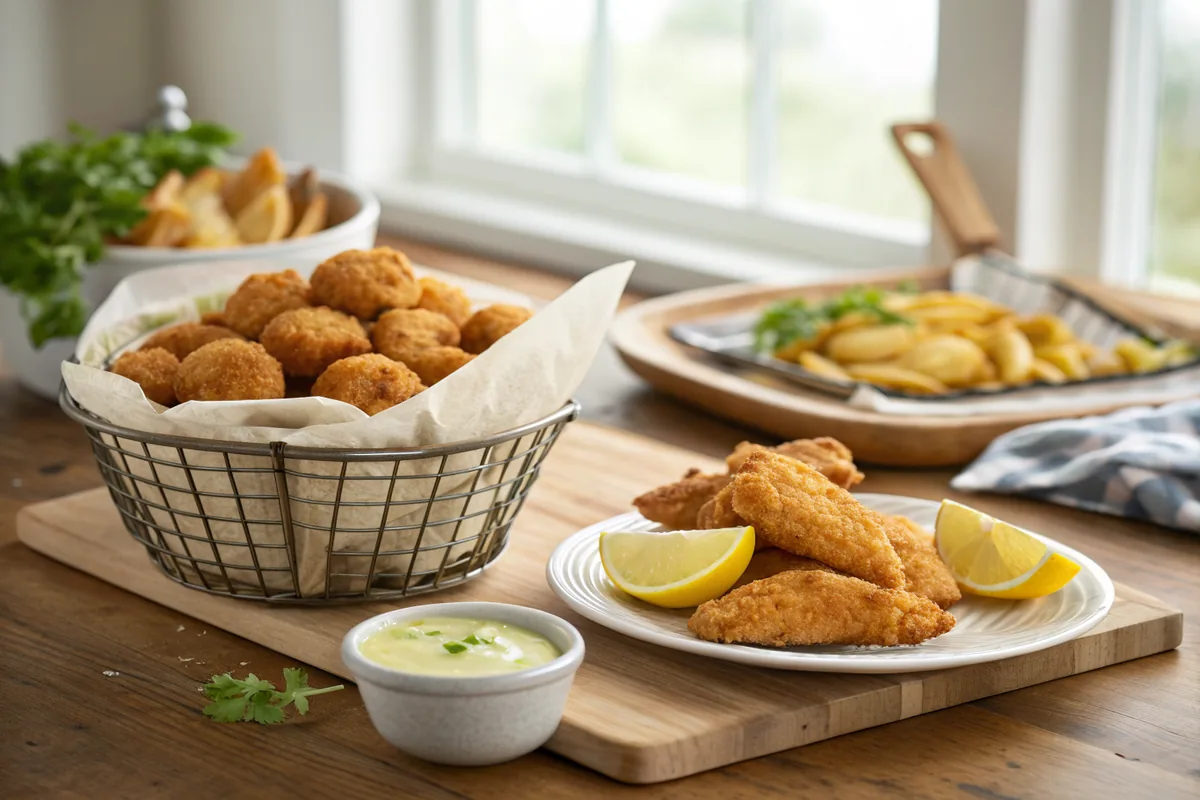
The hush puppy's first home is the fish fry, and its natural partners are fried catfish, fried shrimp, and a bowl of shrimp and grits if the kitchen is feeling ambitious. On that table they go with tartar sauce, hot sauce, a squeeze of lemon, and a wedge of raw onion. A basket of hush puppies next to a platter of fried fish is a complete Southern summer evening, and everything else is optional.
The second home is the barbecue joint, where Texas has adopted them as a side on the same tray as baked beans, creamy slaw, and the pickles. They do the same crunchy, starchy job that a slice of white bread does on a brisket plate, but better. Dipped in barbecue sauce they are wonderful, and a jalapeno hush puppy with a slice of smoked sausage is a Central Texas appetizer that belongs on more menus. The whole Southern side of that tray is mapped on the Southern comfort food hub.
Honey butter is the sweet side of the table: softened butter beaten with honey and a pinch of salt, served in a small dish so each hot hush puppy can be split and buttered. It is a Texas steakhouse habit borrowed from the dinner rolls and it suits hush puppies perfectly. On the savory side, comeback sauce, the mayonnaise, ketchup, and hot sauce blend from the fried green tomatoes page, or plain ranch, which no Texan will judge you for.
Hush puppies also sit comfortably next to a pot of black-eyed peas or collard greens in place of cornbread, and they dunk into potlikker as happily as a wedge from the skillet does. On a night when the fryer is already out for fried green tomatoes or okra, a batch of hush puppies from the same oil is almost free.
Variations Worth Frying
Jalapeno and cheddar. A minced jalapeno and half a cup of sharp cheddar in the batter. The cheese melts into pockets and the shell around them goes extra crisp. This is the barbecue-joint hush puppy and the one that disappears first at a party.
Sweet corn. Half a cup of fresh or thawed frozen corn kernels stirred in. Adds pops of sweetness and texture, and it is the summer version when the corn is good.
Bacon and green onion. Four slices of thick bacon, cooked crisp and crumbled, with the green onions doubled. Fry these in the bacon fat mixed into the oil if you want to go all the way.
Shrimp hush puppies. Half a pound of raw shrimp, chopped small, folded into the batter with a teaspoon of Old Bay. They need an extra minute in the oil. A Gulf Coast specialty that turns the side into a main.
Crawfish or andouille. A cup of chopped cooked crawfish tails or finely diced andouille, and a heavier hand of cayenne. Louisiana's answer, and it is a good one.
Storage and Reheating, Such As It Is
Hush puppies do not keep well and it is better to accept that than to fight it. They peak within ten minutes of the fryer and are still good for thirty. After that the shell softens as steam from the inside works its way out. Fry only as many as you will eat, and keep the batter for the next batch.
The batter itself holds in the refrigerator, covered, for up to a day. It thickens as it sits and the leavening fades, so stir in a tablespoon of buttermilk and a half teaspoon of baking powder before frying. Fritters fried from cold batter take about thirty seconds longer.
Leftover cooked hush puppies keep two days refrigerated. Reheat them on a rack in a 400F oven for 6 to 8 minutes or in an air fryer at 375F for 4 minutes, which brings the shell most of the way back. Never the microwave. They freeze after frying for up to 2 months and reheat from frozen in a 400F oven for about 12 minutes, which is a respectable result and better than most frozen fried things.
Mistakes That Ruin Hush Puppies
Frying the batter as soon as it is mixed. The cornmeal has not hydrated, the batter is too loose, and you get sinkers. Ten minutes of rest, always.
Oil too cool. Below 350F the shell sets slowly and the fritter soaks. 365F, measured, and back to 365F between batches.
Scoops too big. A golf ball of batter cooks through in three minutes; anything larger is dark outside and raw inside. A tablespoon and a half.
Diced onion instead of grated. Chunks steam and go soft inside the fritter. Grate it and use the juice.
Coarse cornmeal. It never softens in a three-minute fry. Fine or medium grind.
Shallow frying. A hush puppy needs to float. Three inches of oil in a deep pot.
Crowding the pot. Eight cold spoonfuls drop the oil 30 degrees. Six to eight at a time with room to roll.
Draining on paper towels, or holding them too long. Steam softens the shell from below and from within. A wire rack, and to the table within ten minutes.
Hush Puppies Recipe
Ingredients
- 1 1/2 cups (7 1/2 oz / 210 g) fine or medium yellow cornmeal
- 3/4 cup (3 1/4 oz / 95 g) all-purpose flour
- 1 tablespoon sugar (optional, see the sugar note)
- 2 teaspoons baking powder
- 1/2 teaspoon baking soda
- 1 teaspoon kosher salt
- 1/2 teaspoon freshly ground black pepper
- 1/4 teaspoon cayenne
- 1 cup (8 oz / 240 ml) buttermilk
- 1 large egg
- 1 small yellow onion, grated on the large holes of a box grater (about 1/3 cup with its juice)
- 2 green onions, thinly sliced
- 1 jalapeno, seeded and minced (optional)
- Peanut or vegetable oil for frying, about 6 cups (48 oz / 1.4 L)
- For the honey butter:
- 4 tablespoons (2 oz / 57 g) unsalted butter, softened
- 1 tablespoon honey
- Pinch of salt
Instructions
- Whisk the dry ingredients. In a large bowl, whisk together the cornmeal, flour, sugar if using, baking powder, baking soda, salt, pepper, and cayenne until evenly combined.
- Mix the wet ingredients. In a second bowl, whisk the buttermilk and egg together, then stir in the grated onion with its juice, the green onions, and the jalapeno.
- Combine and rest 10 minutes. Add the wet to the dry and stir just until no dry streaks remain. The batter should be thick enough to hold a mound on a spoon, like a stiff muffin batter. Let it rest, uncovered, for 10 minutes while the oil heats; the cornmeal will absorb the liquid and the batter will thicken slightly.
- Heat the oil to 365F. Set a Dutch oven or deep heavy pot over medium-high heat with 3 inches of oil and bring it to 365F on a thermometer. Set a wire rack over a sheet pan beside the stove.
- Scoop the batter. Use a small cookie scoop, about 1 1/2 tablespoons, or two spoons, to drop rounded portions of batter into the oil. Dip the scoop in the hot oil first so the batter releases cleanly. Fry 6 to 8 at a time without crowding.
- Fry 3 minutes, rolling once. The hush puppies will sink, then rise and float within 30 seconds. Fry until deep golden brown all over, about 3 minutes, nudging them with a slotted spoon to roll them over halfway so they color evenly. They are done when they sound hollow when tapped and a tester comes out clean.
- Drain on the rack and salt. Lift them out with a slotted spoon onto the wire rack and sprinkle lightly with salt while they are hot. Let the oil come back to 365F before the next batch.
- Make the honey butter. Stir the softened butter, honey, and a pinch of salt together in a small bowl until smooth. Serve alongside, with hot sauce or comeback sauce for the other side of the table.
- Serve within 10 minutes. Pile the hush puppies in a basket lined with a paper towel and get them to the table hot. They are best in the first ten minutes and still good for thirty.
Frequently Asked Questions
What are hush puppies made of?
Hush puppies are a fried cornmeal batter, roughly two parts fine or medium cornmeal to one part all-purpose flour, with baking powder and a little baking soda for lift, salt, buttermilk, one egg, and grated onion. Some versions add sugar, green onions, jalapeno, or corn kernels. The batter is rested ten minutes so the cornmeal absorbs the liquid, then dropped by the spoonful into 365F oil and fried about three minutes until deep golden with a crisp shell and a soft, steamy center. They are essentially cornbread batter, slightly stiffer, deep-fried instead of baked.
Why do my hush puppies fall apart in the oil?
Usually the batter is too loose or was fried without resting. Cornmeal absorbs liquid slowly; a batter mixed and fried immediately is wetter than it looks and spreads in the oil before the shell can set. Let it rest ten minutes, and if it still does not hold a mound on a spoon, stir in a tablespoon of cornmeal. Too little flour is the other cause, since flour provides the gluten that holds the ball together; keep the ratio near two parts cornmeal to one part flour. Oil below 350F also lets fritters spread before they set.
Why are my hush puppies raw or gummy in the middle?
Two causes: the scoops were too big, or the oil was too hot. A tablespoon and a half of batter makes a golf-ball fritter that cooks through in three minutes; anything larger has a dark shell around a wet center by the time it looks done. Oil above 375F darkens the outside before the inside sets. Keep the oil at 365F, keep the scoops small, roll them halfway, and break the first one of each batch open to check for a soft, steamy, fully set center.
Are hush puppies the same as cornbread?
They are made from nearly the same ingredients but they are different breads. Cornbread is a pourable batter baked in a hot skillet, with a crackly bottom crust from preheated fat and a tender crumb. A hush puppy is a stiffer batter with grated onion, deep-fried in 365F oil so it forms a thin, crisp shell on every side around a soft center. Neither one can be cooked the other way: baked hush puppy batter makes dense onion muffins, and fried cornbread batter spreads into flat, greasy discs.
Do hush puppies have sugar in them?
It depends on where you are. Coastal Carolina hush puppies are often noticeably sweet, the classic Deep South fish-camp version has none, and Texas splits between sweeter barbecue-joint hush puppies and savory catfish-house ones. A tablespoon of sugar in a two-dozen batch rounds the corn flavor without tasting sweet. If your cornbread has no sugar, leave it out here and let the grated onion supply the sweetness, especially if you are serving them with honey butter.
What oil is best for frying hush puppies?
Peanut oil is the classic fish-fry choice, with a high smoke point and a clean flavor, and it is the best option. Vegetable or canola oil work well. Lard is the old-fashioned fat and makes a slightly richer shell. Use about three inches in a Dutch oven or deep cast iron pot so the fritters can float and roll, and hold it at 365F. If you are frying fish the same evening, fry the hush puppies last in the same oil, which is how the dish was traditionally made. Avoid butter and olive oil, which burn at frying temperature.
Can hush puppies be made ahead or frozen?
The batter can be mixed up to a day ahead and refrigerated, covered; stir in a tablespoon of buttermilk and a half teaspoon of baking powder before frying, since it thickens and the leavening fades. Fried hush puppies are best within ten minutes and good for thirty. Leftovers keep two days in the refrigerator and reheat on a rack in a 400F oven for 6 to 8 minutes or in an air fryer at 375F for 4 minutes. They also freeze after frying for up to 2 months and reheat from frozen in a 400F oven for about 12 minutes.
What do you serve hush puppies with?
Fried catfish and fried shrimp first, with tartar sauce, hot sauce, and lemon, because that is the table the dish was built for. In Texas they also turn up on the barbecue tray next to baked beans and slaw, dipped in barbecue sauce. Honey butter is the sweet accompaniment, comeback sauce or ranch the savory one. They stand in for cornbread beside a pot of black-eyed peas or collard greens and dunk into potlikker just as well, and a bowl of shrimp and grits with a basket of hush puppies is a full Lowcountry supper.