Tex-Mex Recipes
Ranch Style Beans
Chef Mia's homemade ranch style beans: pintos in a tangy chili-cumin sauce with vinegar and no molasses. The copycat that finally tastes like the can.
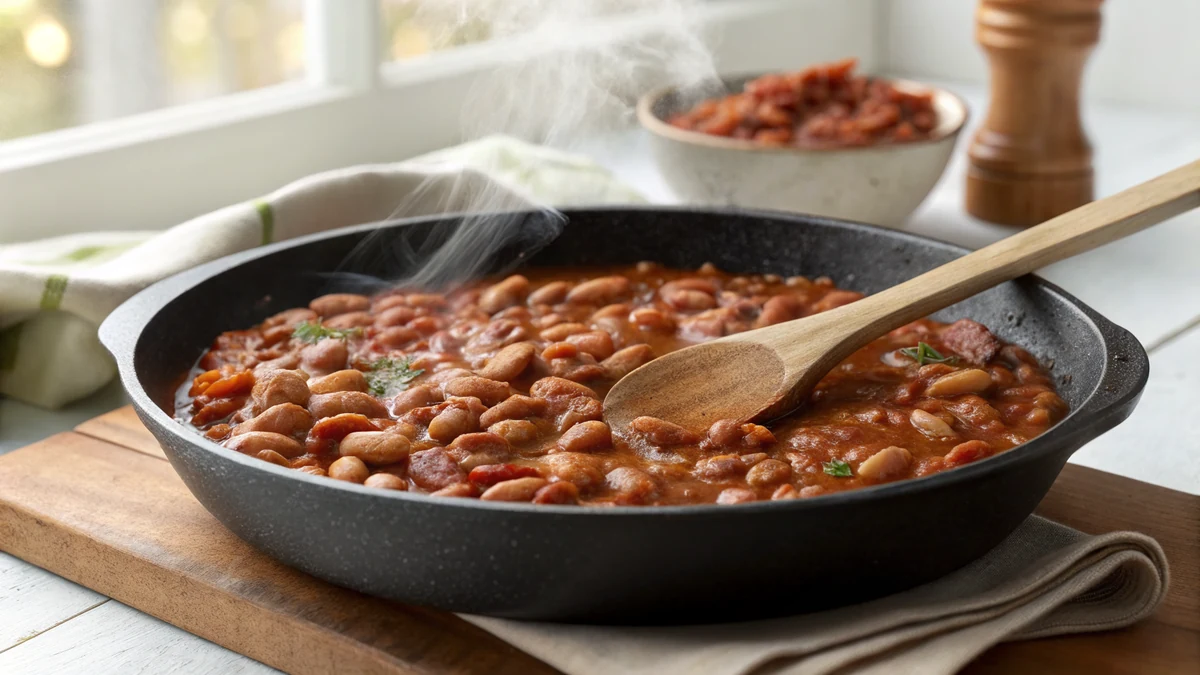
Quick answer: Ranch style beans are the tangy, savory Texas canned bean that people confuse with baked beans and should not. There is no molasses, no brown sugar, and no bacon in the flavor profile; what defines them is a sharp chili-powder-and-cumin sauce cut with distilled white vinegar, thickened just enough to cling to the beans rather than pool around them. To copy it at home, simmer pinto beans until tender, build a separate sauce from beef broth, tomato paste, chili powder, cumin, garlic, onion powder, and a tablespoon and a half of white vinegar, then combine and cook them together 25 minutes so the beans absorb it. The tell that you got it right is the finish: savory and slightly sour, never sweet. This recipe is inspired by the canned Texas classic and is not affiliated with or endorsed by any brand.
Every Texas pantry I have ever raided has a couple of these cans in it, and nobody can quite tell you what is in them. They are not baked beans. They are not chili beans, though they are closer to that. They are savory and a little sour and faintly dusty with chili powder, and they have been the default emergency side dish in this state for the better part of a century. You open one, heat it, and it tastes like a specific thing that no other canned bean tastes like.
I started trying to reverse-engineer them after a Thanksgiving where I needed four cans and the store had none, and my first three attempts were failures for the same reason: I kept making baked beans. Brown sugar crept in. A little molasses. Some bacon. Every time, I ended up with something perfectly nice that tasted nothing at all like the can, because I was building sweetness into a bean that is fundamentally not sweet.
The breakthrough was vinegar, and specifically plain distilled white vinegar rather than cider or wine. That sour backbone is the thing your palate has been registering all these years without naming it, and once you put it in, the whole profile snaps into focus. What follows is the version I have made a dozen times since. This page is a home copycat inspired by the canned Texas classic; I have no affiliation with the brand and I am not reproducing anyone's formula, just working backward from taste the way anyone with a saucepan can.
What Ranch Style Beans Actually Taste Like
Before you can copy something you have to describe it accurately, and this is where most homemade attempts go wrong before the first pan gets hot. So let me be precise about the target.
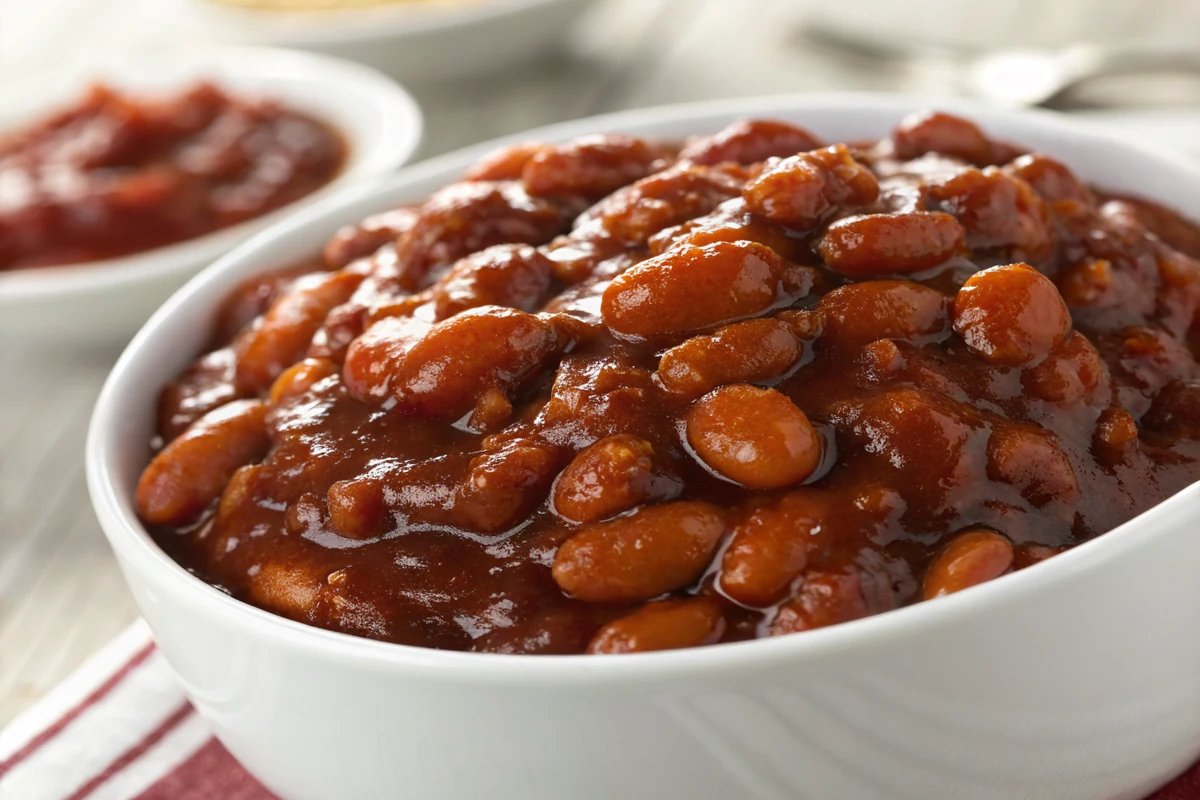
The sauce is thin-bodied but clinging. It is not a syrup and it is not a gravy. It coats each bean in a thin film and there is only a small amount pooled in the bottom of the bowl. The color is a dull brick red, matte rather than glossy, which is your first clue that there is no sugar in it; sugar-based bean sauces shine.
The flavor arrives in a specific order. Savory and meaty first, from tomato and a beef-broth backbone. Then chili powder and cumin, dusty and warm rather than hot. Then, on the finish, a distinct sour note that lingers a beat after you swallow. That sour finish is the signature and it is what your palate uses to identify the dish even if you have never consciously noticed it.
The beans themselves are whole, soft, and slightly firmer than a home pot of pintos usually ends up. They hold their shape completely. There is no creaminess, no broken beans thickening the sauce, no bacon, and nothing sweet anywhere in the profile.
That last point deserves repeating because it is the hard part. Every instinct trained on American canned beans wants to add brown sugar. Do not. The moment sweetness enters, you have left this dish and arrived somewhere in the neighborhood of Texas BBQ baked beans, which is a great pot of beans and a completely different one.
The Vinegar Is the Whole Secret
A tablespoon and a half of distilled white vinegar, added near the end, is the single change that took my attempts from generic chili beans to something my family blind-tasted against the can and could not confidently separate.
Use plain distilled white vinegar and not a substitute. Apple cider vinegar brings a fruity roundness that reads as wrong here. Red wine vinegar brings tannin. Lime juice brings citrus oil. All three are lovely acids and all three announce themselves as an ingredient. Distilled white vinegar is nearly flavorless apart from sourness, which is exactly why it belongs: you want the sour without a second flavor riding along.
Timing matters as much as choice. Vinegar goes in during the last few minutes, over low heat, and gets no more than three minutes of contact. Acetic acid is volatile; boil it hard for twenty minutes and the sharp aromatic top note evaporates off, leaving behind a flat sourness that tastes like a mistake rather than a decision. Added late, it stays bright.
If you taste at the end and it seems slightly too sour, resist correcting it with sugar. Let it rest ten minutes instead. The sharpness settles considerably as the pot cools off the simmer, and what reads as aggressive in a hot spoonful lands as balanced at serving temperature. If it genuinely is too much after resting, a splash more broth is the correct fix.
Why Beef Broth and Not Water
The canned original has an unmistakably meaty base to it despite containing no visible meat, and beef broth is the cleanest way to reproduce that at home without putting bacon in and shoving the whole thing sideways into a different dish.
I use low-sodium beef broth for the sauce, two and a half cups, reduced by about a quarter before the beans arrive. That reduction step is not optional filler. You are concentrating the broth while it is still on its own, because once a pound of beans goes in they will absorb liquid and dilute whatever flavor is there. Build strong, then dilute deliberately.
Low-sodium specifically, because you are reducing and then adding salt at the end. Regular beef broth reduced by a quarter and then salted to taste is a reliable route to something inedible. Salt is the one thing you should always be able to add later, and never a thing you should be trying to remove.
For a vegetarian version, mushroom broth is a far better swap than vegetable broth. Vegetable broth tends to be sweet and carroty, which fights the profile directly. Mushroom broth brings glutamates and a savory depth that stands in credibly for beef. Add half a teaspoon of soy sauce if you want to push it further; nobody will identify it and it fills in the meaty gap.
Grate the Onion, Do Not Dice It
This is a small technique with an outsized effect on whether your batch reads as a copycat or as a homemade approximation, and it costs you nothing but thirty seconds with a box grater.
Diced onion, no matter how fine, leaves visible pieces and a distinct texture in the finished pot. The canned original has no onion texture in it at all; the allium flavor is fully dissolved into the sauce. If you want to land close, you need the onion to disappear.
Grating on the large holes of a box grater turns the onion into a wet pulp that melts completely within about five minutes in hot fat. What is left is pure onion flavor distributed evenly through the sauce with no chunks. A food processor pulsed to a paste works too, though it releases more water and takes a couple of extra minutes to cook off.
I still use onion powder alongside the fresh onion, and that is not redundancy. Fresh onion cooked down gives you sweetness and body; onion powder gives you a toasted, concentrated allium note that fresh onion loses entirely once it caramelizes. The canned original clearly has both, and the combination is more convincing than either alone.
Same logic applies to the garlic and garlic powder pair in the ingredient list. Fresh for the round base note, powder for the sharp dry one. It reads as excessive on paper and tastes correct in the pot.
Cooking the Beans Plain First
The beans get cooked in nothing but water and a bay leaf. No salt, no aromatics, no stock. This feels wasteful and it is deliberate.
There are two reasons. First, acid and salt both slow bean softening, and this sauce is built on tomato paste and vinegar. Cooking the beans in the sauce from raw would give you a pot that simmers for three hours and still has beans with a chalky middle. Cook them plain, then introduce them to the acid once they are already tender and the acid can no longer hurt them.
Second, the flavor absorption happens during the twenty-five minutes the tender beans spend simmering in the finished sauce, not during the initial cook. A bean that has already absorbed two hours of seasoned stock has less capacity left to take on the sauce. Starting them blank means the only thing they have room to absorb is the thing you want them to taste like.
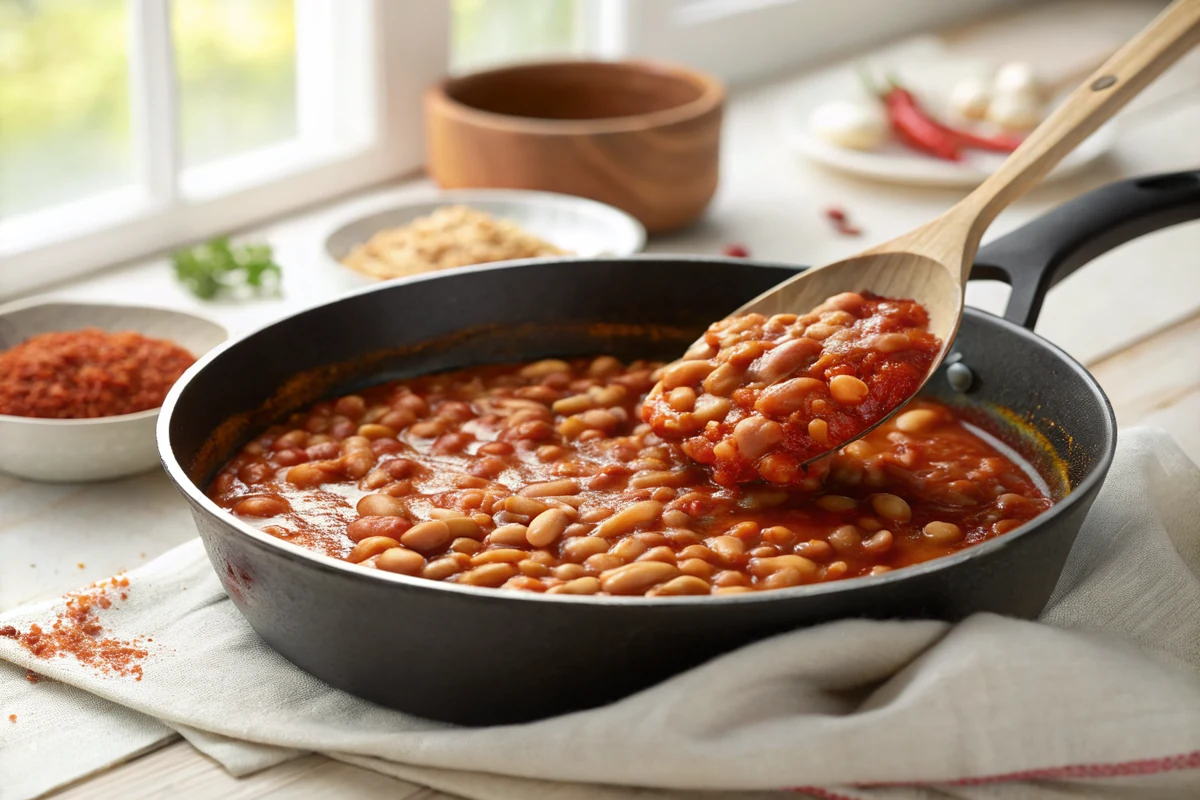
Save a cup of the cooking water when you drain them. That starchy liquid is how you adjust consistency at the end without diluting flavor the way plain water would. It is also the only thickener in the recipe; there is no flour, no cornstarch, and no mashed beans.
If you want to use canned pinto beans instead of dried, you can, and the result is honestly close. Use three 15-ounce cans, drained and rinsed well, and cut the simmer-together stage to 15 minutes since canned beans are softer and will break down if pushed. Substitute half a cup of water plus a teaspoon of cornstarch for the reserved bean liquid. Dried is better and cheaper; canned is Tuesday.
The Consistency Target and How to Hit It
Sauce that coats the beans, with only a small amount pooling. That is the target, and it is a narrower window than most bean dishes ask for.
The way to check: drag a spoon across the surface of the pot. The line it leaves should hold for about a second before closing back over. If it closes instantly, you are too thin. If it does not close at all, you are too thick and headed toward paste.
Judge it off the heat, not on it. A simmering pot always looks looser than the same pot will be at the table, and the difference is substantial here because the starch from the beans continues to set as it cools. I have over-reduced more than one batch by correcting a consistency that would have fixed itself in ten minutes of resting.
Do not mash beans to thicken. Whole beans in a clean sauce is the texture of the dish. Mashing clouds the sauce, turns it grainy, and pulls it toward refried beans territory, which is a different recipe with a different point. If you genuinely need more body, reduce longer or add a tablespoon of tomato paste, not mashed beans.
Where These Sit Against My Other Bean Pots
Texans cook a lot of beans and the categories blur, so here is the map, because these five dishes get confused with each other constantly and the differences are real and tastable.
Texas pinto beans is the creamy Sunday pot: pintos simmered slow with bacon and jalapeno until the pot liquor bodies up on its own. Soft, smoky, mild, no vinegar edge. It is the plainest and probably the most-cooked of the group.
Charro beans is the brothy Rio Grande Valley bowl, cooked in stock with bacon and chorizo and finished with a mountain of cilantro. Loose enough to eat with a spoon. Where ranch style beans cling, charro beans swim.
Texas BBQ baked beans go the opposite direction from this page entirely: molasses, brown sugar, chopped brisket, three hours in the oven until a dark crust sets on top. Sweet, thick, and unmistakably a barbecue side.
Cowboy beans are ground beef and bacon in a sweet-smoky sauce, hearty enough to eat as a main course out of a bowl. If you want beans with meat in them, that is the page, not this one.
Ranch style beans are the tangy, savory, meatless-tasting-but-beef-backed pot that sits apart from all four. Sharper than any of them, and the only one where sourness is the defining note rather than an accent.
And technically outside the bean family altogether sit my Southern black-eyed peas: cowpeas, thinner-skinned and faster-cooking than any pinto, simmered with a smoked hock into potlikker in about two hours, no soak. The quick pot of the lineup, and the only one carrying a New Year mandate.
What to Serve Them With
These are a workhorse side and they go with a wider range of food than their sharp profile suggests, precisely because the acidity cuts richness.
With barbecue, they are excellent next to anything fatty. Sliced brisket and ranch style beans is a better pairing than brisket with sweet baked beans, in my opinion, because the vinegar does the same job pickles do on a barbecue tray. Same goes for pulled pork and hot links.
With Tex-Mex, they are the standard side alongside Mexican rice. They also work as a topping rather than a side: spooned over Frito pie, they add a sour note that the chili and cheese badly need.
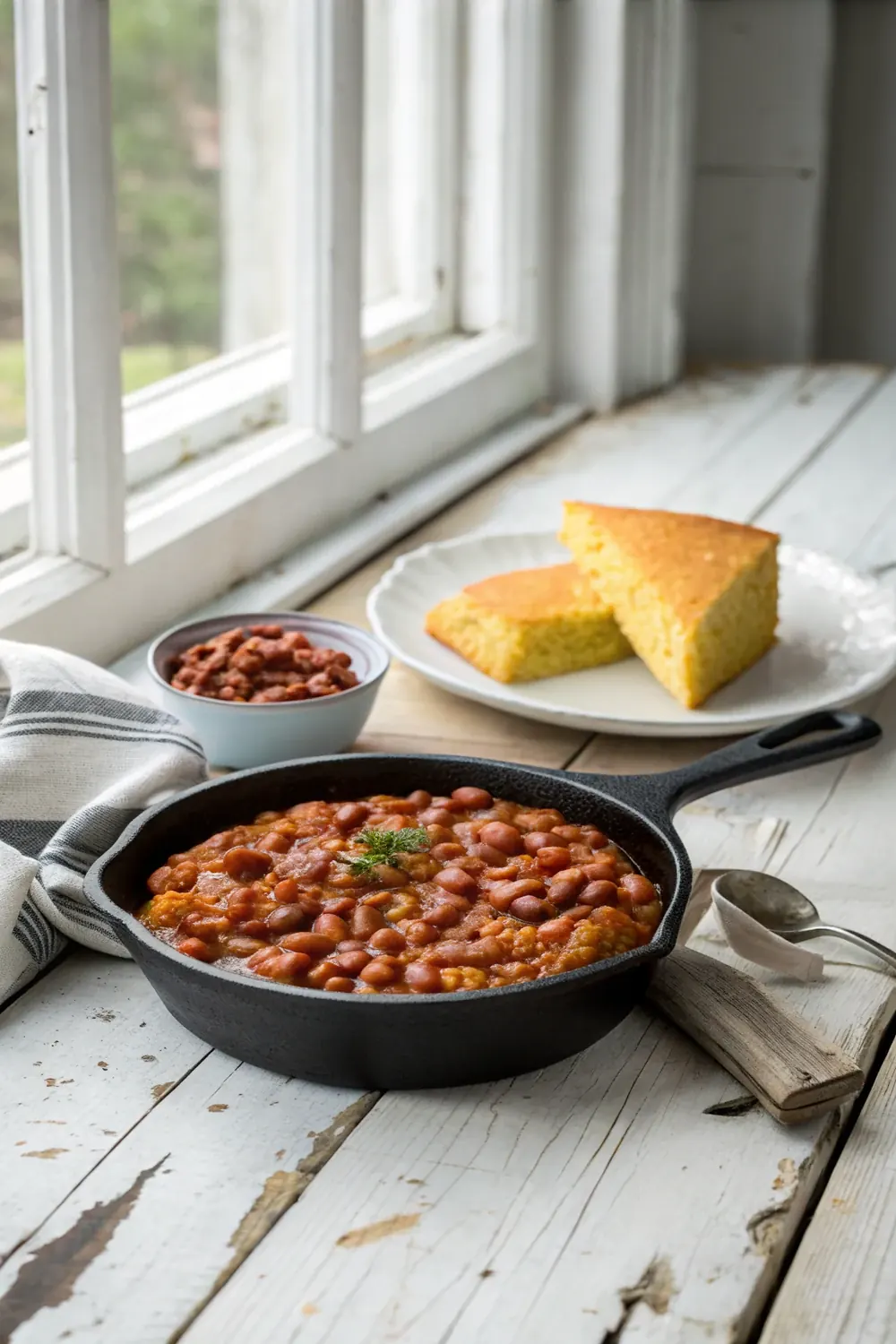
Cornbread is the obvious partner and it is obvious for a reason. A wedge of cast iron skillet cornbread crumbled into a bowl of these, with maybe some raw onion on top, is a complete supper that costs about a dollar a serving.
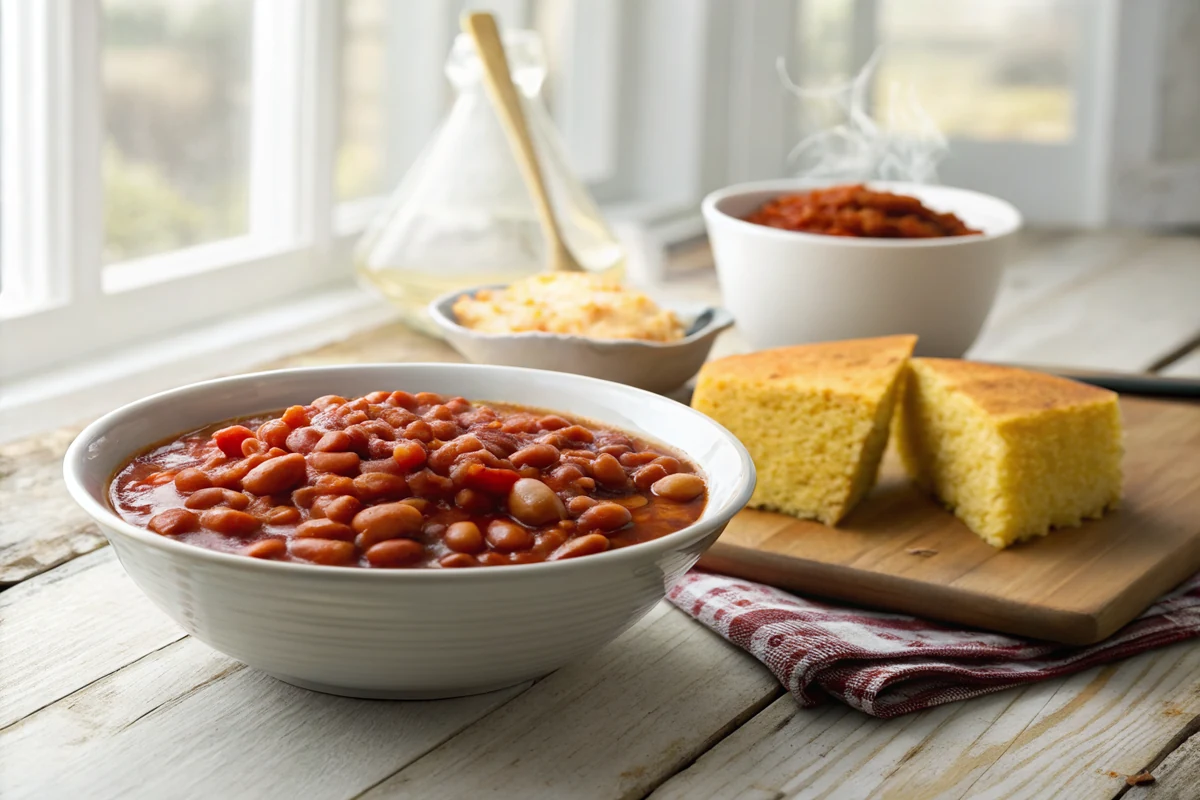
And for the fastest use of all: drain a portion, warm it, and spoon it into breakfast tacos with egg and cheese. The sour edge against soft scrambled egg is genuinely great and it is what I do with the last cup of every batch.
Storage, Freezing, and Making It Ahead
Refrigerated in a sealed container they keep five days, and like most bean dishes they are better on day two once the sauce has fully penetrated. The vinegar note softens slightly overnight, which most people prefer.
Reheat gently on the stove. They will have tightened in the fridge because the beans keep drinking the sauce, so add a splash of broth or water and stir over low heat until loose again. Taste for salt; it usually needs a pinch after thinning.
They freeze for three months and do it well. Whole beans in a light sauce survive freezing far better than a creamy or heavily reduced bean dish, which tends to break. Cool fully, portion into containers with an inch of headspace, and thaw overnight in the fridge before reheating.
For making ahead before a party, this dish is a genuine asset. Make the full batch two days early, hold it in the fridge, and reheat in a slow cooker on WARM for the event. It holds for hours without degrading, unlike a thick baked bean that sets up hard, or a brothy pot that reduces away.
One make-ahead trick: hold the vinegar back if you are cooking more than a day ahead. Make the whole recipe through the seasoning step, refrigerate, then stir the vinegar in during the reheat. You get a noticeably brighter finish than vinegar that has sat in the pot for two days.
Troubleshooting the Copycat
It tastes like chili, not like ranch style beans. Almost always too much chili powder or the addition of ground beef. This is not a chili bean; the meat character comes from broth and tomato only. Pull the chili powder back to two tablespoons and make sure the vinegar went in.
It tastes sweet. Something in your chili powder blend contains sugar, or your tomato paste is a sweetened brand, or you used cider vinegar. Check the chili powder label; several supermarket blends include sugar and even flour. A pure ancho or a clean Texas-style blend is worth buying for this.
The sauce is watery. Either you skipped reducing the broth before the beans went in, or you did not give the combined pot its full twenty-five minutes. Simmer uncovered until a spoon-drag holds, and remember to judge it after resting.
The beans are mushy and the sauce is cloudy. Overcooked at the initial stage, or stirred too aggressively during the simmer-together. Fold gently with a spatula rather than stirring with a spoon. If it has already happened, embrace it and serve them as a dip with chips; they are still good, just not a copycat.
The beans never got tender. Old dried beans, or acid or salt introduced during the initial cook. Beans more than a year off the harvest sometimes never soften at all regardless of technique. Buy from a store with turnover rather than the dusty bag at the back of the shelf.
It is flat and needs something. Nine times out of ten it wants salt, not more spice. Add half a teaspoon, stir, wait two minutes, taste again. If it is genuinely salted correctly and still flat, another half tablespoon of vinegar is the second lever.
Ranch Style Beans Recipe
Ingredients
- For the beans:
- 1 lb (454 g) dried pinto beans, sorted and rinsed
- 8 cups (1.9 L) water
- 1 bay leaf
- For the sauce:
- 2 tablespoons neutral oil or rendered beef fat
- 1 small yellow onion, grated on the large holes of a box grater
- 4 garlic cloves, minced
- 3 tablespoons tomato paste
- 2 1/2 cups (590 ml) low-sodium beef broth
- 2 tablespoons chili powder
- 1 tablespoon ground cumin
- 1 teaspoon onion powder
- 1 teaspoon garlic powder
- 1 teaspoon smoked paprika
- 1/2 teaspoon dried Mexican oregano
- 1/4 teaspoon cayenne, optional
- To finish:
- 1 1/2 tablespoons distilled white vinegar
- 2 teaspoons kosher salt, plus more to taste
- 1/2 teaspoon black pepper
Instructions
- Soak and cook the beans plain. Soak the pintos overnight in three inches of cold water, then drain. Put them in a pot with 8 cups of fresh water and the bay leaf, bring to a boil, then simmer partially covered 75 to 90 minutes until tender with no chalky center. No salt, no acid, nothing else. You are cooking a blank bean here; all the character arrives later.
- Reserve the bean liquid. Drain the beans over a bowl and keep 1 cup of the cooking liquid. That starchy water is your thickener at the end and there is no good substitute for it. Set the beans aside and discard the bay leaf.
- Grate the onion into the pan. Heat the oil in a wide skillet or the same pot over medium. Add the grated onion and cook 4 to 5 minutes until it has given up its water and softened completely. Grating rather than dicing is deliberate: the onion needs to melt into the sauce and vanish, because the canned original has no visible onion pieces in it.
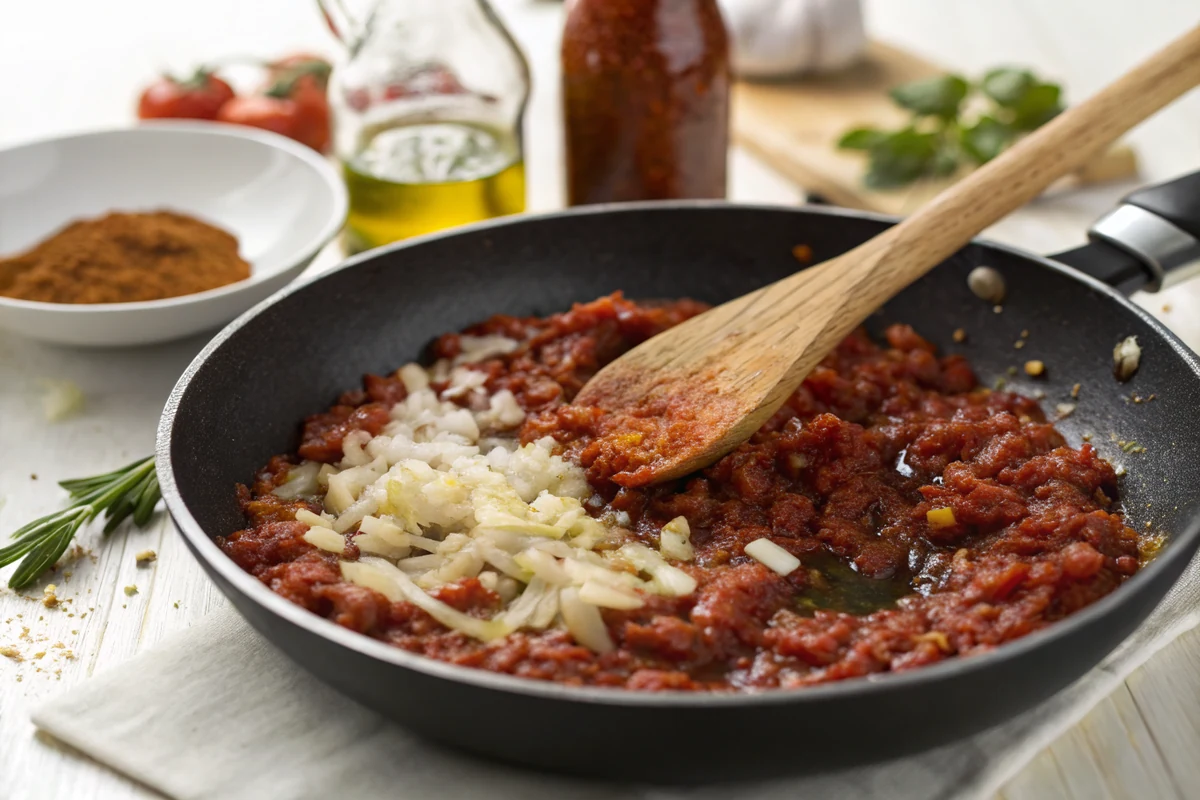
- Cook the tomato paste dark. Add the garlic and cook 30 seconds, then stir in the tomato paste and keep it moving for a full 2 minutes. The paste should go from bright red to a deep brick color and start sticking to the pan. This caramelization is where the savory depth comes from, and skipping it leaves the sauce tasting raw and tinny.
- Bloom the spice blend. Add the chili powder, cumin, onion powder, garlic powder, smoked paprika, Mexican oregano, and cayenne if using. Stir constantly for 45 seconds in the hot fat until fragrant. Do not let it go past that; chili powder scorches fast on a hot dry pan and turns bitter with no way back.
- Build and reduce the sauce. Pour in the beef broth, scraping the pan bottom clean. Bring to a simmer and cook 10 minutes uncovered, until it has reduced by roughly a quarter and coats the back of a spoon lightly. You are concentrating flavor before the beans go in and dilute everything.
- Combine and simmer together. Add the cooked beans and half a cup of the reserved bean liquid. Stir gently and simmer 20 to 25 minutes, uncovered, stirring occasionally with a folding motion rather than a stirring one. This is the step where the beans actually absorb the sauce instead of merely sitting in it, and it cannot be shortened.
- Add the vinegar off the boil. Drop the heat to low and stir in the white vinegar. Let it go 3 minutes, no more. Vinegar simmered hard for a long stretch loses its sharp top note and leaves only a dull sourness behind; you want the bright edge intact, because that edge is the whole signature of the dish.
- Season and set the consistency. Add the salt and pepper and taste. It should read savory first, sour second, and not sweet at any point. If the sauce is looser than you want, simmer a few more minutes uncovered; if it has gone tight, loosen with the remaining bean liquid. The target is a sauce that coats each bean and barely pools when you drag a spoon through.
- Rest before serving. Pull off the heat and let the pot sit 10 minutes before serving. The sauce tightens noticeably as it cools from a simmer, and it is the resting texture, not the bubbling texture, that you should be judging. Taste once more for salt after the rest.
Frequently Asked Questions
What are ranch style beans?
Ranch style beans are pinto beans in a tangy, savory chili-and-cumin sauce with a distinct sour finish from vinegar, long a staple canned side dish in Texas. They are not baked beans and contain nothing sweet: no molasses, no brown sugar, no bacon. The sauce clings to the beans in a thin coat rather than pooling, and the beans stay whole and firm rather than creamy.
What is the difference between ranch style beans and baked beans?
Sweetness and cooking method. Baked beans are built on molasses or brown sugar and finished in the oven until thick and often crusted on top. Ranch style beans are savory and sour, built on tomato, chili powder, cumin, beef broth, and vinegar, cooked entirely on the stovetop, and never sweet. Confusing the two is the single most common reason homemade copycats fail.
What is the secret ingredient in ranch style beans?
Distilled white vinegar, about a tablespoon and a half per pound of dried beans, added in the last few minutes over low heat. It supplies the sour finish that defines the flavor. Use plain white vinegar rather than cider or wine vinegar, which contribute their own fruit or tannin flavors and pull the profile away from the target.
Can you make ranch style beans with canned pinto beans?
Yes. Use three 15-ounce cans, drained and rinsed well, and shorten the simmer-together stage to about 15 minutes since canned beans are already soft and will break apart if pushed. Replace the reserved bean cooking liquid with half a cup of water whisked with a teaspoon of cornstarch. Dried beans give a firmer texture and cost far less, but canned works on a weeknight.
Are ranch style beans spicy?
Not really. They are assertively seasoned but mild in heat, with warmth coming from chili powder and cumin rather than capsaicin. The quarter teaspoon of cayenne in this recipe is optional and pushes it to a gentle background heat. To make them genuinely spicy, add a minced serrano with the garlic or a chopped chipotle in adobo with the tomato paste.
Do ranch style beans have meat in them?
The version here has no meat in it. The meaty depth comes from beef broth and caramelized tomato paste rather than bacon or ground beef, which is what keeps it distinct from a chili bean. For a vegetarian batch, swap the beef broth for mushroom broth plus half a teaspoon of soy sauce, which stands in for the savory backbone better than vegetable broth does.
Why are my homemade ranch style beans sweet?
Check three things. Your chili powder blend may contain added sugar, which several supermarket brands do. Your tomato paste may be a sweetened variety. Or you used apple cider vinegar, which reads fruity and sweet compared to distilled white. Any of the three will drag the profile toward baked beans, which is exactly the flavor this recipe is trying to avoid.
How long do homemade ranch style beans keep?
Five days refrigerated and three months frozen, and they improve on day two as the beans finish absorbing the sauce. They tighten in the fridge, so loosen with a splash of broth when reheating and taste for salt afterward. If you are making them more than a day ahead, hold the vinegar back and stir it in during the reheat for a brighter finish.