Tex-Mex Recipes
Chile Con Queso
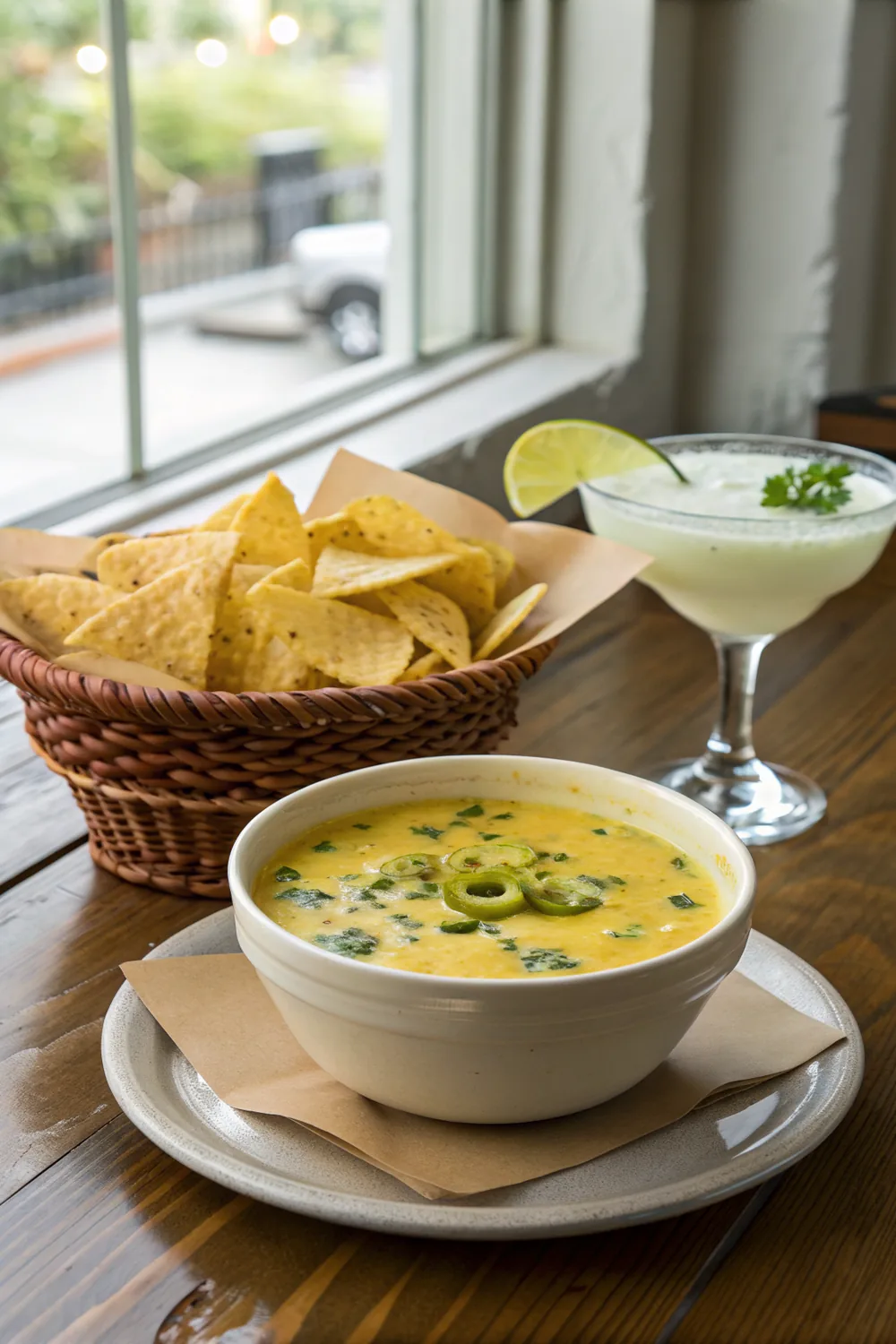
Chef Mia's chile con queso: 1 lb deli American cheese, 12 oz evaporated milk, green chiles, tomato, low heat, 20 minutes. Smooth yellow Tex-Mex dip.
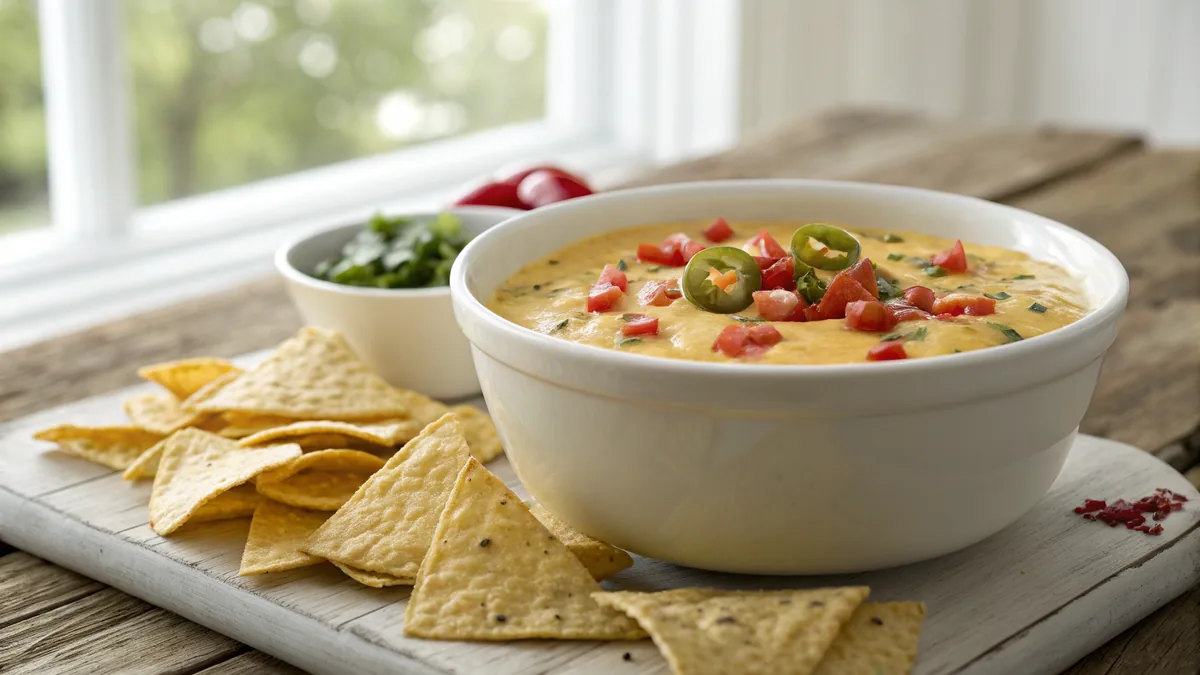
Quick answer: Chile con queso is the yellow Tex-Mex cheese dip: one pound of deli-sliced yellow American cheese melted on low heat into a 12 ounce can of evaporated milk with sauteed onion, garlic, a half cup of roasted green chiles, a diced tomato, a half teaspoon each of cumin and chili powder, and a squeeze of lime at the end. It takes 20 minutes, serves 8 as a dip, and never goes above a bare simmer, because American cheese stays smooth thanks to the sodium citrate already in it, and boiling is the one thing that breaks it. No Velveeta is needed, though the Velveeta and Ro-Tel microwave version is covered as the tailgate variation. Serve it in a warm bowl with thin restaurant-style tortilla chips, or build it into a Bob Armstrong dip with taco meat, guacamole, and pico in the middle.
Every Tex-Mex meal in Texas begins with the same bowl, and most home cooks have never made it right, because they either boil it or they buy the wrong cheese. Chile con queso, the yellow one, is not a complicated thing. It is a pound of yellow American cheese from the deli counter, melted into evaporated milk with onion, garlic, roasted green chiles, and a little tomato, kept on low heat and pulled before it ever bubbles. That is the whole dish. The restaurants in Austin and San Antonio that are famous for it are not hiding a secret; they are respecting a temperature.
This is the third queso on the site and it is a different bowl from the other two. My queso blanco dip is the white version, made with white American cheese in the style of Chuy's and Mi Cocina, pale and mild with green chile and no tomato. My smoked chorizo queso is the Velveeta-based pot that goes on the pit next to the brisket and picks up post oak smoke and crumbled chorizo. And my queso flameado is a Mexican skillet of melted Oaxaca cheese with chorizo, eaten with a fork and a tortilla rather than dipped. What you are reading now is the classic yellow chile con queso: green chiles and tomato, no chorizo, no smoke, the dip that arrives with the chips before you have opened the menu.
I cook this one in a heavy saucepan on the lowest flame my stove has, and I treat it like a custard, not a soup. The cheese goes in a handful at a time, the pot never sees a bubble, and the whole thing is done in the time it takes to warm the tortillas. Below you will find the reasons deli American works when a good sharp cheddar does not, the sodium citrate trick that lets you use the cheddar anyway, an honest look at the Velveeta and Ro-Tel shortcut, the Bob Armstrong build from Matt's El Rancho, and every way I keep a pot of queso warm through a party. The rest of the Tex-Mex recipes on this site assume a bowl of this is already on the table.
The Yellow Bowl at the Center of the Tex-Mex Table
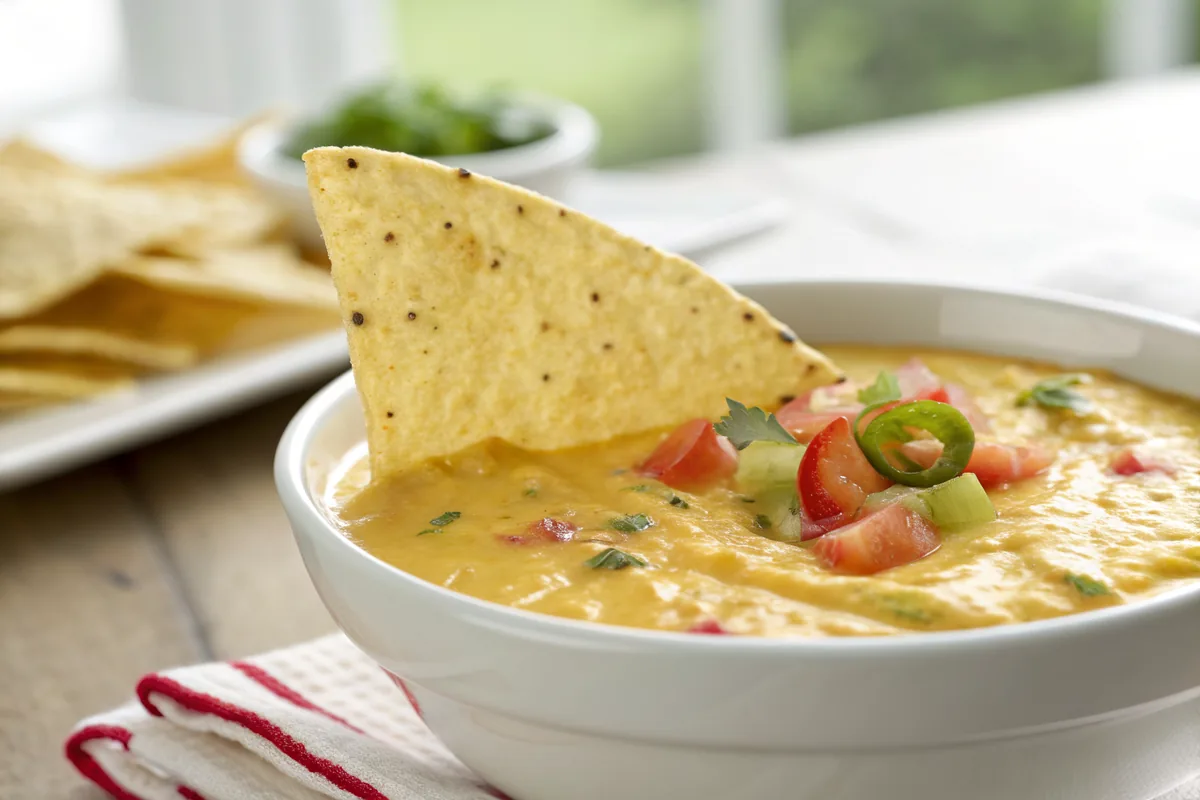
Chile con queso means, plainly, chile with cheese, and that order of words is the history of the dish. The original was a northern Mexican and border preparation of roasted green chiles held together with melted cheese, closer to a rajas con queso than to anything you would dip a chip into. When it crossed into the Tex-Mex restaurants of San Antonio, Austin, and El Paso in the early twentieth century, the proportions flipped. Cheese became the body and chile became the seasoning, and once processed American cheese was a grocery staple in Texas, sometime in the 1920s and 1930s by the community cookbooks I have seen, the dip took on the smooth, pourable, faintly orange character that everyone in the state now recognizes on sight.
Nobody owns the invention and I am not going to give you a date and a name that does not hold up. What I can tell you is that by the middle of the century, the bowl of yellow queso with the basket of chips, and at the better places a Texas margarita beside it, was the opening act of every Tex-Mex restaurant meal in Central Texas, and it still is. It arrives before you order, it is refilled without being asked for, and its quality is how regulars judge the kitchen before a single enchilada comes out. The restaurants that are famous for it in Austin and San Antonio share one method: American cheese, some kind of milk, low heat, green chile, a little tomato, served hot enough to steam and thin enough to pour.
That is the version on this page. It is the queso of a Tex-Mex restaurant on a Friday night, not a Super Bowl slow cooker, and not a Mexican cheese dish. It is unapologetically built on American cheese because that cheese is what makes it possible, and the rest of this page explains why and gives you a way around it if you want real cheddar in the pot.
Deli American, Sodium Citrate, and the Emulsion That Never Breaks
Cheese is an emulsion of fat and water held together by casein proteins. In a natural aged cheese like cheddar or Monterey Jack, those proteins are bound tightly to each other by calcium. Heat them and the protein network contracts, squeezes out its fat, and clumps, which is why a pot of melted cheddar goes stringy and greasy within a minute and turns into rubber as it cools. American cheese solves that at the factory. It is real cheese, mostly young cheddar and Colby, ground and cooked with emulsifying salts, chiefly sodium citrate and sodium phosphate, which grab the calcium and free the casein to act as an emulsifier. Melted, it flows like a sauce and stays that way. That is the entire reason it is the cheese of chile con queso, and no amount of technique with a block of sharp cheddar will match it without help.
Buy it from the deli counter, sliced thick, a full pound. Ask for yellow American, not white, and not the individually wrapped singles from the dairy case, which have more added water and a softer, sweeter set. The good deli brands are labeled pasteurized process American cheese, which under the federal standard has to be built mostly from actual cheese; that is the distinction from Velveeta, labeled a pasteurized prepared cheese product, a category with looser rules and more whey and milk protein concentrate. Both melt beautifully. The deli cheese tastes more like cheese, and in a dish where cheese is ninety percent of the bowl, that difference is the whole flavor.
Now the trick for people who want cheddar in the pot. Sodium citrate is the same emulsifying salt that makes American cheese work, and it is sold as a fine white powder online and in restaurant supply stores for a few dollars. Stir 1 teaspoon, about 5 grams, into the evaporated milk before the cheese goes in, and you can swap 8 ounces of sharp cheddar or Monterey Jack, grated from a block, for half of the American. Two teaspoons carries a full pound of natural cheese with no American at all. The citrate binds the calcium the way the factory would have, and the cheddar melts into a sauce as smooth as any queso in Austin, with a sharper, more grown-up flavor. It tastes faintly of nothing; it does not read as salty or chemical. My favorite ratio for company is half deli American and half sharp cheddar with the one teaspoon, which keeps the classic yellow color and adds real cheese depth.
Whatever cheese you use, grate or tear it yourself. Pre-shredded cheese is dusted with cellulose or potato starch to keep it from clumping in the bag, and that coating turns a queso grainy and dull. It is the most common reason a cheddar-and-citrate queso still comes out slightly sandy. A block and a box grater take two minutes.
Hatch, Poblano, the Small Can, and the Jalapeno Question
The chile in chile con queso is a roasted green chile: mild to medium, smoky from the char, soft enough to melt into the cheese. In late August and September that means Hatch chiles, when HEB and Central Market roast them by the sack in the parking lot and the whole store smells of it; two roasted Hatch chiles, peeled, seeded, and diced, is the right amount for a pound of cheese, and the Hatch chile recipes hub covers how to buy, roast, and freeze them for the other ten months. Out of season, one large poblano does the same job with a slightly deeper, greener flavor. Roast it under the broiler until blackened on all sides, about 8 minutes, steam it in a covered bowl for 10, then peel, seed, and dice.
The small can is not a compromise and I want to be clear about that. A 4 ounce can of diced green chiles, the Hatch-grown kind sold in every Texas grocery, is what most of the restaurants actually use, drained and stirred in. It is already roasted and peeled, it is consistent, and in a dip that is mostly cheese, the difference between it and a fresh-roasted poblano is real but small. Drain it well; the liquid in the can thins the queso and adds a faintly tinny note.
Jalapeno is the heat question and the answer depends on the table. A traditional Tex-Mex restaurant queso is mild, built so a child can eat it, and the heat lives in the salsa next to it. If you want the queso itself to bite, one jalapeno, seeded and minced, softened with the onion, is the right amount for a pound of cheese: warm, not hot. Two makes it a spicy queso. Leaving the seeds in is a different dish. Pickled jalapeno slices stirred in at the end are the diner version and they are good, with the vinegar cutting the richness, but their brine will thin the pot, so add them sparingly.
Fresh green chiles that are not roasted do not belong here. Raw diced poblano or bell pepper stays crunchy and grassy in the cheese and never gives up the smoky sweetness the dish is named for. Roast, or open the can.
Evaporated Milk Beats Cream, and It Beats Regular Milk
The liquid in a restaurant queso is nearly always evaporated milk, and there is science behind that habit. Evaporated milk is whole milk with about 60 percent of its water cooked off, so it carries roughly twice the milk protein and milk sugar of regular milk in the same volume, and it has already been heated hard in the canning, so its whey proteins are denatured and will not curdle or form a skin on the stove the way fresh milk does. Those concentrated proteins reinforce the cheese emulsion, which is why a queso made on evaporated milk stays smooth longer as it cools and reheats more forgivingly than one made on fresh milk.
Regular whole milk works and I use it to thin a queso that has tightened, but as the base liquid it makes a thinner, flatter dip that skins quickly and breaks sooner if it gets too hot. Cream is the opposite mistake: it makes a queso that is rich to the point of heaviness, with so much butterfat that the finished dip goes greasy on top and sets into a solid puck in the fridge. Half-and-half lands in between and is a fair substitute if the can is not in the pantry. Skip sweetened condensed milk, which is a different product entirely and will make a dessert.
One 12 ounce can to one pound of cheese is the ratio, and it gives a queso that pours off a spoon in a slow ribbon when hot. Restaurants that serve it thinner, the kind that runs off the chip, add up to a half cup more milk; I would rather serve it slightly thick and thin it at the table, because a queso only ever gets thicker as it sits.
Twenty Minutes on Low, and the 160F Ceiling
The whole method turns on one number. American cheese melts fully at around 150F (66C) and the emulsion in it holds comfortably to about 175F (79C). Above that, the proteins begin to tighten and the fat begins to separate, and a rolling boil, 212F, breaks any queso in under a minute no matter what cheese it is made from. So the pot is never allowed to bubble. Onion and garlic soften on medium-low, the evaporated milk comes to a bare steam, and from the moment the first piece of cheese goes in, the burner sits on its lowest setting and stays there. A thermometer clipped to the pan should read between 150F and 160F (66 to 71C) for the last ten minutes, and it should never climb past 170F.
Add the cheese in handfuls, not all at once. A pound of cold cheese dropped into a pot of hot milk chills the milk, and the impatient cook turns up the heat to compensate, which is exactly how the bottom scorches and the top breaks. A handful at a time, stirred gently until nearly gone, then the next; the pound takes five to seven minutes and the temperature never lurches. Use a silicone spatula and scrape the bottom on every pass. Heavy pans matter here; a thin saucepan has hot spots that will brown the cheese where it touches the metal, and those brown flecks are bitter.
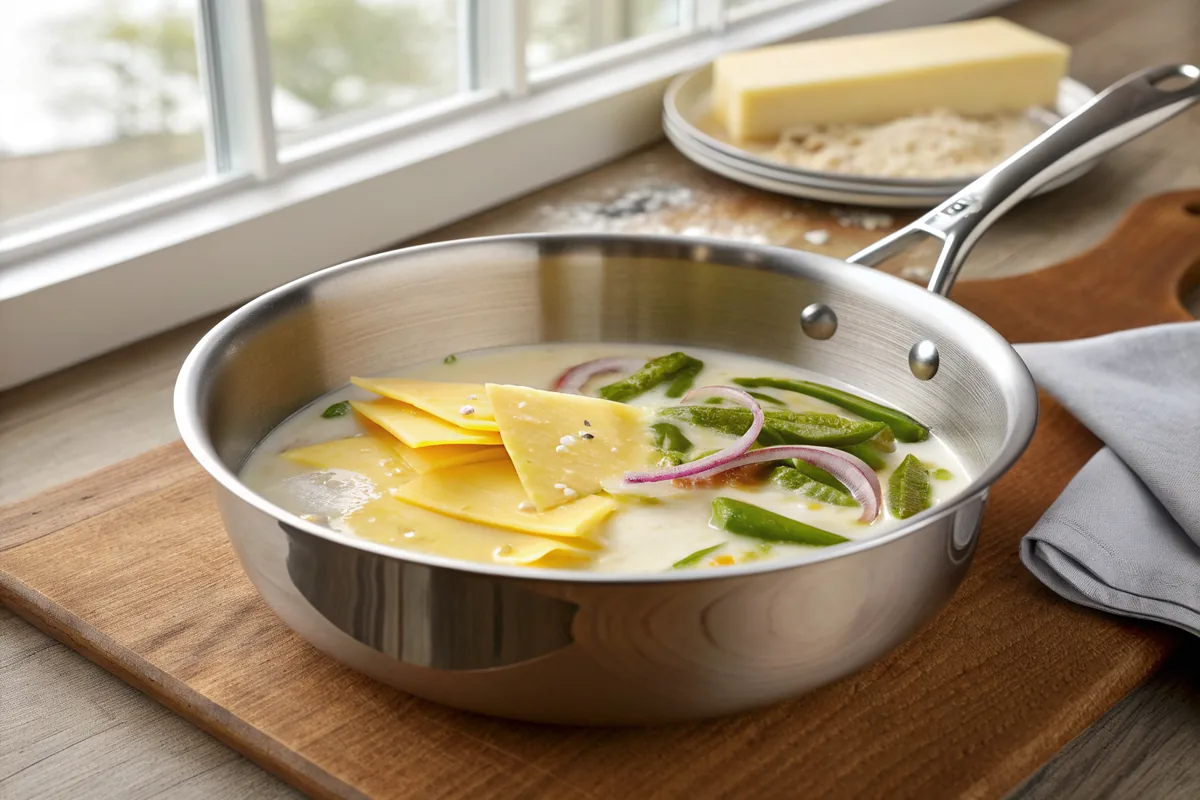
The tomato goes in last, after the cheese, and for a reason beyond color. Tomato is mostly water and acid. Added early, its liquid thins the pot and its acid nudges the cheese toward breaking; added in the last minute, it warms through and stays in distinct red pieces that give the queso its speckled restaurant look. Seed the tomato and dice it small, or use drained canned diced tomatoes, which have already given up most of their juice. Lime juice and cilantro go in off the heat, because lime loses its brightness within a minute at cheese temperature and cilantro goes brown.
Twenty minutes, start to finish, is honest if the chiles are already roasted or from a can. If you are roasting a poblano, add fifteen minutes and do it before anything else. The queso itself, from oil in the pan to bowl on the table, is under fifteen.
Velveeta and Ro-Tel: The Tailgate Version, Told Straight
The most famous queso in Texas is two ingredients and a microwave, and pretending otherwise would be silly. One 16 ounce block of Velveeta, cubed, and one 10 ounce can of Ro-Tel diced tomatoes with green chiles, undrained, go into a microwave-safe bowl and cook on high in one-minute bursts, stirred between each, for about five minutes total until smooth. That is it. It has been the recipe on the side of the can for decades, Ro-Tel itself is a Rio Grande Valley product, and it is the queso of every tailgate, dorm room, and church supper in the state. I make it. It is on the Texas tailgating food list for exactly the reason it should be: it cannot fail, it holds for hours, and it costs six dollars.
Here is the honest comparison. Velveeta is engineered to melt and stay melted; it is even more forgiving of heat than deli American and it will survive a slow cooker on high for an afternoon without breaking. It is also softer and sweeter, with a slightly gelatinous set and a flavor that reads as creamy more than cheesy. The undrained Ro-Tel brings its own liquid, so no milk is needed, but it also brings a canned-tomato acidity that dominates. Set the two side by side and the deli-American version tastes cleaner and sharper, with a clear cheese flavor and the roasted chile and fresh tomato as distinct notes rather than a uniform tangy paste. The tailgate version is a very good dip. The deli version is a restaurant queso. They are cousins, not the same recipe.
A middle road, and the one I use when a slow cooker is the only option: half a pound of Velveeta and half a pound of deli American, one 4 ounce can of green chiles drained, a half cup of evaporated milk, and the tomato added fresh at the end. It holds like the tailgate version and tastes much closer to the restaurant one. If you want the pit-smoked, chorizo-loaded version of the Velveeta pot, that is a separate recipe and it lives on the smoked chorizo queso page.
On the stovetop, the tailgate version needs the same rule as every other queso: low heat, no boiling. The microwave works because it heats the cheese gently and unevenly, and the stirring between bursts evens it out. Do not set the microwave to eight minutes and walk away; the edges will boil, break, and turn to oil while the center is still a cold cube.
The Bob Armstrong Build from Matt's El Rancho
Matt's El Rancho has been serving Tex-Mex in Austin since the 1950s, and its most famous order is not on the enchilada side of the menu. The Bob Armstrong dip is a bowl of the restaurant's queso with a scoop of taco-seasoned ground beef in the middle, a spoon of guacamole beside it, and pico de gallo on top, served with chips. The story the restaurant tells is that a regular, the Texas Land Commissioner Bob Armstrong, asked in the 1970s for something different from the usual queso and the kitchen improvised this. Whether or not every detail of that story is exact, the dish itself is now a standard across Austin, copied under a dozen names, and it is the best thing you can do with a pot of chile con queso for a crowd.
The build is about temperature and contrast, and it is worth doing in order. The queso goes into a wide, shallow bowl, not a deep one, so there is surface area for the toppings and every chip reaches all of them. The beef is a half pound, browned and crumbled with a tablespoon of taco seasoning and a quarter cup of water cooked down to a glaze, kept warm; it goes in the center in a mound so it does not sink and disappear. Guacamole goes beside the beef, cold, in one scoop: my Texas guacamole is the right one, chunky and limed, and it needs to be cold against the hot cheese. Pico de gallo goes last, spooned over the top so its onion, tomato, jalapeno, and lime cut through everything; the pico de gallo on this site is made for exactly this job.
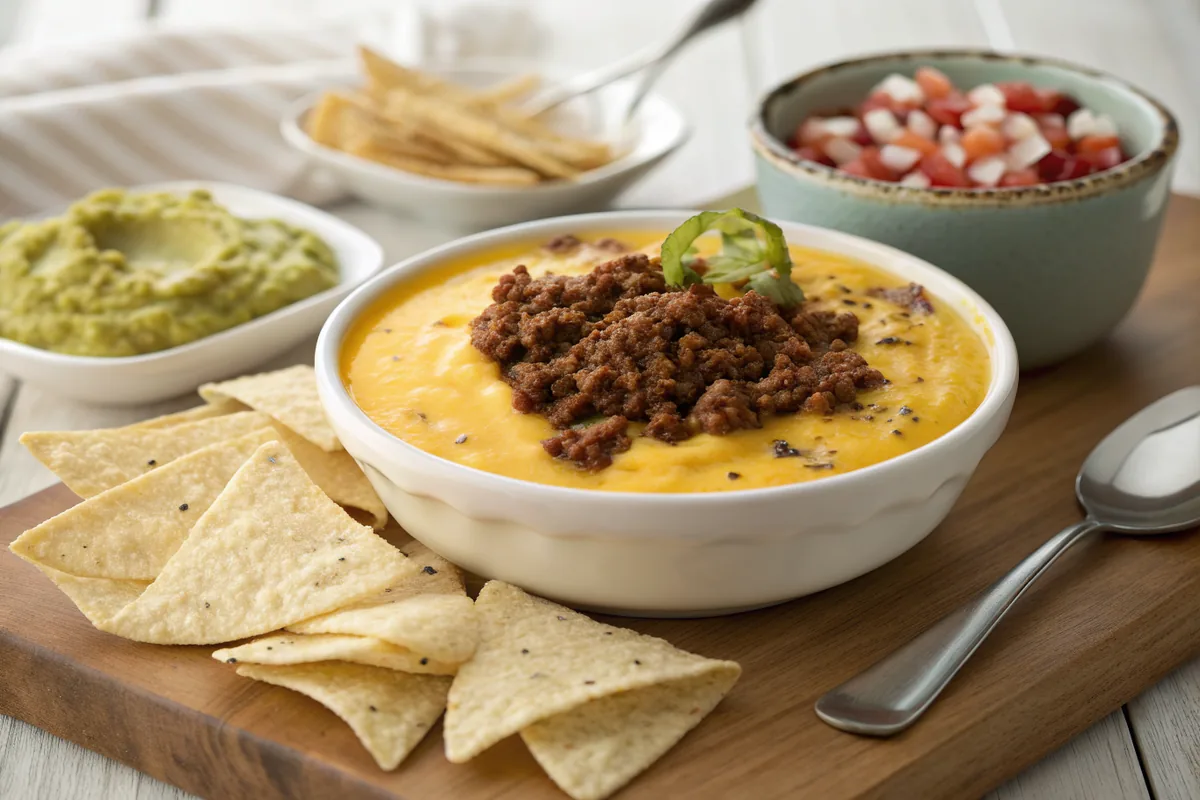
A few notes from serving it at parties. Do not stir the toppings in; the whole point is that a chip drags through hot queso, warm beef, cold guacamole, and sharp pico in one pass, and a stirred Bob Armstrong is a beige stew. Build it at the last minute, because the guacamole warms and the queso tightens within fifteen minutes. And make the beef with more seasoning than you think; it is a small amount of meat in a lot of cheese, and it has to announce itself. Leftover brisket, chopped and warmed, is the Central Texas substitution and it is arguably better.
Queso as a Sauce: Enchiladas, Fries, Burgers, Frito Pie
A pot of chile con queso is a sauce as much as a dip, and thinned with a quarter cup more milk it becomes the queso sauce that Tex-Mex kitchens ladle over half the menu. Over enchiladas it is the crossover order: cheese enchiladas with chili gravy on one side and a ladle of queso over the top, sometimes called enchiladas suizas in Tex-Mex shorthand even though that name means something different in Mexico. If you make my beef and cheese enchiladas, a half cup of queso over the finished pan, under the broiler for two minutes, turns them into something a San Antonio restaurant would charge extra for.
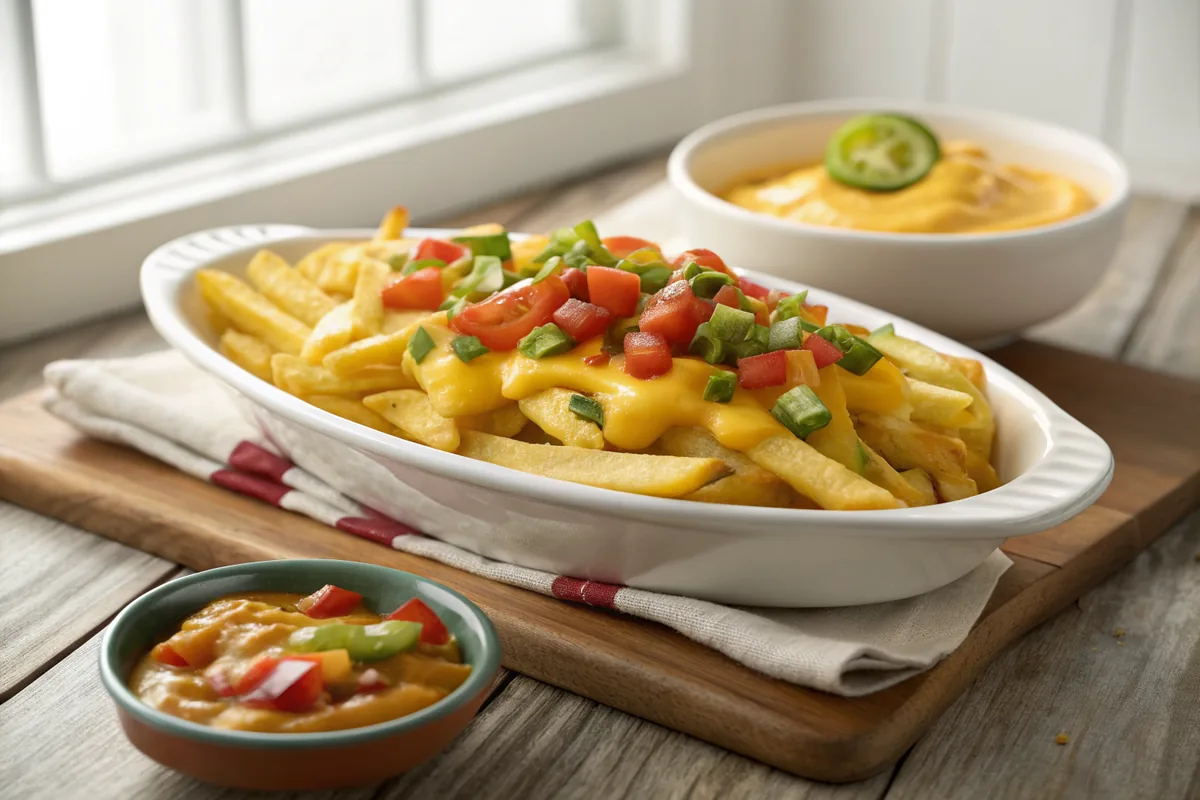
Queso fries are the bar version: hot crisp fries, a ladle of queso, pickled jalapeno slices, and if you are at a barbecue joint, chopped brisket on top. The fries have to be very hot and very crisp because the queso will soften them within minutes; serve them the moment the cheese hits. On a burger, a spoonful of queso in place of the cheese slice, added after the patty comes off the grill, gives you a Texas cheeseburger with green chile built in. Over a plate of scrambled eggs and chorizo at breakfast, it is the reason people in Austin get up early on Saturday.
And then the Frito pie. The classic Texas Frito pie is chili over corn chips with cheese, onion, and jalapeno, and it does not need queso. But the queso Frito pie, corn chips with a ladle of queso first and the chili on top, is a Central Texas concession stand standard and it is worth knowing about, because the queso melts the layers together in a way shredded cheese never does. Use the thickest version of the queso for this, no extra milk, so it does not soak the chips.
Three Quesos on This Site, and Which One You Want
The word queso covers at least three different dishes on this site and it is worth being precise, because people arrive here looking for one and find another. This page is chile con queso, the yellow one: deli American cheese, evaporated milk, roasted green chiles, tomato, onion, cumin, served as a dip with chips. It is the bowl that comes to the table at a Tex-Mex restaurant in Austin or San Antonio, and it is what most Texans mean when they simply say queso.
The queso blanco dip is the white version. Same technique, but white American cheese, no tomato, no chili powder, green chile and sometimes a little jalapeno for a pale, mild, faintly tangy dip in the style of Chuy's and Mi Cocina in Dallas. Choose it when you want the cleaner, milder, whiter bowl; choose this page when you want the classic yellow-orange one with the tomato flecks. They are two dialects of the same language.
The smoked chorizo queso is a different animal: a Velveeta-based pot loaded with browned Mexican chorizo, set on the smoker beside the brisket for an hour so it picks up post oak smoke. It is the barbecue-joint queso, heavier, meatier, smoky, built to hold in an aluminum pan through a long afternoon. If you have a pit lit, make that one. If you have a stovetop and twenty minutes, make this one.
The queso flameado is not a dip at all. It is a Mexican and northern-border dish of Oaxaca or asadero cheese melted in a small cast iron skillet with chorizo, flamed with tequila, and eaten with a fork or spooned into warm tortillas. The cheese is stringy and pull-apart by design, which is exactly the texture this page is engineered to avoid. Order it as a first course with tortillas; do not try to dip a chip into it.
Holding Queso Warm for a Party, Reheating It, and Why the Freezer Loses
For a party, a small slow cooker on the warm setting is the standard and it works, with two rules. Warm, never low or high; the low setting on most slow cookers runs close to 200F at the wall, which will break the queso within an hour and scorch the edges. And stir it every twenty minutes and add a tablespoon of milk whenever the top begins to tighten, because a queso on a warmer loses water steadily and thickens toward paste. Set up this way, a pot of deli-American queso holds three to four hours. The Velveeta version holds all day.
Without a slow cooker, a small cast iron skillet or a heavy saucepan on the lowest flame does the same job for an hour, stirred often; a chafing dish over a water bath is the restaurant method and the gentlest of all. Warm the serving bowl with hot water before pouring, since a cold ceramic bowl pulls fifteen degrees out of the queso in the first minute and starts the skin forming. For a table of people eating from one bowl, a small skillet that goes straight from stove to trivet stays hot longest.
Leftovers keep in the refrigerator, covered, for 4 days, and they set into a firm block; that is normal. Reheat on the stove in a small saucepan on low with a splash of milk, stirring, until it loosens and smooths out, about 5 minutes for a cup. Or microwave in 30-second bursts at half power, stirring between each, with a tablespoon of milk per cup. Either way, the same rule as the first cook applies: it must not boil. Reheated deli-American queso is very nearly as good as fresh; the tomato loses a little brightness and a squeeze of lime restores it.
Freezing does not work well and I would rather say so than have you find out. The emulsion survives the freezer, but the water in the tomato and chiles forms ice crystals that break the texture, and thawed queso comes back slightly grainy and weeping, and it never fully smooths again even with milk and low heat. If you must, freeze a batch made without the tomato, thaw it overnight in the refrigerator, and reheat very slowly with a tablespoon of milk per cup and a pinch of sodium citrate if you have it, which repairs most of the damage. Better to make less. A half batch is 8 ounces of cheese and a small can of milk and takes twelve minutes.
Where Chile Con Queso Goes Wrong
Boiling it. The single cause of most broken, greasy, grainy queso. Above 175F the cheese proteins tighten and the fat weeps out. Lowest heat from the moment the cheese goes in, and a thermometer if you have one.
Pre-shredded cheese. The anti-caking starch coats every shred and makes the dip grainy and dull. Deli slices torn by hand, or a block and a grater.
Sharp cheddar with no help. It breaks. Use deli American, or add 1 teaspoon of sodium citrate per 8 ounces of natural cheese.
Dumping the cheese in all at once. The milk chills, you raise the heat, the bottom scorches and the top breaks. A handful at a time on the lowest flame.
Too much tomato liquid. Unseeded tomato, or undrained canned tomatoes, thins the pot and pushes the acid toward breaking. Seed and dice small, or drain, and add it in the last minute.
Undrained green chiles. Same problem: the brine thins the queso and adds a tinny edge. Drain the can.
Lime and cilantro added on the heat. The lime goes flat and the cilantro browns. Both go in off the heat, last.
Serving it in a cold bowl. Fifteen degrees gone in a minute and a skin on top before the first chip. Warm the bowl, or serve it in the skillet.
Fixing a broken queso the wrong way. If it does break, pull it off the heat, add a splash of cold milk, and whisk hard; a pinch of sodium citrate brings most of it back. Adding more cheese to a broken pot just makes more broken pot.
Chile Con Queso Recipe
Ingredients
- 1 tablespoon neutral oil or unsalted butter
- 1/2 small yellow onion, finely diced (about 1/2 cup)
- 2 cloves garlic, minced
- 1/2 cup (about 3 oz / 85 g) roasted, peeled, and diced green chiles: 2 Hatch chiles, 1 large poblano, or one 4 oz can of diced green chiles, drained
- 1 jalapeno, seeded and minced (optional, for heat)
- 1/2 teaspoon ground cumin
- 1/2 teaspoon chili powder
- 1 (12 oz / 354 ml) can evaporated milk
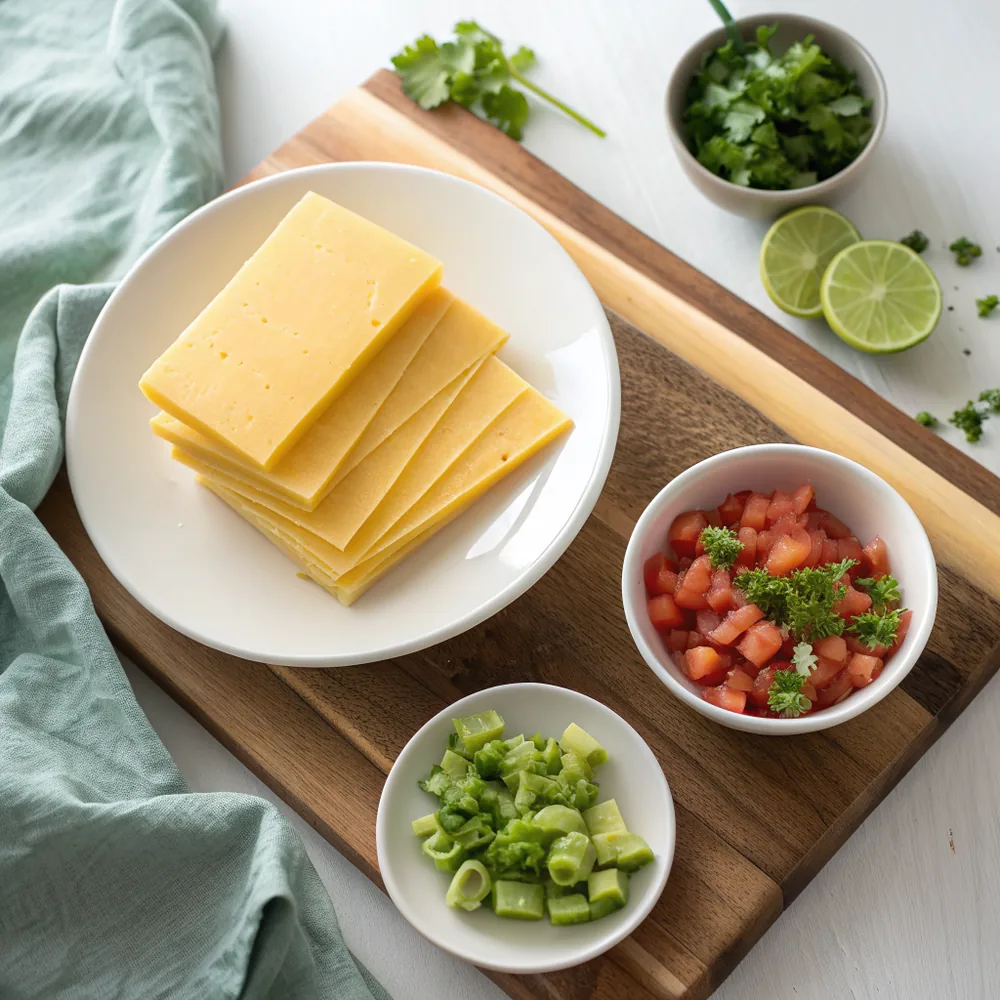
- 1 lb (454 g) yellow American cheese, sliced thick from the deli counter, torn into pieces
- 1 Roma tomato, seeded and finely diced (about 1/2 cup), or 1/2 cup drained canned diced tomatoes
- 1 tablespoon fresh lime juice
- 2 tablespoons chopped cilantro
- Kosher salt, to taste
- Thin restaurant-style tortilla chips, or warm flour tortillas, for serving
- For the optional sodium citrate route:
- 1 teaspoon (about 5 g) sodium citrate per 8 oz of sharp cheddar or Monterey Jack you swap in for the American, grated from a block
- For the optional Bob Armstrong build:
- 1/2 lb (227 g) ground beef, browned with 1 tablespoon taco seasoning and 1/4 cup water
- 1/2 cup guacamole
- 1/2 cup pico de gallo
Instructions
- Prep the cheese and vegetables. Tear the sliced American cheese into rough 2 inch pieces and leave it on the counter to lose its chill. Dice the onion fine, mince the garlic, dice the roasted chiles and the seeded tomato small enough to ride on a chip. If you are roasting your own chiles, do that first: char under the broiler, steam in a covered bowl 10 minutes, peel, seed, dice.
- Soften the onion and garlic. Set a heavy 2 or 3 quart saucepan over medium-low heat with the oil. Cook the onion with a pinch of salt for 4 to 5 minutes until soft and translucent but not browned. Add the garlic and the jalapeno, if using, and cook 1 minute more.
- Bloom the spices with the chiles. Stir in the diced green chiles, cumin, and chili powder and cook 1 minute, until the spices smell toasty and the chiles have given up a little moisture.
- Warm the evaporated milk. Pour in the evaporated milk and bring it just to steaming, about 150F (66C), 2 to 3 minutes. Small bubbles at the edge are fine. A rolling boil is not; if it gets there, pull the pan off the heat and let it settle for a minute.
- Drop the heat and add cheese in handfuls. Turn the burner to its lowest setting. Add a handful of cheese and stir gently with a silicone spatula until it is almost fully melted, then add the next handful. The whole pound takes 5 to 7 minutes. Never dump it all in at once and never let the pot bubble.
- Check the texture. When the last piece has melted, the queso should coat the spatula in a smooth, glossy layer and fall off it in a slow ribbon. If it is thicker than that, stir in a splash of whole milk, a tablespoon at a time. It will thicken further as it cools, so err on the loose side.
- Fold in the tomato. Stir in the diced tomato and cook 1 minute on the lowest heat, just to warm it through. Adding it last keeps the tomato bright and keeps its liquid from thinning the pot.
- Finish with lime and cilantro. Off the heat, stir in the lime juice and cilantro. Taste and add salt; deli American is salty, so most batches need none or a small pinch.
- Serve warm, in a warm bowl. Pour into a bowl you have rinsed with hot water and dried, or into a small cast iron skillet, and serve immediately with thin tortilla chips or warm flour tortillas. Thin with a splash of milk if it tightens while it sits.
- Optional Bob Armstrong build. For the Bob Armstrong version, pour the queso into a wide shallow bowl, spoon the taco-seasoned ground beef into the center, add a scoop of guacamole beside it, and top with pico de gallo. Serve with chips and let people drag through all four layers at once.
Frequently Asked Questions
What is chile con queso made of?
Chile con queso is yellow American cheese melted into evaporated milk with roasted green chiles, a little diced tomato, sauteed onion and garlic, cumin, and chili powder, finished with lime and cilantro. The classic Tex-Mex restaurant proportions are one pound of deli-sliced American cheese to one 12 ounce can of evaporated milk, a half cup of diced green chiles, and a half cup of tomato. It is cooked on the lowest heat for about 20 minutes and never boiled, which keeps it smooth and pourable, and it is served hot with thin tortilla chips as the opening dip of a Tex-Mex meal.
Why does American cheese work for queso when cheddar breaks?
American cheese is made with emulsifying salts, mainly sodium citrate and sodium phosphate, which bind the calcium that holds the casein proteins together in natural cheese. Freed from that calcium, the proteins act as an emulsifier and keep fat and water blended as the cheese melts, so it flows like a sauce and stays smooth. Cheddar and Monterey Jack lack those salts; heated, their protein network contracts, squeezes out the fat, and turns stringy and greasy. Adding 1 teaspoon of sodium citrate per 8 ounces of natural cheese to the milk reproduces the effect and lets cheddar melt as smoothly as American.
Can I make chile con queso without Velveeta?
Yes, and this recipe does not use it. Deli-sliced yellow American cheese melts just as smoothly as Velveeta and tastes cleaner and more like cheese, because it is labeled process cheese and has to be built mostly from real cheese rather than whey and milk protein concentrate. Use one pound of deli American with a 12 ounce can of evaporated milk on low heat. If you want to avoid processed cheese entirely, use a pound of grated block cheddar or Monterey Jack with 2 teaspoons of sodium citrate stirred into the milk first, which gives the same smooth texture with a sharper flavor.
Why did my queso turn grainy or oily?
It got too hot, or the cheese was pre-shredded. Above about 175F the proteins in melted cheese tighten and release their fat, so the dip goes oily on top and grainy underneath, and a boil breaks it in under a minute. Keep the burner on its lowest setting once the cheese goes in and add it a handful at a time. Pre-shredded cheese is coated with starch that makes queso grainy even at the right temperature, so tear deli slices or grate a block. To rescue a broken pot, pull it off the heat, add a splash of cold milk, and whisk hard; a pinch of sodium citrate brings most of it back.
What is the difference between chile con queso and queso blanco?
Both are Tex-Mex cheese dips made the same way; the difference is the cheese and the color. Chile con queso is the yellow version, made with yellow American cheese and finished with diced tomato and chili powder for a yellow-orange dip flecked with red and green. Queso blanco is made with white American cheese, no tomato, and no chili powder, for a pale, mild dip in the style of Chuy's and Mi Cocina. Queso flameado is a third thing entirely: melted Oaxaca cheese with chorizo eaten with a fork, and smoked chorizo queso is a Velveeta pot cooked on the smoker.
How do you keep queso warm for a party?
A small slow cooker on the warm setting, not low, holds a pot of deli-American queso for three to four hours. Stir it every twenty minutes and add a tablespoon of milk whenever the surface starts to tighten, since a warmer slowly cooks off water and the dip thickens toward paste. The low setting on most slow cookers runs near 200F and will break the queso within an hour. Without a slow cooker, a small cast iron skillet on the lowest flame stirred often, or a chafing dish over a water bath, does the same job. Always pour into a bowl warmed with hot water.
Can you freeze chile con queso?
It does not freeze well. The cheese emulsion survives, but the water in the tomato and green chiles forms ice crystals that break the texture, and thawed queso comes back grainy and weeping and never fully smooths again. Refrigerated, it keeps 4 days and reheats almost perfectly on the stove over low heat with a splash of milk, stirring, or in the microwave in 30-second bursts at half power. If you must freeze it, make the batch without tomato, thaw overnight in the refrigerator, and reheat very slowly with a tablespoon of milk per cup and a pinch of sodium citrate. A half batch takes twelve minutes, so make less instead.
What is a Bob Armstrong dip?
A Bob Armstrong dip is a bowl of chile con queso with a scoop of taco-seasoned ground beef in the center, a spoon of guacamole beside it, and pico de gallo on top, served with tortilla chips. It comes from Matt's El Rancho in Austin, where it is named for a regular, the former Texas Land Commissioner, who asked the kitchen for something different in the 1970s. Build it in a wide shallow bowl at the last minute, do not stir the toppings in, and keep the guacamole cold against the hot cheese so every chip drags through hot queso, warm beef, cold guacamole, and sharp pico at once.