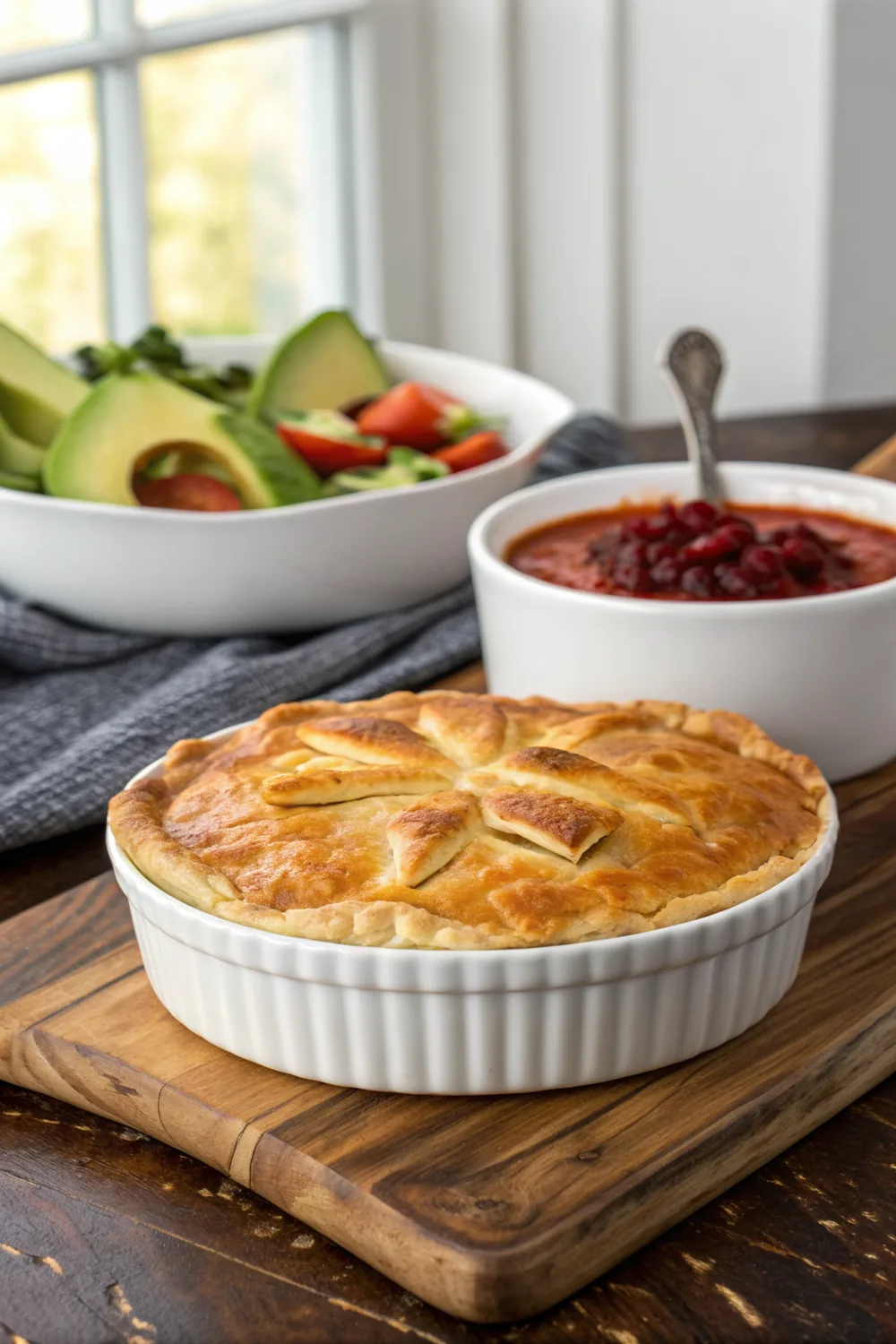
Southern Comfort Food
Leftover Turkey Recipes
Chef Mia's leftover turkey recipes: 9 Texas day-after dishes, from a gravy pot pie at 400F to King Ranch casserole, tortilla soup, and white chili.
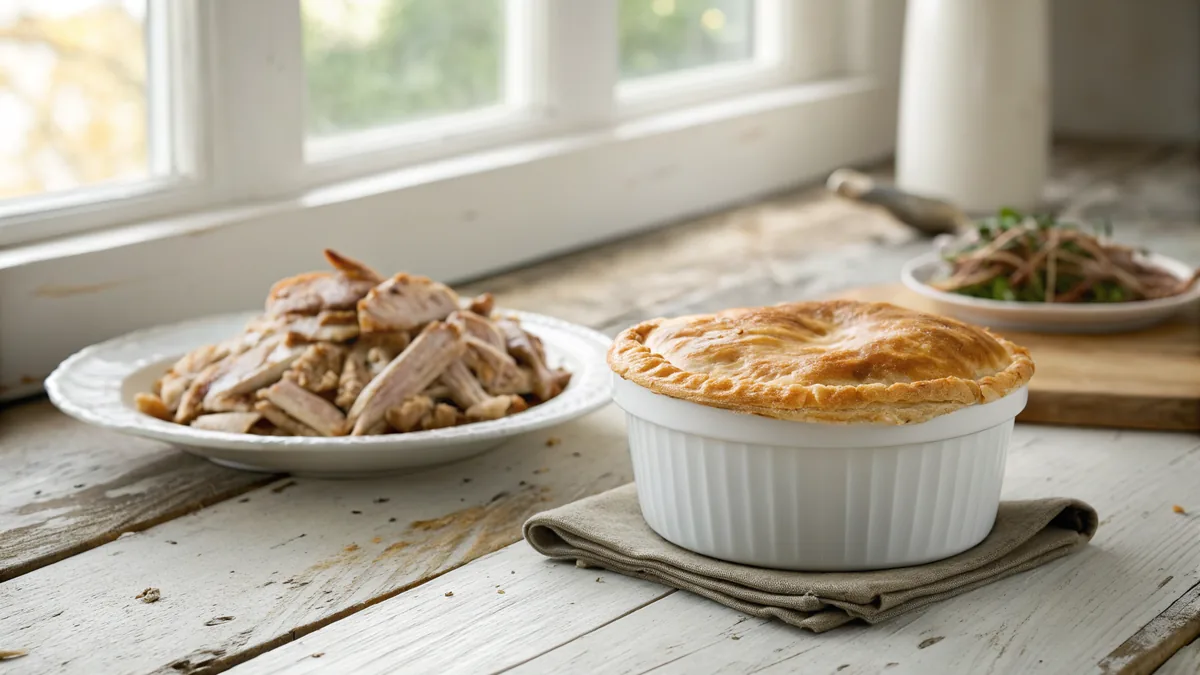
Quick answer: Leftover turkey keeps 3 to 4 days in the refrigerator and 4 months in the freezer, and it stretches into nine dinners if you carve it into large pieces, save the gravy, and simmer the carcass into about 3 quarts of stock. The headline dish is a pot pie built on 2 cups of leftover gravy thinned with a cup of stock, 3 to 4 cups of diced turkey, sauteed onion, celery, carrot, and peas, under one sheet of pie dough or biscuit rounds, baked at 400F (205C) for 25 to 30 minutes until the top is deep golden and the filling bubbles at the edge. Around it: the Friday sandwich with jalapeno cranberry sauce, King Ranch turkey casserole, tortilla soup, poblano enchiladas, turkey and dumplings, breakfast tacos and migas, white chili with green chiles, and a Sunday spaghetti casserole.
A Thanksgiving turkey is one dinner on Thursday and four more by Sunday, if you carve it right. That is not a figure of speech in my kitchen in Lockhart; it is the plan. I buy the bird with Friday and Saturday already in mind, I carve it into big pieces instead of slices so the meat stays juicy in the refrigerator, I save every drop of gravy, and I put the carcass on to simmer before the last guest has left. The turkey itself is the least interesting thing about the weekend. What you do with it is where the good cooking is.
This page is the day-after plan, and it is built the Texas way. The nine dishes below borrow techniques from pages already on this site, the King Ranch casserole, the tortilla soup, the poblano enchiladas, the chicken and dumplings, and I have written each one out in full so you do not have to go back and forth. Each section also tells you what changes when the meat is cooked turkey instead of raw chicken or beef, because that difference matters more than most leftover recipes admit. Cooked turkey wants less time in the pot, more liquid around it, and more salt than you think. For the rest of the year, when the bird is a rotisserie chicken from HEB, the leftover rotisserie chicken page runs the same playbook on a smaller carcass.
If you have not cooked the turkey yet, plan the leftovers now. My rule from the turkey per person guide is 1 pound of raw whole bird per guest for dinner and 1 1/2 pounds per guest if you want a weekend of leftovers, which you do. Whether the bird was roasted, smoked over post oak using the Texas BBQ turkey method, dropped into peanut oil as a deep-fried turkey, or was a single smoked turkey breast for a small table, everything below works. Smoked turkey makes the best tortilla soup and chili of your life; fried turkey makes the best sandwich. The whole holiday, from brine to pie, is laid out on the Texas Thanksgiving hub.
Carve It Big, Then Put the Carcass On: Storage and Three Quarts of Stock
The first leftover decision happens on Thursday night, before the dishes, and it is the one most people get wrong. Do not slice the whole turkey. Slices dry out in the refrigerator overnight because every slice is all surface. Instead, take the meat off the bones in the largest pieces you can: the two breast lobes whole, the thighs whole, the drumsticks whole, the wings whole. Wrap each piece tightly or lay them in a container with a splash of stock or gravy over them. Big pieces hold their moisture for days and you slice or dice them the morning you need them.
Cooked turkey keeps 3 to 4 days in a refrigerator at 40F (4C) or below, and that clock starts when it comes out of the oven, not when you put it away. Get it into the cold within two hours of carving, which on a Thanksgiving afternoon means putting the leftovers away before the pie comes out. Gravy keeps the same 3 to 4 days. The dressing and the green bean casserole do too, and both reheat better than most people expect.
For anything beyond Sunday, freeze. Turkey freezes well for up to 4 months, and it freezes best submerged: pack diced or shredded meat into freezer bags and pour enough gravy or stock over it to cover, then press the air out. The liquid is a shield against freezer burn, and when the bag thaws you have both the meat and the sauce for a pot pie or a soup in one motion. Meat frozen dry goes fibrous within a month. If you smoked the bird, the smoke flavor survives freezing intact and actually deepens, which is why a bag of smoked turkey in stock is the best thing in my freezer in January.
The math of how much you have to work with starts at the store. A 14-pound bird yields roughly 6 pounds of cooked meat off the bone, and a table of ten eats about half of it on Thursday. That leaves 3 pounds, or about 9 cups of diced turkey, which is exactly what the nine dishes below assume: 3 to 4 cups each, three or four dishes a weekend, and a bag in the freezer.
Then the carcass. It is not garbage; it is the base of half the dishes on this page. Thursday night, once the meat is off, break the frame into three or four pieces so it fits in your biggest pot, and add the neck, the wing tips, the back, any skin you did not eat, and the bones from the thighs. Cover it with cold water by 2 inches, about 5 quarts for a 14-pound carcass. Add a halved onion, skin on for color, two carrots and two celery ribs broken in half, a head of garlic cut across, a bay leaf, a teaspoon of black peppercorns, and a few thyme sprigs. No salt yet.
Bring it to a boil, skim the gray foam that rises in the first ten minutes, then drop to the barest simmer, one lazy bubble every second or two, and leave it for 2 hours. A hard boil emulsifies the fat into the liquid and makes a cloudy, greasy stock; a bare simmer keeps it clear. A roasted or smoked carcass gives you a deep brown stock with body; a fried turkey carcass gives you a lighter, cleaner one. At the two-hour mark, strain it through a fine sieve, discard the solids, and you will have about 3 quarts.
Cool it fast by setting the pot in a sink of ice water and stirring for ten minutes, then refrigerate. By morning the fat will have set into a cap on top; lift it off and keep it, because turkey fat is the right fat to fry the tortilla strips for the soup. The stock underneath should be jelly, which is the collagen from the bones and the reason this soup and this gravy taste like something and a carton from the store does not. Salt the stock only when it goes into a dish, since every recipe below reduces it differently.
Stock keeps 4 days refrigerated and 6 months frozen. I freeze it flat in quart bags and in ice cube trays for the small amounts a pot pie or a pan of enchiladas needs. If you did not get to the carcass Thursday night, it will wait in the refrigerator until Friday morning; it will not wait until Saturday.
The Friday Sandwich: Cold Turkey, Jalapeno Cranberry, Cold Dressing
The first leftover dish is the one you eat standing at the counter Friday at noon, and it does not get cooked at all. Split a soft roll. Spread mayonnaise on both halves, more than seems polite. On the bottom half, lay slices of cold turkey, sliced that minute off a whole breast lobe, a mix of white meat and a piece of dark from the thigh if you have it. On top of the turkey, a thick layer of jalapeno cranberry sauce, at least 2 tablespoons, cold from the jar. Then a slab of cold cornbread dressing about 3/4 inch thick, pressed down so it holds together. Close it and press the whole thing flat with your palm.
Every component in that sandwich is doing a job. The mayonnaise gives cold, lean turkey the fat it lost in the oven. The cranberry sauce, with its heat from the jalapeno and its sour edge, cuts the richness and wakes the meat up; plain sweet cranberry sauce works but reads like dessert in a sandwich. Cold cornbread dressing firms up overnight into something sliceable, and it brings sage, onion, and the crumbly corn texture that turns a sandwich into the whole dinner reassembled. A soft roll, and I mean the pillowy Roadhouse-style rolls if any survived, gives instead of fighting back; a crusty baguette shatters and pushes everything out the sides.
If the turkey was fried, this is its best use. Deep-fried turkey has the juiciest white meat of any method and the skin stays glassy even cold; get a piece of that skin into the sandwich. Smoked turkey makes a different sandwich, closer to a barbecue sandwich, and I swap the mayonnaise for a thin layer of barbecue sauce and keep the cranberry. Roasted turkey is the classic and needs the most mayonnaise. Whatever the bird, do not heat the sandwich. Warm cranberry sauce goes runny and warm dressing goes to mush; the whole point is the contrast of cold, dense layers.
Make it for a crowd by building it on a whole sheet of rolls, split horizontally in one piece, layered, closed, and cut into squares. It sits happily for an hour on the counter under a towel, which is more than you can say for anything else on Friday.
Pot Pie Built on Thursday's Gravy
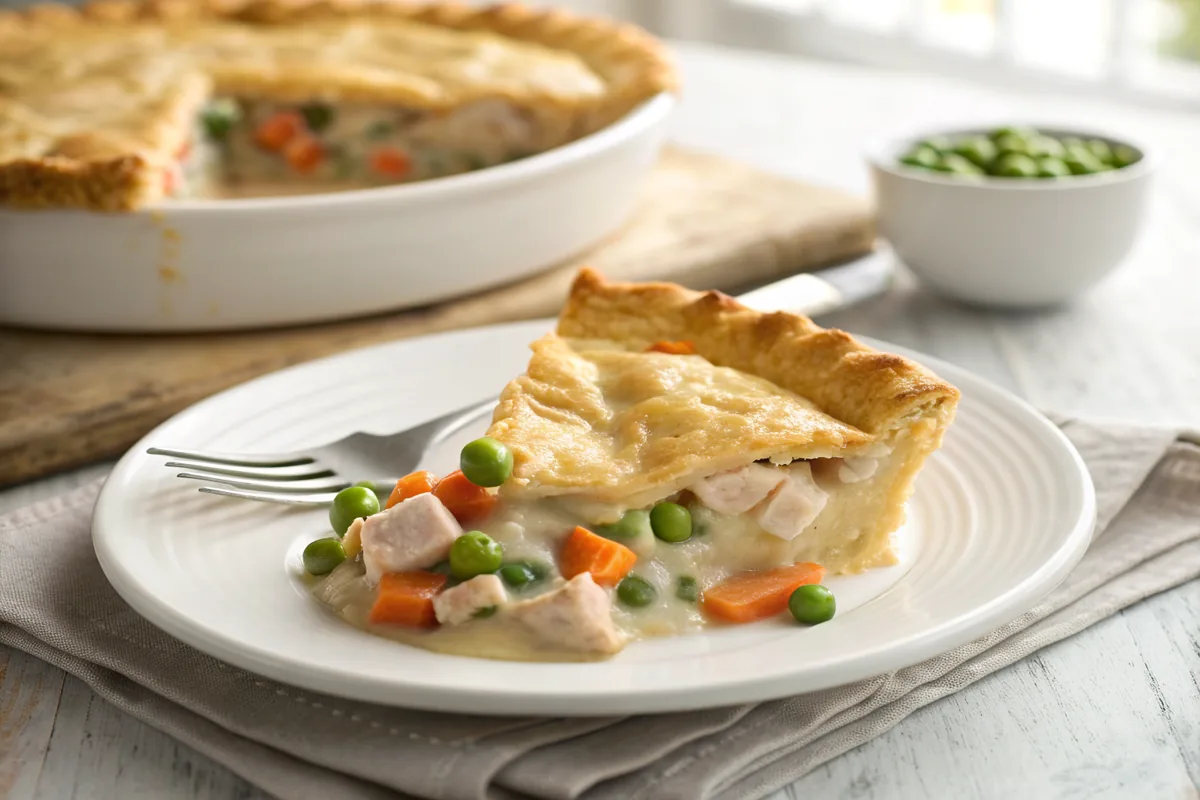
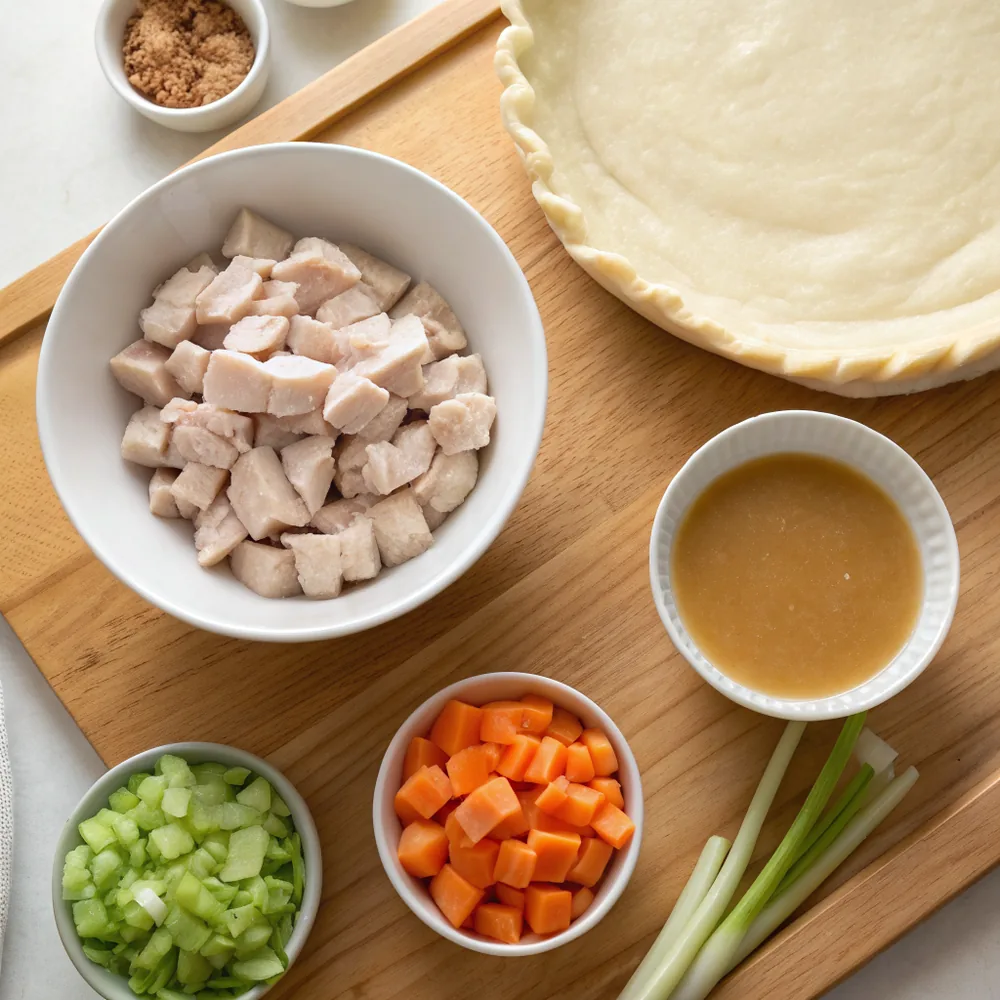
This is the recipe card above, and the reason it is the headline dish is that it uses the two leftovers everybody has too much of, gravy and turkey, and turns them into something that tastes deliberate instead of reheated. The key idea is that the gravy is the sauce. A pot pie from scratch spends twenty minutes building a veloute, a roux thinned with stock and enriched with cream, and that is exactly what a good turkey gravy already is. Two cups of it, thinned with a cup of stock so it does not bake into paste, is a finished pot pie sauce with the drippings already in it.
The vegetables are sweated in butter, not boiled, because their sweetness is the only fresh flavor in a dish made entirely of leftovers. Onion, celery, and carrot for 8 to 10 minutes until soft; peas straight from the freezer at the end so they stay green. If your gravy was thin on Thursday, the 2 tablespoons of flour go in over the vegetables to fix it; if it was properly thick, skip the flour. The plate test in the instructions tells you which.
What changes because the turkey is already cooked: everything about the timing. A raw chicken pot pie needs its meat to poach in the sauce, so the filling simmers for 15 minutes before it is topped. Cooked turkey goes in off the heat, at the end, and does nothing but warm through in the oven. Any longer in the sauce and it shreds and goes stringy. The filling also needs more salt than a raw-meat version, because cooked meat does not release its own seasoned juices into the sauce; taste it, and be braver than you want to be.
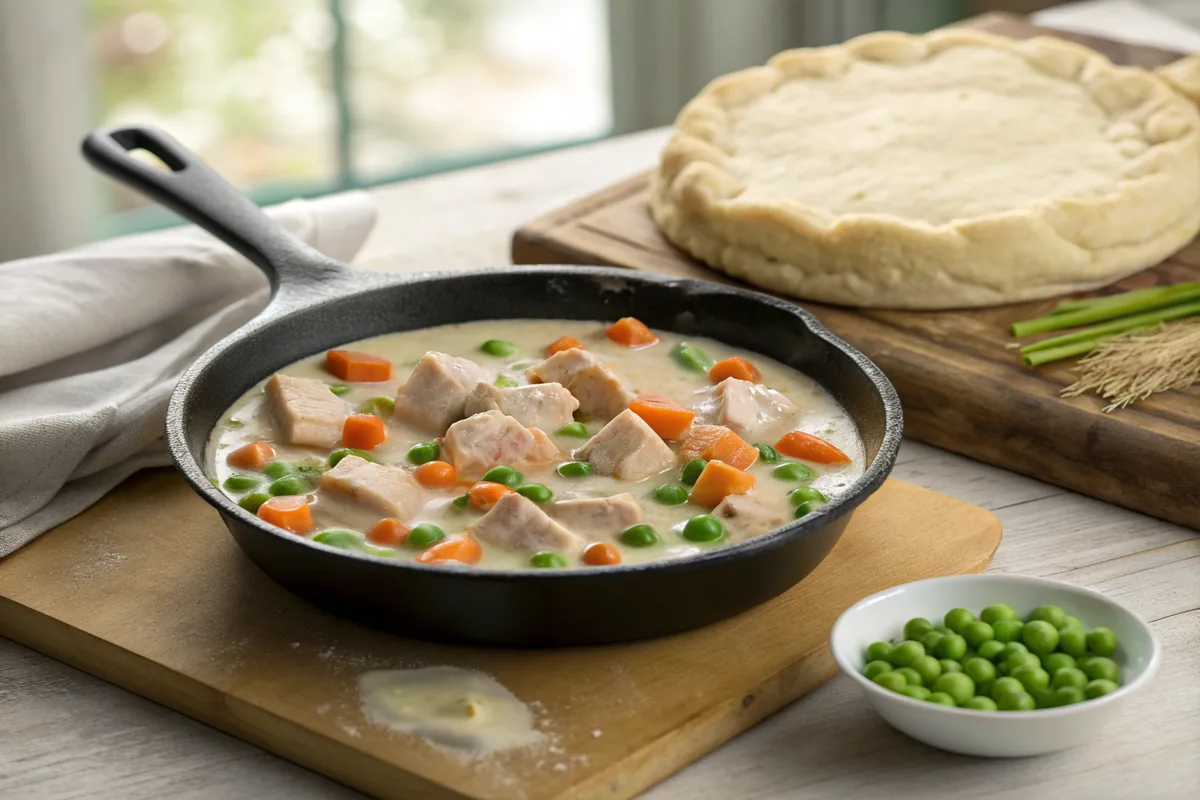
The top is one sheet of dough, no bottom crust. A bottom crust under a wet filling never crisps, and a pot pie is about the contrast of a shattering lid over a soft, hot interior. Store-bought pie dough is completely fine here; so are biscuit rounds, which give you a cobbler-style top that soaks up gravy at the bottom and browns on top, and which some people in my family insist is the only correct version. Either way, 400F for 25 to 30 minutes, until the top is deep gold and you can see the filling bubbling at the edge. Ten minutes of rest before you cut, or the first slice will flood the plate.
King Ranch Turkey Casserole
King Ranch chicken is the great Texas casserole, and it was practically designed for leftover turkey: layers of corn tortillas, shredded poultry, and a chile-and-tomato cream sauce under a lid of melted cheese. My full-length version is on the original King Ranch chicken page, with the from-scratch sauce that replaces the two cans of soup, and there is a King Ranch beef casserole for the rest of the year. The turkey version follows the chicken page exactly, with one shortcut and one change.
Make the sauce first. Melt 4 tablespoons of butter in a skillet, cook 1 diced onion, 1 diced green bell pepper, and 1 diced poblano until soft, about 8 minutes, then add 3 cloves of minced garlic, 1 tablespoon of chili powder, 1 teaspoon of ground cumin, and a pinch of cayenne for 1 minute. Sprinkle in 1/4 cup of flour, stir 1 minute, then whisk in 2 cups of the carcass stock and 1 cup of milk. Simmer 5 minutes until thick, then stir in a 10-ounce can of diced tomatoes with green chiles, drained, and 1/2 cup of sour cream. Salt it until it tastes slightly too salty on its own, because the tortillas will take some.
The shortcut is the meat: the chicken recipe poaches 2 pounds of thighs in stock for 25 minutes and shreds them. You skip all of that. Four cups of shredded turkey, dark and white mixed, go straight into the layers. The change is the liquid. Cooked turkey is drier than freshly poached chicken and it will pull moisture out of the sauce during baking, so make the sauce a little looser than you would for chicken, with an extra 1/2 cup of stock, and toss the shredded turkey with 1/2 cup of sauce before you layer it so every piece is coated. A smoked bird is outstanding here; the smoke reads as if you had used chipotle.
Assemble in a 9-by-13-inch dish: a thin layer of sauce, then 6 corn tortillas torn in half and overlapped, a third of the turkey, a third of the remaining sauce, and 1 cup of shredded cheddar and Monterey Jack. Repeat twice more for three layers, finishing with cheese. Bake uncovered at 350F (175C) for 30 to 35 minutes until bubbling at the edges and browned in spots on top. Rest 15 minutes so it holds a square. It is better on Sunday than Saturday, which makes it the right casserole to assemble a day ahead.
Tortilla Soup From the Carcass Stock
Tortilla soup is the reason you made the stock. The version on the leftover rotisserie chicken page is a 30-minute weeknight soup built on a store-bought carcass; this one is the same soup with a Thanksgiving-sized head start, because 3 quarts of two-hour turkey stock is a better base than any rotisserie chicken can give you. The soup is a broth soup, not a stew: clear, deeply flavored, brick red from chiles and tomato, with the turkey and the garnishes added at the end so they stay distinct.
Toast 3 dried guajillo chiles and 1 ancho, stemmed and seeded, in a dry skillet for 30 seconds a side, then soak them in hot water for 15 minutes. Blend them with a cup of the soaking water, 4 Roma tomatoes, half a white onion, and 3 garlic cloves until smooth. Heat 2 tablespoons of the turkey fat you lifted off the stock in a Dutch oven over medium-high, pour in the puree, and fry it, stirring, for 6 to 8 minutes until it darkens and thickens to a paste and smells toasty. This frying step is what separates real tortilla soup from tomato broth. Add 2 1/2 quarts of the turkey stock, 1 teaspoon of ground cumin, a teaspoon of Mexican oregano crushed in your palm, and salt to taste, and simmer 20 minutes.
Here is where turkey changes the method. On the chicken page, raw or rotisserie chicken simmers in the broth for its last ten minutes. Cooked turkey should not simmer at all. Put 3 cups of shredded turkey in the bottom of each bowl, cold, and ladle the boiling broth over it; the broth heats the meat in seconds and the meat stays tender. Smoked turkey here is the best bowl of soup you will eat all year, and dark meat is better than white because it stays juicy in hot liquid.
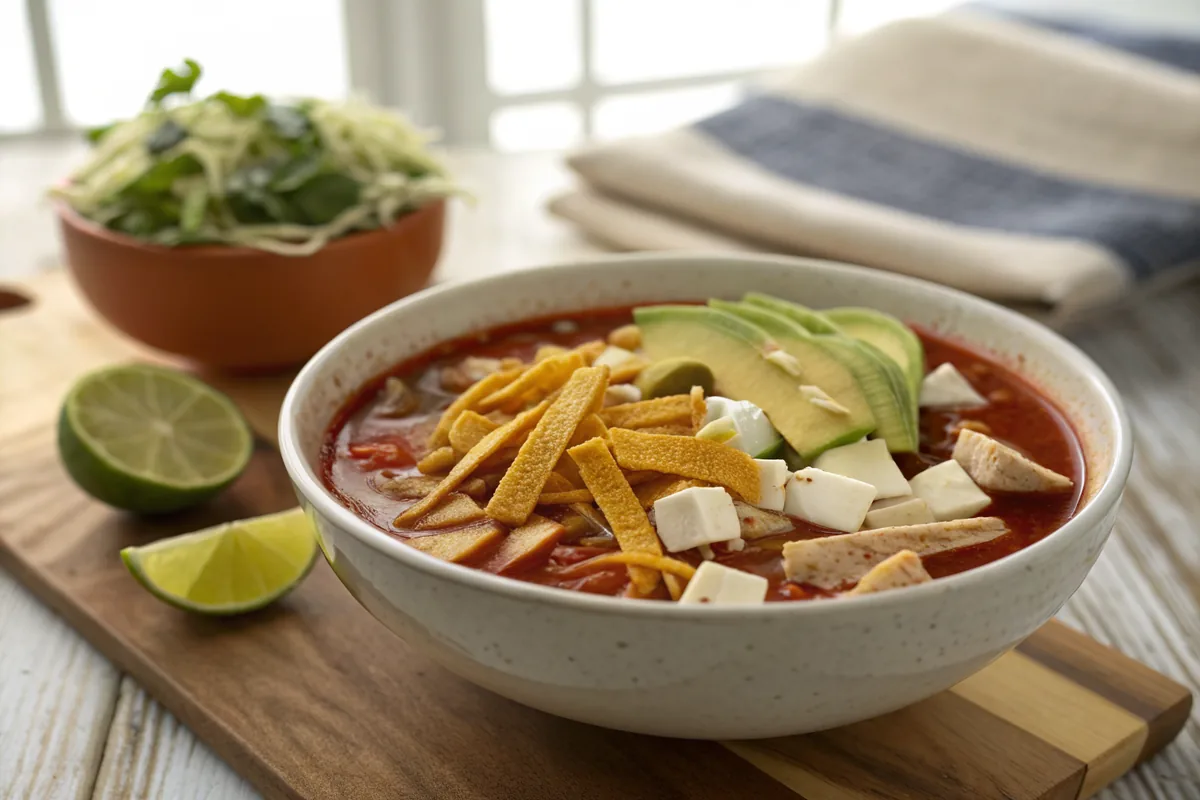
Garnish is half the soup: tortilla strips fried crisp in 1/2 inch of turkey fat or oil at 350F (175C) for 2 minutes, diced avocado, crumbled queso fresco, cilantro, a spoon of pico de gallo or restaurant-style salsa on top, and a lime squeezed over everything at the table. Do not skip the lime. The soup keeps 4 days and freezes well without the garnishes, which is the best argument for making the full 2 1/2 quarts.
Turkey Enchiladas With Poblano Cream
White meat turkey is the driest thing on the leftover shelf by Saturday, and enchiladas are the fix, because the meat gets rolled inside a tortilla and buried under sauce where it rehydrates as it bakes. The sauce I use is the roasted poblano cream from the poblano chicken enchiladas, which is mild, green, and rich, and which suits turkey better than a red chile sauce does. Turkey has less flavor than chicken thigh; a heavy red sauce steamrolls it, and the poblano cream carries it.
Roast 4 poblanos over a gas flame or under the broiler until blackened all over, 8 to 10 minutes, steam them in a covered bowl for 10 minutes, then peel, seed, and chop them. Melt 3 tablespoons of butter, cook half a diced white onion and 2 minced garlic cloves for 4 minutes, add the poblanos and 1/2 teaspoon of salt, and cook 2 minutes more. Blend with 1 1/2 cups of the turkey stock and 1 cup of Mexican crema or sour cream until smooth, then return it to the pan and simmer 5 minutes. It should coat a spoon; thin it with stock if it is thicker than heavy cream. For a sharper, brighter version, replace half the poblano cream with a cup of tomatillo salsa verde, which is what I do when the turkey was smoked.
The filling is 3 cups of shredded turkey tossed with 1/2 cup of the sauce, 1 cup of shredded Monterey Jack, and 1/4 cup of chopped cilantro. The chicken recipe adds the poached meat to the filling with its poaching liquid; because turkey brings no liquid of its own, the half cup of sauce in the filling is not optional. It is the difference between enchiladas that are creamy inside and enchiladas that are stuffed with dry shreds. Warm 12 corn tortillas in a dry skillet or in a towel in the microwave until pliable, fill each with a heaping 1/4 cup, roll, and lay them seam-side down in a 9-by-13-inch dish coated with a thin layer of sauce.
Pour the rest of the sauce over, scatter another cup of Jack on top, and bake at 375F (190C) for 20 to 25 minutes, until the cheese is melted and the sauce is bubbling at the edges. Enchiladas with cooked meat need less time than ones with raw filling would; you are heating, not cooking, and 25 minutes is the ceiling before the tortillas go soft. Serve with pico, sliced radishes, and a wedge of lime.
Turkey and Dumplings, the Saturday Pot
Chicken and dumplings is Southern comfort at its most literal, and the turkey version is arguably better, because a turkey carcass makes a deeper stock than a chicken ever could, and the stock is the whole dish. My everyday version is the chicken and dumplings with biscuit dough, which uses refrigerated biscuits cut into pieces as the dumplings. That shortcut is exactly right on a holiday weekend when you have already made pie dough and gravy from scratch.
Melt 4 tablespoons of butter in a Dutch oven, cook a diced onion, 2 diced celery ribs, and 2 diced carrots for 8 minutes, add 1/4 cup of flour and stir 2 minutes, then whisk in 6 cups of the turkey stock and 1 cup of whole milk. Bring to a simmer, add a bay leaf, 1 teaspoon of dried thyme, 1/2 teaspoon of black pepper, and salt to taste, and cook 10 minutes until it is the thickness of a thin gravy. If you have a cup of leftover turkey gravy, stir it in here and use one less cup of stock; it adds body the roux cannot.
The difference with turkey is the order of operations. The chicken recipe simmers raw thighs in the broth for 20 minutes before the dumplings go in, and that simmer seasons the broth. With cooked turkey, the broth is already seasoned by the stock, so you add 3 cups of shredded turkey in the last 5 minutes, just before the dumplings finish, and no earlier. Turkey that simmers for 20 minutes in a pot of dumplings dissolves into threads.
The dumplings: cut a can of 8 large refrigerated biscuits into quarters, or drop tablespoons of a simple dough of 2 cups flour, 1 tablespoon baking powder, 1 teaspoon salt, 3 tablespoons cold butter, and 3/4 cup buttermilk. Drop them onto the simmering broth, cover tightly, and cook 15 minutes without lifting the lid. They steam, not boil, and the lid is what makes them light instead of gummy. Stir in the turkey and a handful of chopped parsley, taste for salt one more time, and serve in bowls with black pepper on top. It keeps 3 days, and the dumplings will swell and thicken it overnight, which some people prefer.
Breakfast Tacos and Migas for Saturday Morning
The morning after the morning after, when the house is full and nobody wants pie for breakfast again, the answer is breakfast tacos, because a breakfast taco absorbs any leftover you point it at. Diced turkey is a better breakfast taco meat than it sounds. The Austin breakfast tacos page has the full method and the fillings; the turkey version is a matter of crisping the meat first so it tastes like something you cooked, not something you found.
Heat 1 tablespoon of turkey fat or butter in a skillet over medium-high. Add 2 cups of diced turkey and let it sit without stirring for 2 minutes until the bottom browns, then toss and cook 2 minutes more. Season with 1/2 teaspoon of chili powder, 1/4 teaspoon of cumin, and salt. Push it to one side, drop the heat to medium-low, and scramble 6 beaten eggs in 2 tablespoons of butter in the empty half of the pan, stirring slowly until just set and still glossy. Fold the two together. Pile into warm flour tortillas with shredded cheddar, a spoon of salsa, and sliced jalapeno, and if the flour tortillas are the buttery homemade ones, so much the better.
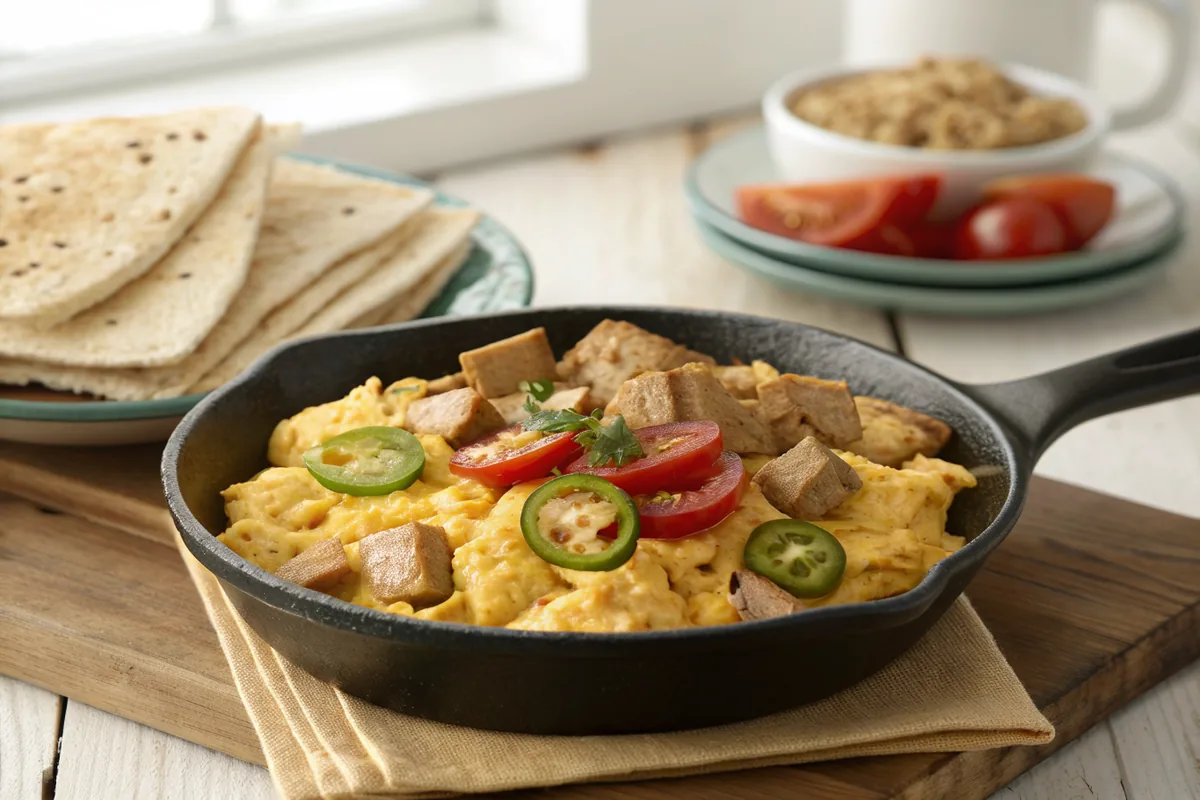
Migas are the same idea with fried tortilla pieces in the eggs, and they are the better dish for a crowd because they come out of one skillet as a heap. My migas recipe starts with day-old corn tortillas cut into strips and fried until crisp in a few tablespoons of oil. For the turkey version: fry 4 tortillas worth of strips in 3 tablespoons of oil until golden, 3 to 4 minutes, and set them aside. In the same pan, brown 2 cups of diced turkey as above, add half a diced onion, a diced jalapeno, and a diced tomato, cook 3 minutes, return the tortilla strips, pour in 8 beaten eggs, and stir slowly over medium-low until just set, about 3 minutes. Cheese on top, lid on for 1 minute to melt it, and serve with warm tortillas on the side.
The turkey difference in both dishes is the browning step. Chorizo or bacon in a breakfast taco brings its own fat and its own seasoning; cooked turkey brings neither, so the two minutes of undisturbed browning in fat and the chili powder are what make it belong in the taco instead of tasting like a garnish. Do not skip either.
White Turkey Chili With Green Chiles
A word about why this is a white chili and not a red one. Texas chili, the real Texas red, is a beef dish: cubed chuck seared and then simmered for hours in a sauce of dried red chiles until the collagen in the meat melts and the fat from the beef binds the sauce. It has no beans, and it has no place for cooked turkey, which has no collagen left to give and no fat to bind anything, and which would fall apart in an hour of simmering. Turkey belongs to the other chili tradition, the green one: green chiles, white beans, poultry stock, and a short cooking time. Nobody in Lockhart will call this Texas chili, and nobody will refuse a second bowl.
Heat 2 tablespoons of oil in a Dutch oven over medium, cook a diced white onion for 6 minutes, add 4 minced garlic cloves, 2 teaspoons of ground cumin, 1 teaspoon of Mexican oregano, and 1/2 teaspoon of ground coriander, and cook 1 minute. Add 2 cups of roasted, peeled, and chopped green chiles, which in a good year means Hatch chiles from the freezer and in any other year means poblanos and Anaheims roasted the same way as for the enchiladas; the Hatch chile page has the roasting and freezing method. Stir in two 15-ounce cans of white beans, drained, and 4 cups of turkey stock, and simmer 20 minutes.
Mash a cup of the beans against the side of the pot to thicken it, then add 4 cups of shredded turkey and simmer 5 minutes more, no longer. That short simmer is the whole turkey adjustment: a chili built on raw chicken thighs cooks them in the pot for 25 minutes, and a white chili built on cooked turkey heats the meat for 5. Finish with the juice of a lime, 1/4 cup of chopped cilantro, and salt until it tastes right, which is usually more than you added. Serve with sour cream, shredded Jack, sliced jalapeno, and tortilla chips or the cornbread from Thursday.
Smoked turkey is the best possible meat for this pot, and the smoke does the work that chipotle would in a red chili. If your bird was smoked, use it here first. The chili keeps 4 days and freezes for 3 months, and it is the dish I make on Sunday with whatever turkey is left after the casserole, because it uses dark meat, white meat, and the last of the stock without caring which is which.
Turkey Spaghetti Casserole and Thanksgiving in a Bowl
Two Sunday dishes, one for the people who want something new and one for the people who want Thursday again. The first is the Texas chicken spaghetti casserole made with turkey, which is what most Texas kitchens do with the last of the bird whether they admit it or not. Cook 12 ounces of spaghetti in salted water 2 minutes short of done and drain it. In the pasta pot, melt 4 tablespoons of butter, cook a diced onion and a diced green bell pepper for 6 minutes, add 3 tablespoons of flour, stir 1 minute, then whisk in 2 cups of turkey stock and 1 cup of milk and simmer until thick, 5 minutes. Stir in a 10-ounce can of diced tomatoes with green chiles, undrained, 8 ounces of cubed processed cheese or 2 cups of shredded cheddar, 1 teaspoon of chili powder, and salt and pepper.
Fold in the spaghetti and 3 cups of diced turkey, scrape it into a buttered 9-by-13-inch dish, top with another cup of cheddar, and bake at 350F (175C) for 25 to 30 minutes until browned at the edges. The chicken recipe boils the pasta in the chicken poaching liquid for flavor. You do not have poaching liquid, but you have something better: boil the spaghetti in a mix of half water and half turkey stock, salted, and the pasta itself tastes like the bird. Add the turkey at the end, as always, so it does not overcook in the sauce.
The second Sunday dish takes no recipe and I will give it one anyway. Thanksgiving in a bowl: a scoop of hot cornbread dressing in the bottom of a wide bowl, a handful of shredded turkey on top, a ladle of hot gravy over both, a spoon of cranberry sauce at the side, and a spoon of sweet potato casserole on the other side, and if the green bean casserole is still around, some of that too. Heat the turkey in the gravy, not the microwave: put the shredded meat in a saucepan with a cup of gravy and 1/4 cup of stock and warm it over low heat for 5 minutes, covered, and it comes back as juicy as Thursday. Everyone I have ever fed this to has asked for it again the following year, and nobody has ever asked for the recipe.
Which Dish on Which Day
The order matters, because the turkey changes every day it sits, and the dishes are ranked by what they need from it. Friday noon is the sandwich, because it wants cold, whole slices off a breast that has firmed up overnight. Friday night is the pot pie, because that is when you have the most gravy and the most energy for a crust, and because a pot pie is the best thing to feed the relatives who stayed. Friday night is also when the stock finishes if you started it Thursday, and you strain it while the pot pie bakes.
Saturday morning is tacos or migas, because a house full of people wakes up hungry and the skillet is faster than anything. Saturday night is soup or dumplings, both built on the stock, both forgiving, both better if the turkey is smoked. Saturday is also when you assemble the King Ranch casserole and put it in the refrigerator unbaked, because it improves overnight.
Sunday is casserole day: the King Ranch goes in the oven at four, or the spaghetti casserole if you skipped the King Ranch, and whatever turkey is left goes into a pot of white chili or into freezer bags under stock. By Sunday night the refrigerator is empty, the freezer has January dinners in it, and the turkey you bought a size up on the advice of the Thanksgiving hub has fed you seven times. That is the whole plan, and it works every year in Lockhart.
Leftover Turkey Recipes Recipe
Ingredients
- 4 tablespoons (2 oz / 57 g) unsalted butter
- 1 medium yellow onion, diced (about 1 cup)
- 2 celery ribs, diced (about 3/4 cup)
- 2 medium carrots, diced (about 1 cup)
- 1 teaspoon kosher salt, plus more to taste
- 2 tablespoons all-purpose flour (only if your gravy is thin)
- 2 cups (16 oz / 480 ml) leftover turkey gravy
- 1 cup (8 oz / 240 ml) turkey stock or chicken stock
- 3 to 4 cups (about 1 lb / 450 g) cooked turkey, diced into 3/4-inch pieces, dark and white meat mixed
- 1 cup (5 oz / 140 g) frozen peas
- 2 teaspoons fresh thyme leaves, or 3/4 teaspoon dried
- 1/2 teaspoon freshly ground black pepper
- 1 sheet pie dough, store-bought or homemade, about 12 inches across, or 8 unbaked biscuit rounds
- 1 large egg beaten with 1 tablespoon water, for the egg wash
- Flaky salt for the top (optional)
Instructions
- Heat the oven to 400F. Set a rack in the lower third of the oven and heat it to 400F (205C). Have a 10-inch cast iron skillet or a 9-by-13-inch baking dish ready. If the dough is frozen, let it thaw on the counter while you cook the filling.
- Sweat the vegetables. Melt the butter in the skillet over medium heat. Add the onion, celery, carrot, and the teaspoon of salt and cook, stirring now and then, until the onion is translucent and the carrot has started to soften, 8 to 10 minutes. Do not let them brown; you want them sweet, not caramelized.
- Thicken only if needed. Spoon a little of your gravy onto a cold plate. If it holds a soft mound, skip the flour. If it runs, sprinkle the 2 tablespoons of flour over the vegetables and stir for 1 minute to cook off the raw taste.
- Add the gravy and stock. Pour in the leftover gravy and the stock, scraping the bottom of the pan, and bring to a gentle simmer. Cook for 3 to 4 minutes, stirring, until it is smooth and coats a spoon. It should be looser than gravy on a plate, because it will tighten in the oven and the turkey will absorb some of it.
- Fold in the turkey and peas. Take the pan off the heat. Stir in the diced turkey, the frozen peas, the thyme, and the black pepper. Taste, and add salt in 1/4-teaspoon steps until the filling tastes properly seasoned on its own; leftover turkey pulls salt out of a sauce, so it usually needs more than you expect.
- Move to the baking dish if needed. If you cooked the filling in an ovenproof skillet, leave it there. Otherwise transfer it to the baking dish and spread it level. Let it cool for 5 minutes so the dough does not melt on contact.
- Top with the dough. Lay the sheet of pie dough over the filling and trim it to a 1-inch overhang, then fold the edge under and press it against the rim of the dish. Cut four 2-inch slits in the center for steam. For the biscuit version, arrange the 8 rounds on top with a little space between them; they will spread to meet.
- Egg wash and salt. Brush the dough all over with the egg wash and sprinkle with a pinch of flaky salt. The wash is what turns the top deep gold instead of pale tan.
- Bake 25 to 30 minutes. Bake at 400F for 25 to 30 minutes, until the crust is deep golden brown and the filling bubbles up through the slits and at the edges. Biscuit tops usually need the full 30 minutes; check that the underside of a center biscuit is no longer doughy.
- Rest 10 minutes before serving. Let the pot pie stand for 10 minutes on the counter. The filling sets from molten to spoonable, and the crust stays crisp because the steam has stopped. Serve with the leftover green beans or a plain green salad; it needs nothing else.
Frequently Asked Questions
How long is leftover turkey good for in the refrigerator?
Cooked turkey keeps 3 to 4 days in a refrigerator at 40F (4C) or below, counted from the moment it came out of the oven, so Thursday's bird is at its limit by Monday. Get it into the cold within two hours of carving. Store it in the largest pieces you can, breast lobes and thighs whole, in a container with a splash of stock or gravy, and slice or dice it the morning you need it; whole pieces stay juicy and slices dry out overnight. Gravy, dressing, and casseroles keep the same 3 to 4 days. Anything you will not eat by Sunday should go into the freezer on Friday, not on Monday.
Can you freeze leftover turkey, and for how long?
Yes, for up to 4 months, and it freezes best submerged in liquid. Pack diced or shredded meat into freezer bags and pour in enough gravy or turkey stock to cover it, press out the air, and freeze flat. The liquid protects the meat from freezer burn and gives you sauce and meat together for a pot pie or soup when it thaws. Turkey frozen dry turns fibrous within about a month. Thaw it overnight in the refrigerator, and reheat it gently in the liquid on the stove rather than in the microwave. Smoked turkey freezes especially well; the smoke flavor survives intact.
What is the best way to reheat leftover turkey without drying it out?
In liquid, on the stove, covered, over low heat. Put the sliced or shredded turkey in a saucepan or skillet with enough gravy or stock to come a third of the way up, about a cup for 3 cups of meat, cover it, and warm it over low heat for 5 to 8 minutes until it is hot through. The liquid keeps the meat from losing more moisture and the lid traps the steam. The microwave overheats the edges before the center is warm and turns white meat to cardboard. For a whole breast lobe, slice it first; a thick piece takes too long to heat and dries on the outside.
Can I use leftover turkey in place of chicken in any casserole or soup?
Almost always, with two adjustments. Add the turkey at the end of cooking, in the last 5 minutes, rather than simmering it the way a recipe simmers raw chicken; cooked meat only needs to heat through and it shreds into threads if it cooks longer. And add more liquid and more salt than the chicken recipe calls for, because cooked turkey is drier than freshly poached chicken and does not release seasoned juices into the sauce. Toss shredded turkey with a little of the sauce before it goes into a casserole so every piece is coated. Dark meat holds up better than white meat in soups and stews.
How much leftover gravy do I need for the pot pie, and what if I do not have enough?
The pot pie uses 2 cups of leftover gravy thinned with 1 cup of turkey or chicken stock, which makes enough filling for 3 to 4 cups of turkey in a 10-inch skillet or 9-by-13-inch dish. If you have only a cup of gravy, make up the difference with a quick roux: melt 2 tablespoons of butter with the vegetables, stir in 3 tablespoons of flour for a minute, then whisk in the gravy plus 2 cups of stock and simmer until it coats a spoon. If you have no gravy at all, use 4 tablespoons of butter, 1/4 cup of flour, 2 1/2 cups of stock, and 1/2 cup of cream.
Why is turkey chili a white chili and not a Texas red?
Texas red chili is a beef dish: cubed chuck simmered for hours in a sauce of dried red chiles, with no beans, until the collagen in the meat melts and the beef fat binds the sauce. Cooked turkey has no collagen left to give, no fat to bind anything, and it falls apart in a long simmer, so it cannot make a red chili in the Texas sense. It belongs to the green chili tradition instead: roasted green chiles, white beans, poultry stock, a short simmer, and the turkey added in the last 5 minutes. Smoked turkey makes the best version because the smoke does the work that dried chiles would.
How do I make stock from the turkey carcass?
Break the carcass into pieces so it fits your largest pot, add the neck, wing tips, and any bones and skin, and cover with cold water by 2 inches, about 5 quarts. Add a halved onion, two carrots, two celery ribs, a halved head of garlic, a bay leaf, a teaspoon of peppercorns, and some thyme, but no salt. Bring to a boil, skim, then hold at a bare simmer for 2 hours. Strain, cool quickly in an ice bath, and refrigerate; lift off the fat cap in the morning and keep it for frying tortilla strips. You will have about 3 quarts, which keeps 4 days refrigerated or 6 months frozen.
Which leftover turkey recipes work best with smoked or fried turkey?
Smoked turkey is best in the dishes with a broth or sauce, because the smoke flavor spreads through the liquid: tortilla soup, white chili, King Ranch casserole, and the poblano enchiladas with salsa verde. Its stock is darker and deeper than a roasted bird's and makes the best dumplings. Deep-fried turkey has the juiciest white meat and skin that stays crisp even cold, so it makes the best Friday sandwich, breakfast tacos, and migas, where the meat is browned in the skillet. Roasted turkey is the all-rounder and is the bird the pot pie was written for, because roasted drippings make the best gravy.